Women get raped if they attend unwanted parties: Bharathi Shankar

coastaldigest.com news network
October 7, 2017

Bengaluru, Oct 7: Bharathi Shankar, chairperson of Karnataka State Women’s Development Corporation has stirred a controversy by saying that women were raped at "unwanted parties, but not at jatres (melas)".

She was speaking at a panel discussion on women's safety during the launch of 'A Billion Eyes' campaign by B.Pac and Bangalore City police. The campaign calls upon bystanders to intervene when women are harassed.

Bharathi was answering an audience question whether women's empowerment was equal to women's safety. Listing measures for women's safety, Bharathi said, "When women go to jatre, do they get raped? They do get raped at unwanted parties."

The women's development corporation is a government of Karnataka undertaking set up to promote schemes for sustained income-generating activities among women's groups.

Bharathi compared women's safety issues to garbage segregation, saying one can't blame the government for problems in society. "About garbage problem, as a citizen I should segregate waste first. If I don't do it and keep blaming the department or corporator, what's the use?" she added.

Bharathi is a Bengaluru-based Congress leader and is a political appointee. She headed the Congress women’s wing of Bengaluru.

Comments

Kumar
 - 
Saturday, 7 Oct 2017

Dont blame anybody if you or your daughter get raped cruelly

Kumar
 - 
Saturday, 7 Oct 2017

You are totally unfit for the position. Big shame

Reshma
 - 
Saturday, 7 Oct 2017

Shame on you. You people are the real curse

Add new comment

  • Coastaldigest.com reserves the right to delete or block any comments.
  • Coastaldigset.com is not responsible for its readers’ comments.
  • Comments that are abusive, incendiary or irrelevant are strictly prohibited.
  • Please use a genuine email ID and provide your name to avoid reject.
News Network
June 11,2020

New Delhi, Jun 11: The Department of Pharmaceuticals has given its nod for lifting of ban on the export of hydroxychloroquine, Union Minister D V Sadananda Gowda said on Wednesday.

India had banned export of hydroxychloroquine on March 25, with some exceptions, amid views in some quarters that the drug could be used to fight COVID-19. On April 4, it completely banned the exports without any exception.

"Department of Pharmaceuticals has approved the lifting of ban on export of Hydroxychloroquine API as well as formulations. Manufacturers except SEZ/EOU Units have to supply 20 per cent production in the domestic market," the minister of chemicals and fertilisers said in a tweet.

The Directorate General of Foreign Trade (DGFT) has been asked to issue formal notification in this regard, he added.

In another tweet, Gowda said he held discussions with representatives of pharma companies along with some of his ministerial colleagues on the challenges being faced by the industry and on the roadmap to boost exports.

"Had detailed discussion with representatives of pharma companies & association, stakeholder Ministries along with Hon Ministers @piyushGoyal  ji, @HardeepSPuri  ji, & @MansukhMandviya  ji on entire gamut of challenges faced by the industry as well as strategies to boost pharma export," Gowda tweeted.

India exported hydroxychloroquine API (active pharmaceutical ingredient) worth USD 1.22 billion in April-January 2019-20.

During the same period, exports of formulations made from hydroxychloroquine was at USD 5.50 billion.

Comments

Add new comment

  • Coastaldigest.com reserves the right to delete or block any comments.
  • Coastaldigset.com is not responsible for its readers’ comments.
  • Comments that are abusive, incendiary or irrelevant are strictly prohibited.
  • Please use a genuine email ID and provide your name to avoid reject.
News Network
August 2,2020

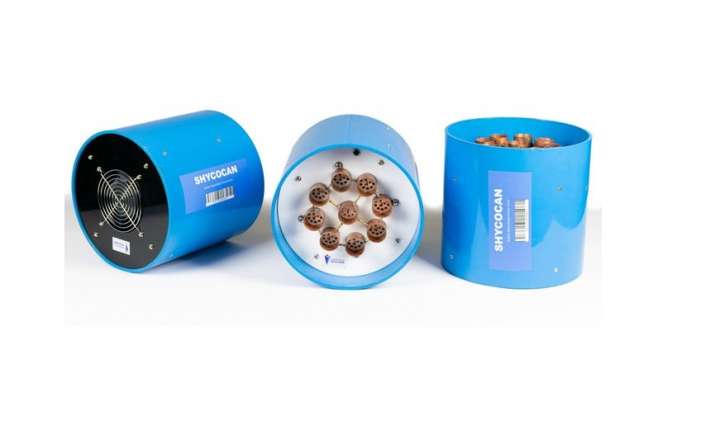
Bengaluru, Aug 2: Bengaluru based Centre for Advanced Research and Development (CARD), the research wing of organisation De scalene has come up with a device called "SHYCOCAN" (Scalene Hypercharge Corona Canon) which neutralizes the coronavirus.

Speaking to news agency Dr Rajah Vijay Kumar, Chairman, Organisation De Scalene said that the device will not kill any bacteria or fungus, however, neutralizes the coronavirus particles.

"The device was tested for its safety and efficacy and is soon going to be manufactured and marketed in the US under the Enforcement Discretion policy of USFDA and in Europe as the device is CE compliant and is CE marked," said Kumar.

He also added the device will cover a volume of 10,000 cubic feet.

The device Scalene Hypercharge Corona Canon (SHYCOCAN) is intended to be used in the residential, industrial and commercial environment and is designed for active containment by attenuation of Corona family of viruses. (Laboratories de Especialidades Immunological S.A. de C.V, Virucidal Activity concludes 99.9 per cent virus elimination), Kumar asserted.

"SHYCOCAN operates on regular 110/240V - 50/60 Hz wall socket and is a plug and play device, that delivers the necessary signals to a photon mediated electrons emitters (PMEE), that produces hypercharge high-velocity electrons by photon mediation that interacts with the negative seeking S-protein of Corona family of viruses thus reducing infectivity and prevent air and surface borne transmission of corona family of viruses," said Kumar.

The device does not use any chemicals, or any other consumables and does not produce harmful ozone gas or any other substances and is completely safe for use in any environment, he added.

"The attack mechanism of the Virus starts with the initial attachment of the virion to the host cell, it is initiated by interactions between the S-protein and its receptor on the "negative" cell membrane. The sites of receptor binding domains (RBD) within the S1 region of a coronavirus S-protein vary depending on the virus. 

The S-protein/receptor interaction is the primary determinant for a coronavirus to infect a host species and governs the tissue tropism of the virus. However, the end result is the fusion and release of the viral genome into the cytoplasm," said Kumar.

He continued saying that the counter mechanism by the device SHYCOCAN is that if negative seeking is the guidance mechanism of the S- Protein, attracted by the transmembrane potential of the host cells, then breaking this mechanism would block the Coronavirus infectivity and spread.

"The device has been in use for more than a year at the S-CARD campus, the headquarters of Scalene," said Kumar.


Comments

Add new comment

  • Coastaldigest.com reserves the right to delete or block any comments.
  • Coastaldigset.com is not responsible for its readers’ comments.
  • Comments that are abusive, incendiary or irrelevant are strictly prohibited.
  • Please use a genuine email ID and provide your name to avoid reject.
News Network
May 29,2020

New Delhi, May 29: Opining that there is no harm in importing ideas from abroad Swadeshi Jagran Manch, an affiliate of Rashtriya Swayamsevak Sangh, has suggested that India should take a cue from Pakistan and turn the “locust threat” into “chicken feed.

In an interview, Ashwani Mahajan, national co-convener of Swadeshi Jagran Manch (SJM) said: “I saw an article which shows that Pakistan has turned the locust threat into an opportunity by converting it into chicken feed”

“If there is a good idea originating from anywhere, we should be open to exploring such ideas. We should adopt good ideas. There is no harm in that,” he added.

He also shared the article on Twitter and wrote: “Pakistan turns locust threat into chicken feed. Need to understand the idea and replicate it in India.”

The article stated “an innovative pilot project in Pakistan’s Okara district offers a sustainable solution in which farmers earn money by trapping locusts that are turned into high-protein chicken feed by animal feed mills”.

“It was the brainchild of Muhammad Khurshid, a civil servant in the Ministry of National Food Security and Research, and Johar Ali, a bio-technologist from the Pakistan Agricultural Research Council,” according to the article.

Both Pakistan and India have been hit by locust attacks. These are desert locusts, which is one of the 12 species of short-horned grasshoppers. Swarms can comprise billions and travel up to 130 km in a day.

India has been battling the locust attacks with moderate success since December. However, the onset of monsoon could bring more trouble.

Comments

Add new comment

  • Coastaldigest.com reserves the right to delete or block any comments.
  • Coastaldigset.com is not responsible for its readers’ comments.
  • Comments that are abusive, incendiary or irrelevant are strictly prohibited.
  • Please use a genuine email ID and provide your name to avoid reject.

