



Women voters outnumber men in Jharkhand; 61 percent turnout

December 14, 2014

Ranchi, Dec 14: Women voters Sunday outnumbered men in the fourth phase of the assembly elections in Jharkhand. Around 61 percent balloting was reported from across the 15 constituencies that went to the polls, officials said.women voters jharkhand
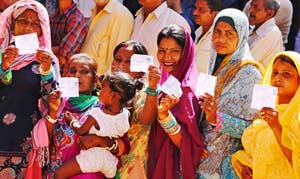
"The highest polling was reported from Chankayari with 71.28 percent, followed by 70.2 percent in Madhupur. Polling was by and large peaceful. The turnout in Maoist-affected areas was more than 60 percent," a poll official said. Women voters scored over the male voters.

"In the fourth phase, women's turnout was around two percent more than male voters," an Election Commission official said.

Balloting for 15 of the 81 assembly constituencies began at 7 a.m. While voting for 13 seats ended at 3 p.m., it continued in Bokaro and Dhanbad till 5 p.m. Voting took place at 5,482 booths, including 36 auxiliary ones.

As many as 716 booths were declared 'very sensitive' and 2,007 declared 'sensitive'.

The Election Commission declared 183 polling stations as model polling stations. Webcasting facility was available in 335 polling stations and 27,410 polling personnel were deployed in the fourth phase.

A total of 43,48,709 voters, including 20,03,516 females, were eligible to elect their representatives.

The fate of 217 candidates, including 16 females, was sealed in the Electronic Voting Machines (EVMs) by the end of balloting for the day. Former chief minister Babulal Marandi contested from Giridih constituency.

Ministers Mannan Mallik of the Congress, Haji Hussain Ansari of the Jharkhand Mukti Morcha (JMM) and Suresh Paswan of the Rashtriya Janata Dal were among the other prominent candidates in this phase.

In the 2005 assembly polls, the Bharatiya Janata Party and its then alliance partner Janata Dal-United won seven of these 15 seats together. The JMM won four seats.

Comments

Add new comment

  • Coastaldigest.com reserves the right to delete or block any comments.
  • Coastaldigset.com is not responsible for its readers’ comments.
  • Comments that are abusive, incendiary or irrelevant are strictly prohibited.
  • Please use a genuine email ID and provide your name to avoid reject.
News Network
June 15,2020

Sitamarhi, Jun 15: Eyewitness accounts from locals in Bihar's Sitamarhi district recount the brutality and intimidation by Nepal's security personnel who on June 12 had resorted to unprovoked firing on a group of people at the international border, which left one Indian dead and two others injured.

"18-20 shots were fired for over one hour and everyone is in shock even now," said Nitish Kumar, a resident of Jankinagar recalling the incident that took place early on Friday morning.

Nepal's Armed Police Force (APF) opened fire at the Lalbandi-Jankinagar border in which three men - Vikesh Yadav, Umesh Ram and Uday Thakur - suffered gunshot injuries. Vikash Yadav succumbed to his injuries on Friday itself.

Another person Lagan Kishore, who was at the border with his family to meet his daughter-in-law, a Nepali national and her family, said he was detained by the APF personnel who dragged him to the other side of the border.

Lagan Kishore said that the Nepali personnel abused and hit him with rifle butts and even abused his son and later resorted to firing.

Several residents of Jankinagar, who spoke to media, termed the incident as "unfortunate and shocking".

Nitish Kumar recalled: "A family was here to meet their in-laws (Nepali nationals). The daughter-in-law was talking to her family while her husband and her father-in-law sat a little distance away. Suddenly I saw Nepali personnel abusing her husband who complained about it to his father. All of a sudden the Nepali forces started thrashing them and then opened fire. They also took the father into custody."

"We were all shocked. I could hear about 18-20 gunshots fired over a period of one hour," Kumar said.

Another local, Ajit Kumar, said he was perplexed with the behaviour of the Nepali Police.

"There used to be no problems earlier. We don't understand what happened to the Nepal Police that day. The firing is unfortunate. If this continues, how will people in the border area live?" he questioned.

Ajit Kumar stated that such an incident has taken place for the first time. "People from here go to work in fields in Nepal and their people come to work in our fields. Such a thing has happened for the first time. About 80 per cent of our people are married to Nepalis," he said.

Many people who live in the adjoining districts of Bihar, which shares over 600 kilometres of border with Nepal, have relatives on either side of the border.

Meanwhile, Nepali police have claimed that Lagan Kishore, who was taken into custody following the firing by APF and handed over to Indian Security Forces at no man's land on June 13, was detained for trying to snatch a weapon from one of their personnel during an altercation.

However, both Kishore and his family have denied the claims and said he was "dragged" across the border and was beaten.

Kishore said that during the firing he had rushed towards the Indian side but Nepalese personnel hit him with rifle butt and took him to Nepal's Sangrampur. He was also asked to confess that he was taken into custody from the Nepali side.

"We ran to return to India when they started firing, but they dragged me from the Indian side, hit me with a rifle butt and took me to Nepal's Sangrampur. They told me to confess that I was brought there from Nepal. I told them you can kill me but I was brought there from India," said Kishore.

Kishore's son also said that Nepali personnel started abusing them and hit him and his father.

Speaking to ANI, Kishore's son said, "We went to meet my brother-in-law. Security personnel started abusing me but I could not understand their language. However, my brother's wife asked them to not abuse. After that, they came to the Indian side and hit me. I told my father about the incident and he confronted them."

"They started beating him and called fellow personnel who started firing and dragged my father from the Indian side, hit him with a rifle butt and took him to Nepal''s Sangrampur," he said.

Relations have become strained between India and Nepal after the latter released a map showing parts of Indian Territory-Lipulekh, Kalapani and Limpiyadhura as its own.

Comments

Add new comment

  • Coastaldigest.com reserves the right to delete or block any comments.
  • Coastaldigset.com is not responsible for its readers’ comments.
  • Comments that are abusive, incendiary or irrelevant are strictly prohibited.
  • Please use a genuine email ID and provide your name to avoid reject.
Agencies
March 22,2020

New Delhi, Mar 22: The exercise to update the National Population Register (NPR) and the first phase of the Census 2021, scheduled to begin from April 1, are likely to be deferred for an indefinite period due to Coronavirus pandemic, officials said.

A formal order on this effect is expected within a day or two.

Discussions are going on at the highest level of the government and in all probability, the NPR and house listing phase of the Census work will be deferred till the threat of the Coronavirus is over, a home ministry official said.

The exercise to update NPR and the housing listing phase of the Census is scheduled to be carried out across the country from April 1 to September 30.

Last week, the home ministry had said the preparation for the Census 2021 and updation of the NPR were at its peak and they will begin from April 1.

The ministry said this after a conference of the Directors of the Census Operations on status of preparatory work around Census 2021 and NPR updation.

There has been opposition from several state governments to the NPR and some of the assemblies even adopted resolutions expressing reservations on the exercise.

The states which have been opposing the NPR include Kerala, West Bengal, Punjab, Rajasthan, Chhattisgarh and Bihar.

However, most of them also said they will cooperate with the house listing phase of the Census.

The objective of the NPR is to create a comprehensive identity database of every usual resident in the country.

The database would contain demographic as well as biometric particulars, they said.

The notification for the house listing census and NPR exercise came recently amid furore over the contentious Citizenship Amendment Act (CAA).

The home ministry officials said most of the states have notified provisions related to the NPR.

The NPR is a register of usual residents of the country. It is being prepared at the local (village/sub-town), subdistrict, district, state and national levels under provisions of the Citizenship Act, 1955 and the Citizenship (Registration of Citizens and Issue of National Identity Cards) Rules, 2003.

The data for NPR was last collected in 2010 along with the house listing phase of the Census 2011. Updating of this data was done during 2015 by conducting door to door survey.

While updating the register in 2015, the government has asked details like Aadhaar and their mobile number.

This time, the information related to their driving licence and voter ID card may also be gathered, the officials said, adding that PAN card details will not be collected as part of this exercise.

Though information regarding the place of birth of parents will be sought, it is up to the residents whether to respond the question as it is voluntary.

For the purposes of the NPR, a 'resident' is defined as a person who has lived in a local area for the past six months or more, or a person who intends to reside in that area for the next six months.

The law compulsorily seeks to register every citizen of India and issue a national identity card.

The demographic details of every individual are required for every usual resident: name, relationship to head of household, father's name, mother's name, spouse's name (if married), sex, date of birth, marital status, place of birth, nationality (as declared), present address of usual residence, duration of stay at present address, permanent residential address, occupation, educational qualification.

The Union Cabinet has approved Rs 3,941.35 crore for the NPR exercise.

Comments

Add new comment

  • Coastaldigest.com reserves the right to delete or block any comments.
  • Coastaldigset.com is not responsible for its readers’ comments.
  • Comments that are abusive, incendiary or irrelevant are strictly prohibited.
  • Please use a genuine email ID and provide your name to avoid reject.
News Network
May 8,2020

New Delhi, May 8: The Supreme Court on Friday suggested that states should consider indirect sale and home delivery of liquor as per its statute and law to avoid crowding at liquor shops amid the ongoing coronavirus-induced lockdown.

A bench headed by Justice Ashok Bhushan refused to pass any orders on a public interest litigation (PIL) seeking clarity on the sale of liquor and to ensure social distancing while it is being sold in liquor shops during the lockdown.

"We will not pass any order but the states should consider indirect sale/home delivery of liquor to maintain social distancing norms and standards," Justice Ashok Bhushan said while disposing of the petition.

The PIL, filed by one Sai Deepak, sought directions for closure of liquor shops for failing to enforce social distancing, which is essential to prevent the spread of coronavirus.

The petitioner told the apex court that he only wants that the life of common people is not affected because of crowding at liquor shops during COVID-19.

Justice Sanjay Kishan Kaul, another judge in the bench, said that discussion on home delivery is already going on.

The top court, after hearing the petition complaining about flouting of safety norms at liquor shops, observed that it cannot pass any orders to different states but they should consider online sale and home delivery of liquor.

Comments

Add new comment

  • Coastaldigest.com reserves the right to delete or block any comments.
  • Coastaldigset.com is not responsible for its readers’ comments.
  • Comments that are abusive, incendiary or irrelevant are strictly prohibited.
  • Please use a genuine email ID and provide your name to avoid reject.