Won't pay Rs 260 fine; catch Mallya first, says ticket-less traveller

March 23, 2016

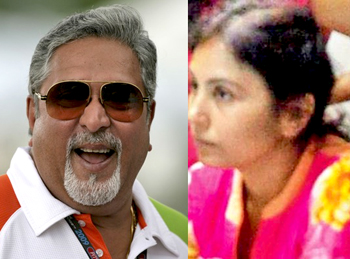
Mumbai, Mar 23: A 44-year-old woman caught for travelling without a ticket has chosen to go to jail for seven days instead of paying a fine of Rs 260, saying the authorities should first arrest and recover the loan dues from liquor baron Vijay Mallya.

mallyaPremlata Bhansali, a mother of two who lives in a high-rise in plush Bhuleshwar area in south Mumbai, was caught by a ticket-checker on Sunday at the Mahalaxmi station.

Asked to pay the fine, Bhansali, according to the Railway Police, said they should first arrest Mallya who owes the banks more than Rs 9,000 crore.

“She was produced in the magistrate's court and asked to pay the fine. But she declined and chose to go to jail for seven days,” said Anand Vijay Jha, senior divisional security commissioner of Mumbai division, Western Railway.

A Railway Protection Force officer said that a lady police constable tried to persuade the woman to pay the paltry fine. “But she spent nearly 12 hours arguing with railway officials, demanding to know why the authorities were going soft on Mallya and harassing the common man.”

The police even summoned her husband Ramesh Bhansali but she refused to pay the fine and insisted on serving the seven-day jail term, the officer said.

Comments

himanshu
 - 
Thursday, 24 Mar 2016

Thank u Premlata for standing for all of us

Satyameva jayate
 - 
Thursday, 24 Mar 2016

If every public dared to do the same Mr.modi himself would go and bring back mallya.
By the way where is chota rajan...ha haaaa another born criminal.
And when will RSS catch dawood....ha haa...

Rikaz
 - 
Wednesday, 23 Mar 2016

Mallya did not eat alone...

Zahoor Ahmed
 - 
Wednesday, 23 Mar 2016

She is mad, Don't connect Railway to Finance. we can't blame Suresh for Jaitelys mistake but we all are responsible for whats going on in India.

Mangalorean
 - 
Wednesday, 23 Mar 2016

Brave women... hatts off...... She will get seven days food free from Railway. again loss for railway only

Add new comment

  • Coastaldigest.com reserves the right to delete or block any comments.
  • Coastaldigset.com is not responsible for its readers’ comments.
  • Comments that are abusive, incendiary or irrelevant are strictly prohibited.
  • Please use a genuine email ID and provide your name to avoid reject.
News Network
April 19,2020

Kasaragod, Apr 19: Kasaragod, Kerala's COVID-19 hotspot, is the only district in the southern state lacking adequate health infrastructure.

In spite of treating the highest number of COVID-19 patients in the state with meagre infrastructural facilities and even without the support of a medical college in the north Kerala district, no deaths have been reported due to coronavirus.

The state health department views the performance of M Kunhiraman and his team, consisting of Janardhana Naik and Krishna Naik, at the General hospital in Kasaragod as a success story.

"Not only did they control the situation quickly with minimum infrastructure, they also started turning out a large number of negative cases within a few weeks and creditably ensured zero mortality.

This can be showcased as a best global model," Chairman of the Information Education and Communication (IEC) Committee and Project Director Kerala State Aids Control Society, R Ramesh said.

Recalling the ordeal, Janardhana Naik said his first major challenge was the physical examination of a patient with suspected COVID-19.

"Even with the PPE kit, nobody knew how effective they were and it took a whole 30 minutes to wear them properly.

But as time passed, we got accustomed to it," he said.

The traditional method of dealing with a patient involved knowing his or her history, observation and physical examination.

For hundreds of years, the hands-on body approach has been the soul of the doctor-patient relationship -- taking the pulse, tapping on and listening to the chest, feeling lumps.

With the onset of COVID-19 all that has changed.

"In fact, the whole exercise was fraught with grave risks because everything connected with COVID-19 was new.

Doctors have to keep a distance even though the physical examination wearing a Personal Protective Equipment (PPE) is difficult.

Sounds from the body are inaudible, vision is blurred through the smog-covered goggles and a stethoscope seldom has any use," Janardhana Naik said.

It was from March 15 that the hospital started receiving COVID-19 patients, primarily from Dubai.

By the time the first person came, the hospital was ready for him.

Soon, patient numbers began to swell and in a couple of weeks they reached about 91.

From then on, it was teamwork.

Committees were formed for each and every task, including the help desk, IT, treatment, medical board, training, food, waste disposal and data maintenance.

Initially, patients had many misgivings about the hospital.

"Some were disillusioned and even aggressive. Some were not happy with the facilities the hospital had to offer.

But gradually through good treatment and counselling by a psychiatrist, who visited the hospital on alternate days, the confidence and mood of the patients changed and they became friendly with the staff," Naik elaborated.

Counselling was also given to the concerned family members of the patients.

Besides treatment, the medical staff had to spend a considerable amount of time clearing the doubts of patients.

When they got discharged some patients insisted on seeing the faces of the medical staff, who till then were anonymous entities covered from head to toe.

Some even wanted to take selfies with them.

However, the medical team politely turned down their requests and preferred to remain hidden in their work attires.

The mood of the patients also rubbed off on the doctors and hospital staff.

All the physicians and hospital staff are now more confident of dealing with contagious diseases after treating COVID-19 patients.

"Our previous experience of treating H1N1, Chikungunya and Dengue cases helped us a lot.

Words of encouragement from the Health Minister K K Shailaja, Health Principal Secretary Dr Rajan N Khobragade and Health Services Director Dr Sarita R L gave us the impetus to build up confidence.

Moreover, the field health workers did a wonderful job in containing the viral spread," Naik added.

As the number of coronavirus cases rose, the state government on April 5 deputed a 26-member medical team from Thiruvananthapuram to set up a COVID-19 hospital in the district.

They turned a block of the under construction Government Medical College as a hospital-like facility, setting up a 200 bed facility to treat coronavirus patients.


Comments

Add new comment

  • Coastaldigest.com reserves the right to delete or block any comments.
  • Coastaldigset.com is not responsible for its readers’ comments.
  • Comments that are abusive, incendiary or irrelevant are strictly prohibited.
  • Please use a genuine email ID and provide your name to avoid reject.
News Network
March 26,2020

Mau/ Kalaburagi, Mar 26: Uttar Pradesh Police on Wednesday asked lockdown violators in Mau to do push-ups and squats as a punishment.
In Karnataka's Kalaburagi, police personnel punished the violators of the lockdown.
In his address to the nation on Tuesday, Prime Minister Narendra Modi announced a 21-day lockdown in the entire country effective from midnight to deal with the spread of coronavirus, saying that "social distancing" is the only option to deal with the disease, which spreads rapidly.
According to the Health Ministry, the total number of positive COVID-19 cases in India reached 606, including 43 foreign nationals.

Comments

Add new comment

  • Coastaldigest.com reserves the right to delete or block any comments.
  • Coastaldigset.com is not responsible for its readers’ comments.
  • Comments that are abusive, incendiary or irrelevant are strictly prohibited.
  • Please use a genuine email ID and provide your name to avoid reject.
Agencies
January 9,2020

New Delhi, Jan 9: Crime in India has increased by 1.3 per cent in 2018 compared to 2017 with the registration of over 50 lakh cognisable crimes, reveals 2018 edition of 'Crime in India' statistics released this week by the National Crime Records Bureau (NCRB).

As per the NCRB, which works under the Ministry of Home Affairs, a total of 50.74 lakh crimes, including 31.32 lakh under the Indian Penal Code (IPC) and 19.41 under the Special Local Laws (SLL) was registered in 2018.

The report says that there was an overall rise of 1.3 per cent in the registration of cases in 2017, but crime rate per lakh population was down to 383.5 in 2018 from 388.6 in 2017.

A total of 1.05 lakh cases of kidnapping and abduction across the country was registered in 2018, showing an increase of 10.3 per cent over 95,893 such cases in 2017, the latest NCRB report said.

A total of 29,017 murders were reported in 2018, up by 1.3 per cent over 2017. Of which, disputes were reported as the motive of the highest number of murder cases (9,623) followed by personal vendetta and enmity (3,875) and gain (2,995).

Accidental deaths have also seen a rise to 4,11,824 in 2018 from 3,96,584 in 2017 -- a rise to 31.1 per cent from 30.3 per cent in 2017.

The NCRB report 'Crime in India-2018' said in its disclaimer section that clarifications on data were pending from West Bengal, Arunachal, Meghalaya, Sikkim and Kolkata. Hence, the data from these states and city may be treated as provisional.

No let up in road accident deaths in 2018: NCRB

There were 1,35,051 incidences of deaths due to negligence relating to road accidents in 2018, according to the latest NCRB report on "Crime in India -2018".

When compared to the previous two years, the statistics show that there has been no significant change in the overall situation.

In 2017 there were 1,34,803 incidences reported from across the country, while in 2016 it was 1,35,656.

Incidents of 'Hit and run' accident cases have climbed up marginally over the last year, if the latest figures are any indication. In 2018, the 'hit and run' cases reported were 47,028. In 2017, the cases registered under this category were 43,727.

The data collection process for NCRB report on "Crime in India - 2018" including clarifications from the states/UTs/central agencies started in July, 2019 and continued till December, 2019.

People involved in farming sector, including 5,763 farmers or cultivators, committed suicide during 2018, the report reveals.

The annual data was released around three months after the government released the National Crime Records Bureau (NCRB) report on "Crime in India 2017".

As per the latest data, of the 10,349 persons who committed suicide in 2018, 4,586 were agricultural labourers.

The number of suicides in farming sector in 2018 accounts for 7.7 per cent of the total suicide victims (1,34,516) in the country, the NCRB data said.

Suicides in India in 2018 rose to 1,34,516 from 1,29,887 in 2017. Rate of suicides is also up from 9.9 in 2017 to 10.2 in 2018.

In 2017, a total of 10,655 farmer suicides were reported.

West Bengal, Bihar, Odisha, Uttarakhand, Meghalaya, Goa, Chandigarh, Daman and Diu, Delhi, Lakshadweep and Puducherry reported zero suicides of farmers or cultivators and agricultural labourers during 2018, said the report.

Comments

Add new comment

  • Coastaldigest.com reserves the right to delete or block any comments.
  • Coastaldigset.com is not responsible for its readers’ comments.
  • Comments that are abusive, incendiary or irrelevant are strictly prohibited.
  • Please use a genuine email ID and provide your name to avoid reject.