


Work unitedly to realise Abdul Kalam’s dream of developed India: Modi

Agencies
July 27, 2017

Rameswaram, Jul 27: Prime Minister Narendra Modi on Thursday urged the people to work together to fulfil former president A P J Abdul Kalam’s dream of seeing a developed India by 2022 when it celebrates its 75th Independence Day. “There are 125 crore people and if each one takes one step, then the country would be 125 crore steps ahead,” he told a public meeting near this island, the home town of the late ‘Missile Man’, after inaugurating his national memorial.narendra

Various schemes launched by central government whether it was “Stand up India or Start up India, ‘Amrut’ cities or smart cities or Clean India projects would go a long way in realising Kalam’s dream of “developed India”, he said. In a reference to epic ‘Ramayana’, Modi said even a small squirrel had helped Lord Ram in constructing the ‘Ramasethu’ (bridge) for him to cross over to Sri Lanka.

“If people are committed like that squirrel, the country can scale great heights,” Modi said addressing a gathering at Mandapam, about 15 kms from Rameswaram. He urged the youth and pilgrims visiting this holy town to include a visit to Kalam’s memorial, designed and built by the Defence Research and Development Organisation (DRDO) with which the former president was associated with for a long time.

Modi heaped praise on labourers involved in the construction of the memorial, saying they had not charged for the extra two hours they had put in every day. After sweating it out from 8 AM to 5 PM, they would later take a break for one hour and put in two additional man hours. They had refused payment for these extra two hours, saying it was their way of contributing towards the memory of Kalam, Modi said, adding this deserved a standing ovation.

The audience was immediately on its feet applauding the the labourers, architects and workers who had toiled in raising the structure. Paying rich tributes to Kalam, whose second death anniversary was observed, Modi said the former president continues to inspire crores of countrymen. “People from every corner of the country come here (mostly on pilgrimage). I urge them, the tour operators and youth — whenever you come here, add to your programme a visit to this memorial,” Modi said.

The Prime Minister pointed out that Kalam loved the youths and the students very much, and it was for their benefit that Stand Up and Start Up schemes had been launched. The Mudra bank loan scheme had been launched to provide loans for the youths without any guarantee and it had benefited over eight crore people, including one crore from Tamil Nadu, he said.
A new India and a new Tamil Nadu could be developed with the cooperation of the central and state governments, he said. Ten cities in the state had been chosen for the smart city project and 33 towns for development under the AMRUT (Atal Mission for Rejuvenation and Urban Transformation) scheme, he said.
The central government had allocated Rs.900 crore for the Smart City and Rs.4,700 crore for the AMRUT scheme, he said the latter would ensure availability of better power, water, sanitation and other essential infrastructure. The Prime Minister hoped that the ‘Sagar Mala’ scheme, linking the coastal areas spreading through the country’s 7,500 km coastal line, would bring more investments and benefit people in a big way.

Announcing the launch of deep sea fishing to Rameswaram fishermen under hte Blue Revolution scheme, for which Rs 1,500 crore had been allocated, he said it would help fishermen to get better revenue and at the same time overcome problems relating to the fishing in the Palk Strait. The Prime Minister also flagged off a weekly train to Ayodhya in Uttar Pradesh from Rameswaram.

In order to help the people worship at Ramar Sethu, the mythical bridge believed to have been built by Lord Rama, the Rameswaram-Dhanushkodi road which was destroyed in the devastating cyclone decades ago had been rebuilt. Modi also unveiled synopsis of Green Rameswaram scheme, a pet project of late Kalam, presented by the local Vivekananda Kendra.

He recalled that it was in Rameswaram that Swami Vivekananda placed his first step when he returned from America in 1897. Earlier, after inaugurating the memorial, Modi paid floral tributes to Kalam at his ‘samadhi’. Evincing keen interest in the features of the memorial, which has on display replicas of rockets and missiles on which the late scientist had worked, the Prime Minister viewed it for about 15 minutes.

It has been built at a cost of Rs 15 crore on land alloted by the Tamil Nadu government at Kalam’s village Peikarambu. On the occasion, the Prime Minister also unveiled a wooden statue of Kalam playing the ‘veena’. The former president was adept at playing the musical instrument. The memorial also has about 900 paintings and 200 rare photographs of the late scientist, who held the office of the president from 2002 to 2007.

Modi was accompanied by Tamil Nadu Governor Ch Vidyasagar Rao, Chief Minister K Palaniswami, Union ministers Pon Radhakrishnan, Nirmala Sitharaman and NDA’s vice presidential nominee M Venakaiah Naidu. The prime minister earlier unfurled the national flag at the entrance of the memorial. Later, he interacted with family members of Kalam.

Modi was seen affectionately holding the hands of Kalam’s elder brother A P J Mohamed Muthumeeran Maraikaya.

Comments

Raj
 - 
Friday, 28 Jul 2017

Congrats Sir. May you achieve many more feats in your career. Good luck

Add new comment

  • Coastaldigest.com reserves the right to delete or block any comments.
  • Coastaldigset.com is not responsible for its readers’ comments.
  • Comments that are abusive, incendiary or irrelevant are strictly prohibited.
  • Please use a genuine email ID and provide your name to avoid reject.
Agencies
May 31,2020

New Delhi, May 31: The fourth phase of the coronavirus-triggered lockdown, which began on May 18, saw 85,974 COVID-19 cases till 8 am on Sunday, which is nearly half of the total cases reported in the country so far.

Lockdown 4.0, which will end on May 31 midnight, has accounted for 47.20 per cent of the total coronavirus infection cases, number crunching from the Union Health Ministry data reveals.

The lockdown, which was first clamped on March 25 and spanned for 21 days, had registered 10,877 cases, while the second phase of the curbs that began on April 15 and stretched for 19 days till May 3, saw 31,094 cases.

The third phase of the lockdown that was in effect for 14 days ending on May 17, recorded 53,636 cases till 8 am of May 18.

The country had registered 512 coronavirus infection cases till March 24.

India is the ninth worst-hit nation by the COVID-19 pandemic as of now.        

The first case of COVID-19 in India was reported on January 30 from Kerala after a medical student of Wuhan university, who had returned to India, tested  positive for the virus.

India registered its highest single-day spike of COVID-19 cases on Sunday, with 8,380 new infections reported in the last 24 hours, taking the country's tally to 1,82,143, while the death toll rose to 5,164, according to the Union Health Ministry.

The number of active COVID-19 cases stood to 89,995, while 86,983 people have recovered and one patient has migrated, it said.

"Thus, around 47.75 per cent patients have recovered so far," a senior Health Ministry official said.

With the fourth phase of lockdown ending on Sunday, the Home Ministry on Saturday said 'Unlock-1' will be initiated in the country from June 8 under which the nationwide lockdown will be relaxed to a great extent, including opening of shopping malls, restaurants and religious places, even as strict restrictions will remain in place till June 30 in the country's worst-hit areas.

While announcing the extension of the lockdown in containment zones across the country, the Home Ministry said temples, mosques, churches and other religious places and shopping malls will be allowed to open in a phased manner from June 8, while a decision on opening of schools and colleges will be taken in July in consultation with states.

Comments

Add new comment

  • Coastaldigest.com reserves the right to delete or block any comments.
  • Coastaldigset.com is not responsible for its readers’ comments.
  • Comments that are abusive, incendiary or irrelevant are strictly prohibited.
  • Please use a genuine email ID and provide your name to avoid reject.
Agencies
August 2,2020

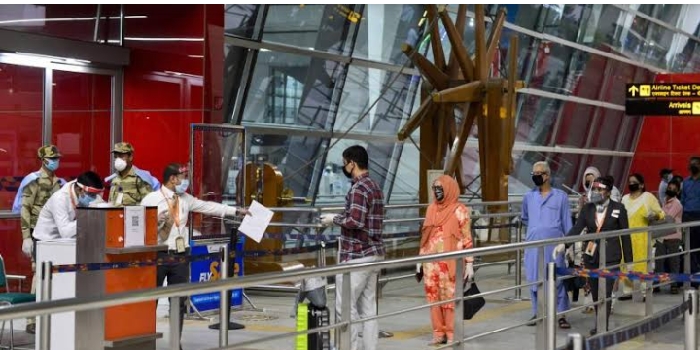
New Delhi, Aug 2: The Ministry of Health and Family Welfare on Sunday issued fresh guidelines for international passengers coming to India amid the COVID-19 pandemic. The new guidelines will be implemented from 12:01 am on August 8.

The ministry has also asked all passengers to submit a self-declaration form online at least 72 hours before travel.

"All travellers should submit self-declaration form on the on the online portal (www.newdelhiairport.in) at least 72hours before the scheduled travel," the guidelines said.

It also said that those coming to India must give an undertaking that they would undergo mandatory quarantine for 14 days as prescribed by the government. "They should also give an undertaking on the portal that they would undergo mandatory quarantine for 14 days i.e. 7 days paid institutional quarantine at their own cost, followed by 7 days isolation at home with self-monitoring of health," it added.

Giving exemptions in some cases, the guidelines mentioned, "Only for compelling reasons/cases of human distress such as pregnancy, death in the family. Serious illness and parent (s) with children of 10 years or below, home quarantine may be permitted for 14 days."

"If they wish to seek such exemption, they shall apply to the online portal at least 72 hours before boarding. The decision taken by the government as communicated on the online portal will be final," it said further.

The guidelines further said that travellers could request for exemption from institutional quarantine by submitting a negative RT-PCR test report on arrival.

"This test should have been conducted within 96 hours prior to undertaking the journey. The test report should be uploaded on the portal for consideration," it added.

Passengers have also been asked to download the Aarogya Setu app on their mobile phones.

Comments

Add new comment

  • Coastaldigest.com reserves the right to delete or block any comments.
  • Coastaldigset.com is not responsible for its readers’ comments.
  • Comments that are abusive, incendiary or irrelevant are strictly prohibited.
  • Please use a genuine email ID and provide your name to avoid reject.
News Network
January 2,2020

United Nations, Jan 2: Nearly 400,000 babies were born around the world on New Year's Day with India recording the highest number of these births worldwide at 67,385, the UN children's agency said.

An estimated 392,078 babies were born around the world on New Year's Day, according to UNICEF. Of this, an estimated 67,385 babies were born in India, the most globally. China comes in second with 46,299 births.

The beginning of a new year and a new decade is an opportunity to reflect on our hopes and aspirations not only for our future, but the future of those who will come after us,” UNICEF Executive Director Henrietta Fore said.

As the calendar flips each January, we are reminded of all the possibility and potential of each child embarking on her or his life's journey—if they are just given that chance.”

Fiji in the Pacific most likely delivered 2020's first baby, while the US, the last of the New Year's Day. Globally, over half of these births were estimated to have taken place in eight countries - India (67,385), China (46,299), Nigeria (26,039), Pakistan (16,787), Indonesia (13,020), United States of America (10,452), Democratic Republic of Congo (10,247) and Ethiopia (8,493).

Each January, UNICEF celebrates babies born on New Year's Day, an auspicious day for child birth around the world, it said. However, for millions of newborns around the world, the day of their birth is far less auspicious.

In 2018, 2.5 million newborns died in just their first month of life; about a third of them on the first day of life. Among those children, most died from preventable causes such as premature birth, complications during delivery, and infections like sepsis. In addition, more than 2.5 million babies are born dead each year.

UNICEF said over the past three decades, the world has seen remarkable progress in child survival, cutting the number of children worldwide who die before their fifth birthday by more than half. But there has been slower progress for newborns. Babies dying in the first month accounted for 47 per cent of all deaths among children under five in 2018, up from 40 per cent in 1990.

UNICEF's Every Child Alive campaign calls for immediate investment in health workers with the right training, who are equipped with the right medicines to ensure every mother and newborn is cared for by a safe pair of hands to prevent and treat complications during pregnancy, delivery and birth.

Too many mothers and newborns are not being cared for by a trained and equipped midwife or nurse, and the results are devastating,” said Fore. “We can ensure that millions of babies survive their first day and live into this decade and beyond if every one of them is born into a safe pair of hands.”

India is projected to surpass China as the world's most populous country around 2027. According to UN estimates, India is expected to add nearly 273 million people between 2019 and 2050, while the population of Nigeria is projected to grow by 200 million. Together, these two countries could account for 23 per cent of the global population increase to 2050.

China, with 1.43 billion people in 2019, and India, with 1.37 billion, have long been the two most populous countries of the world, comprising 19 and 18 per cent, respectively, of the global total in 2019. Through the end of the century, India is estimated to remain the world's most populous country with nearly 1.5 billion inhabitants, followed by China with just under 1.1 billion, Nigeria with 733 million, the US with 434 million, and Pakistan with 403 million inhabitants.

Comments

Add new comment

  • Coastaldigest.com reserves the right to delete or block any comments.
  • Coastaldigset.com is not responsible for its readers’ comments.
  • Comments that are abusive, incendiary or irrelevant are strictly prohibited.
  • Please use a genuine email ID and provide your name to avoid reject.