



Russia helps U.S., Syria establish contact, Turkey in shock

[email protected] (The Hindu)
September 30, 2012

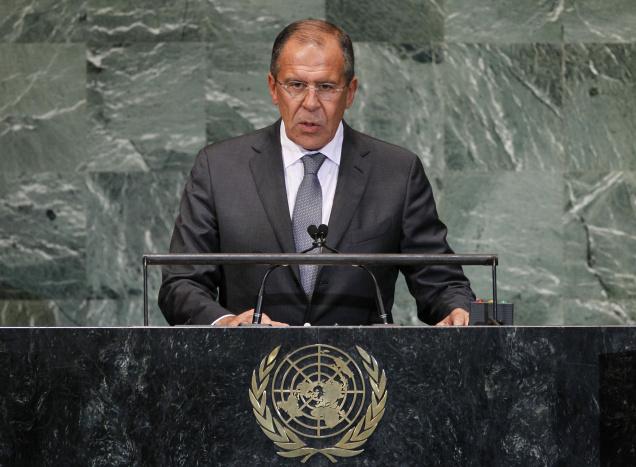
Lavrov

Dubai, September 30: With a little bit of help from Russia, the Americans and the Syrians have established contact with each other, sending shockwaves in Turkey, which has blamed Moscow and Beijing for the continuation of strife in Syria.

Addressing the American media on Thursday, Russian Foreign Minister, Sergei Lavrov dropped a bombshell. He said that Moscow had helped the American experts to establish contact with the Syrians on the subject of chemical weapons. “I hope I won't disclose any big secret, but we have helped American experts establish contact with the Syrians on this issue, and we have received explanations and assurances that the Syrian government is guarding these facilities in the best possible way,” said Mr. Lavrov, as reported by Russia Today.

He also added that Russia was not considering granting asylum to Syrian President Bashar Al Assad, in case he decided to quit office.

“No, we won't grant him asylum,” Mr. Lavrov said, pointing out that the Syrian President “was a friend of other countries northwest of Syria.”

Lebanon's Al Manar television website quoted its Arab sources in France as confirming that the U.S. delegation at the U.N. General Assembly annual session wanted to discuss with Syria, the issue of chemical weapons. The Syrian side pledged “with a Russian guarantee” that it would not use these weapons “inside Syria during the conflict between the government and the militant opposition”. However, the Syrian delegation was emphatic in stating that in case Syria was subjected to a foreign attack, in that case countries involved in inciting and participating in that attack would be legitimate targets “for the Syrian rockets… loaded with chemical warheads, including countries neighbouring Syria”.

Coinciding with the Mr. Lavrov's announcement of opening a U.S.-Syria dialogue track on chemical weapons, Turkish Prime Minister, Recep Tayyip Erdogan went uncharacteristically ballistic—blaming both Russia and China of siding with Syria. His outburst against Moscow and Beijing was aired live on NTV, a leading Turkish television station.

“The main source of disappointment is Russia. Let alone raising its voice against Syria, it stands by the massacre,” said Mr. Erdogan as reported by Reuters.

“China stands by Russia, and although [Chinese President] Hu Jintao had told me they wouldn't veto the plan [for a safe zone] for a third time, they did at the U.N. vote.” Mr. Erdogan described the position of Iran, a staunch Syria ally, as “impossible to understand”.

Turkey has emerged as a frontline state against the Assad government, with Saudi Arabia, Qatar and the United States as allies.

The bitter acrimony that this has caused between one time allies — Turkey and Syria — is climbing to new heights. Syria is now seriously considering arming Kurdish fighters for combat against


Turkey, Al Manar said. Citing its “Kurdish sources,” close to the Kurdistan Workers' Party (PKK) and the Kurdish Democratic Union Party in Syria, the website said that the Assad government “had sent a letter to Turkey saying that the Turkish interference in Syria would prompt Damascus to arm every Kurdish man in both Turkey and Syria”.

The Syrian government is apparently considering supplying the Kurds advanced weaponry including the anti-tank Kornet rockets, as it considers playing its “Kurdish card”.

Adding psychological warfare to its arsenal, the Syrian army has been sending cellphone text messages nationwide to the armed opposition stating: “Game Over”. These messages have also said that the countdown to evict the foreign fighters from Syria had begun, Associated Press reported.



Comments

Add new comment

  • Coastaldigest.com reserves the right to delete or block any comments.
  • Coastaldigset.com is not responsible for its readers’ comments.
  • Comments that are abusive, incendiary or irrelevant are strictly prohibited.
  • Please use a genuine email ID and provide your name to avoid reject.
News Network
April 16,2020

Brussels/Amsterdam, Apr 16: As the novel coronavirus continues to wreak havoc in the western world since its outbreak in Wuhan last December, researchers believe that the Chinese leadership is trying to absolve President Xi Jinping by using a section of the western media to influence public opinion globally.

"There are clear indications that China is conducting activities in a persistent and systematic manner to influence public opinion-making, academia, think tanks and political decision-making among the member states of the Belt and Road Initiative (BRI) in general and western capital cities in particular," Siegfried O Wolf, Director of Research at Brussels-based think tank South Asia Democratic Front, said.

Some western media say some Chinese officials were secretly aware that they were facing a pandemic from the new coronavirus but allowed Wuhan to host a mass banquet for tens of thousands of people and millions began their annual trip home for the Lunar New Year celebrations.

The pandemic has since then affected 210 countries and territories around the world. Over 2 million people have been declared positive in which over 134,000 lost their lives.

"The frequency and extra-ordinary large scale of Chinese sponsored events in European political hubs, like in Brussels, and the subsequent media coverage can be seen as evidence for Beijing's public diplomacy efforts. However, the rising skepticism within the EU regarding Xi Jinping's development projects and the emerging questioning of Chinese sources funding Free Universities, like the one in Berlin, shows that this strategy produced mixed results so far," Wolf said.

He added, "However, one must also state that these efforts helped China to gain certain leverage among many non-Chinese media, western as well as non-western ones. Today, we can observe that China's political leadership tries to instrumentalise this influence for a major image campaign to distract from the fact that it carries the initial responsibility for the dramatic spread of COVID-19 by holding back key information."

Wolf also said that the current internal dynamics in China, like the shirking of responsibilities by the local authorities, are most-likely part of a twofold strategy. Firstly, there is the strategic component - namely, to reaffirm to the general public that the Communist Party of China is still in full control of the situation. The second strategic pillar is one of 'whitewashing'.

"Concretely, Beijing's obvious aim is to distract the domestic and international attention from the real, but hidden causes of the Coronavirus outbreak and its potential reputational and political consequences for Xi Jinping and his BRI," he stated.

Yoana Barakova, a Research Analyst at European Foundation for South Asian Studies (EFSAS), an Amsterdam-based think-tank, said, "The death of Dr. Li Wenliang, one of the very few medical professionals who tried to warn the world in December 2019 about the looming threat, sparked widespread condemnation around the international community in early February. Yet, little did he know that his legacy would continue much later after his demise, with the emboldened Chinese government trying to cover up its missteps through hardcore censorship after being exposed for undermining and underestimating the initial danger."

The researchers believe that the deterioration in press freedom under Jinping's regime has become more evident in recent days, with local authorities trying to control the state narrative by cosmetically placing media's focus on government's superficial attempts to tackle the crisis.

Comments

Add new comment

  • Coastaldigest.com reserves the right to delete or block any comments.
  • Coastaldigset.com is not responsible for its readers’ comments.
  • Comments that are abusive, incendiary or irrelevant are strictly prohibited.
  • Please use a genuine email ID and provide your name to avoid reject.
News Network
April 26,2020

Apr 26: The remarkable story of an airman who overcame prejudice to become one of only a handful of Indian fighter pilots in the First World War has emerged in newly-released archive files by the UK's Commonwealth War Graves Commission (CWGC).

Lieutenant Shri Krishna Chanda Welinkar is one of the thousands of moving stories from the war preserved in family correspondence and being brought alive as part of a digitisation project.

The never-before-published files contain thousands of letters, pictures and other papers sent between the Commission and the next of the kin of First World War dead.

Among them is the story of Welinkar, who hailed from Bombay in colonial India. After much hardship and discrimination, he eventually became a pilot and went missing while on patrol over the skies above the Western Front in June 1918.

His family had to wait nearly three years before they finally knew for certain that he had died, and his grave was located.

“For everyone who died in the First World War, there was inevitably a partner, parent or child back home who had questions. The heartbreaking letters in CWGC's archive give us an insight into what it was like for those families trying to come to terms with their loss,” said Andrew Fetherston, chief archivist for CWGC.

“They are stories that show desperate searches for closure, former enemies uniting and, on many occasions, the sad realisation that a missing loved one would always remain so. We are pleased to be able to make this invaluable piece of World War history accessible to a new generation and help deepen our understanding of how the First World War impacted those who were left behind,” he said.

Welinkar was one of the 1.3 million Indians who answered the call to fight for the British Empire. Nearly 74,000 never saw their homeland again and are remembered today in cemeteries and memorials throughout the world, including France, Belgium, the Middle East and Africa.

Welinkar was a well-educated man studying at Cambridge University. He trained to become an aviator in Middlesex and wished to join the Royal Flying Corps, later known as the Royal Air Force.

Upon attempting to enlist, Welinkar encountered the same prejudices as his other fellow Indian airmen and was encouraged to become an air mechanic instead.

He was eventually given a commission in the Royal Flying Corps as an Officer. In 1918, he was posted to France and patrolled the skies above the Western Front.

In June 1918, Lieutenant Welinkar embarked on what would be his final patrol; he did not return and was reported missing. His fate remained unknown for many months afterwards.

The newly-released e-files chronicle the remarkable discovery of Welinkar and his final resting place long after the war had ended. Colonel Barton, who knew Welinkar, acted on behalf of his mother and helped find her missing son. They spoke to former enemies and honed their search to the grave of an unidentified man, buried by the Germans as “Oberleutnant S.C. Wumkar” in a grave in Rouvroy, Belgium.

The body was later moved and reinterred in Hangard Communal Cemetery Extension but it wasn't until the vital clue, found in the original German burial records in February 1921, that it was confirmed beyond doubt this grave was of Welinkar's.

In May 1921, Colonel Barton, on behalf of Welinkar's mother, requested that a Commission headstone be placed on the grave with the following personal inscription: “To the Honoured Memory of One of the Empire's Bravest Sons”.

This records – known as Enquiry Files – are part of a collection of nearly 3,000 files which have never been made available to the public before. Nearly half have been digitised so far, alongside a previously unreleased collection of more than 16,000 photographs held in negatives in the Commission's archive.

The files, internally referred to simply as E-Files, contain correspondence between the CWGC and the next of kin of the war dead. They often contain letters, typed memos between Commission staff and on occasion photos, maps and diagrams.

CWGC only holds an enquiry file for a small proportion of the 1.7 million people it commemorates from the Commonwealth. Today it is only possible to release those surviving records from the First World War because correspondence with families of Second World War casualties often involves people still alive today and cannot be made public for many years, due to the UK's data protection rules.

To date, more than 1,300 of the surviving 3,000 First World War enquiry files have been digitised.

The CWGC commemorates the 1.7 million Commonwealth servicemen and women who died during the two World Wars. It also holds and updates an extensive and accessible records archive, while operating over 23,000 locations in more than 150 countries and territories.

Comments

Add new comment

  • Coastaldigest.com reserves the right to delete or block any comments.
  • Coastaldigset.com is not responsible for its readers’ comments.
  • Comments that are abusive, incendiary or irrelevant are strictly prohibited.
  • Please use a genuine email ID and provide your name to avoid reject.
Agencies
January 11,2020

New York, Jan 11: The United Nations Security Council (UNSC) on Friday renewed a six-year-long cross-border humanitarian aid deliveries mechanism into Syria.

According to Sputnik, the Security Council voted in favour of a resolution on Friday that allows cross border deliveries to be conducted via Turkey, preserving two checkpoints and excluding the Al-Yarubiyah border crossing with Iraq and the Al-Ramtha crossing with Jordan, until July 10, 2020.

Russia proposed to amend the adopted resolution by replacing a part of the draft which stipulates that humanitarian assistance into Syria should be delivered based on the principles of humanity, neutrality, impartiality and independence by the phrase that such aid should be provided "in accordance with the guiding principles of humanitarian emergency assistance, as contained in UNGA resolution 46/182."

The agreement was reached after Belgium and Germany decided to amend the original version of their joint resolution, which proposed keeping three points for cross-border deliveries into the Arab republic.

In December last year, the United Nations had said that over 235,000 people fled the Idlib region in the last two weeks after Russia and Syria launched airstrikes in a bid to take over the last major opposition bastion.

Russia backed Syria government launched a fresh assault to capture the province.

Syrian Bashar al-Assad regime, backed by Iran, has reportedly promised to take back the rebel-controlled area and broke a ceasefire that was announced in August.

They have since December 19 seized dozens of towns and villages from armed fighters amid clashes that have killed hundreds on both sides.

Comments

Add new comment

  • Coastaldigest.com reserves the right to delete or block any comments.
  • Coastaldigset.com is not responsible for its readers’ comments.
  • Comments that are abusive, incendiary or irrelevant are strictly prohibited.
  • Please use a genuine email ID and provide your name to avoid reject.