



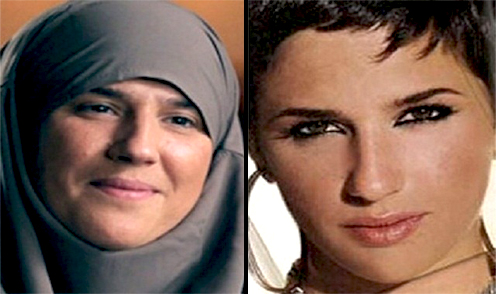
French rapper stuns fans, makes first TV appearance wearing hijab

[email protected] (Ramdane Belamri , Al Arabiya)
October 3, 2012
French_rapper

Paris, October 3: Amid a nationwide debate in France surrounding attitudes towards the Islamic veil, or hijab, a French rapper has surprised fans by announcing her conversion to Islam and choosing to wear a headscarf.

Mélanie Georgiades, known as Diam's, has gone through what onlookers have described as a “complete transformation” from an image she had prior to 2009.

Since 2009, Diam's had been unusually absent from the mainstream rap scene, prompting more than three years of controversy over her whereabouts, despite making the odd public appearance with her scarf.


But recently the French rapper made her first television appearance with her new image.

Diam's appeared in an exclusive TV interview with French TV station TF1, to talk about a past experience with drugs, including hallucinating narcotics, and being in a mental asylum until she discovered the “serenity of Islam.” The rapper said the religion was introduced to her by coincidence, when she saw a Muslim friend praying.

Diam's, said she has been married for over a year and is a now a new mother, moving far away from her drug-relate past.

In her TV interview she said her “conversion to Islam was the result of a personal conviction, after understanding the religion and reading the Holy Quran.”

When asked about wearing the hijab in France, a country which has banned the niqab, she said: “I believe that I live in a tolerant society, and I don't feel hurt by criticism, but by insults and stereotyping and ready-made judgments.”

Asked by her host about why she is wearing a hijab while many Muslim women don't wear it, and don't find it to be a religious obligation, she answered: “I see it as a divine order or a divine advice, this brings joy to my heart and for me this is enough.”


Stardom?

Diam's said that by converting to Islam she gained comfort, adding that stardom doesn't fit in with her life anymore, adding “this has warmed my heart, as I know now the purpose of my existence, and why am I here on Earth.”

Diam's criticized the media which photographed her coming out of one of the mosques in France, wearing her Hijab and looking at her mobile, preceded by a man in a training suit, which many believed to be her husband.

Discussing how her life was like before her conversion to Islam, Diam's said: “I was very famous and I had what every famous person looks for, but I was always crying bitterly alone at home, and this is what none of my fans had felt.”

She added: “I was heavily addicted to drugs, including hallucinating narcotics and was admitted in mental asylum to recover, but this was in vain until I heard one of my Muslim friends saying ‘I am going to pray for a while and will come back,' so I told her that I want to pray as well.”

Recalling that moment, Diam's said: “it was the first time that I touched the floor with head, and I had a strong feeling that I have never experienced before, and I believe now that kneeling in prayer, shouldn't be done to anyone but Allah.”


Islam, a religion of tolerance

Diam's said that she moved to Mauritius to read the Quran, and have a better understanding of Islam, discovering during her retreat, the tolerance of Islam.

When asked by her host about her views on Islam, and those who commit all the murders and atrocities pretending to be doing it in the name of religion, she answered: “I think we should differentiate between the ignorant and the knowledgeable, and the ignorant should not speak about what he doesn't know, Islam does not allow murdering innocent victims the way we see it nowadays.”



Comments

Adriana
 - 
Tuesday, 12 Apr 2016

I think this is among the most important info for me.
And i'm glad reading your article. But want to remark on few general things,
The website style is wonderful, the articles is really great :
D. Good job, cheers

Stop by my homepage ... how do i get
rid of my man boobs: http://howtolosemanboobsfast.strikingly.com/

Buford
 - 
Friday, 12 Feb 2016

Hello there, I found your blog by the use of Google
while looking for a similar topic, your website got here up, it appears to be
like great. I have bookmarked it in my google bookmarks.

Hi there, just turned into alert to your weblog through Google, and located that it's
truly informative. I am going to be careful for brussels.
I'll appreciate when you continue this in future.
Many people might be benefited out of your writing.
Cheers!

Also visit my page - skin is
itchy: https://howtogetridofhivesfaster.wordpress.com/2015/12/01/how-to-get-ri…

Add new comment

  • Coastaldigest.com reserves the right to delete or block any comments.
  • Coastaldigset.com is not responsible for its readers’ comments.
  • Comments that are abusive, incendiary or irrelevant are strictly prohibited.
  • Please use a genuine email ID and provide your name to avoid reject.
News Network
April 12,2020

Washington, Apr 12: The US has overtaken Italy as the country with the highest number of deaths due to COVID-19 pandemic with the fatalities crossing 20,000, according to Johns Hopkins University data, as the novel coronavirus continues to wreak havoc across the globe.

The deadly coronavirus, that originated in China in December last year, has so far killed more than one lakh people across the globe. The United States on Saturday became the country with the highest number of deaths at 20,597, surpassing Italy's 19,468 fatalities.

More than 5.3 lakh Americans have tested positive for coronavirus, which is about the same for the next four countries put together: Spain (163,027), Italy (152,271), Germany (125,452) and France (93,790). In terms of fatalities, the US and Italy are followed by Spain (16,606), France (13832) and United Kingdom (9,875), the varsity data showed.

New York City, the financial capital of the world, has emerged as the epicenter of coronavirus in the world. A city of 8.3 million, which is one of the most densely populated cities in the US, by Saturday night had as many as 8,627 deaths and more than 180,000 people had tested positive for COVID-19.

President Donald Trump has declared a national emergency and all the 50 States have been notified with major disaster declaration. More than 95 per cent of the country's 330 million population are under stay-at-home order. Trump has deployed more than 50,000 personnel from the armed forces in fight against COVID-19.

After an initial two-week social mitigation measures, that includes social distancing, the measures have been extended till April 30. Initially, members of the White House Task Force on Coronavirus had projected between one and two lakhs deaths. Now, they have dropped the projection to 60,000 deaths, mainly due to the successful implementation of these measures.

"The people of our country have gone through a lot. But we did it the right way. And we look like we'll be coming in on the very, very low side, really below the lowest, the lowest side of the curve of death," Trump told Fox News on Saturday night.

Trump asserted that situation was improving in places like New York, where there is a drop in new patients. Responding to a question, he said he wanted the country to open up as soon as possible.

However, he has not taken a decision so far, even as some media reports said that he the President was looking for early May.

"I think it's going to be the toughest decision that I've ever made. I really, hopefully that I ever will have to make. But it's certainly the toughest decision that I've ever made. I hope that I'm going to make the right decision," Trump said, adding that he will be making a decision reasonably soon.

"We're setting up a council now of some of the most distinguished leaders in virtually every field including politics and business and medical. We'll be making that decision fairly soon," Trump said.

Meanwhile, The New York Times reported that its investigations have revealed that the president was warned about a potential pandemic but that internal divisions, lack of planning and his faith in his own instincts led to a halting response.

According to The Washington Post, coronavirus is killing about one in 10 hospitalised middle-aged patients and four in 10 older than 85 in the United States. It is particularly lethal to men even when taking into account common chronic diseases that exacerbate risk.

Globally, the novel coronavirus has killed 108,862 people and infected over 1.7 million people globally. The US has the highest number of infections at 529,887, according to Johns Hopkins University data.

Comments

Add new comment

  • Coastaldigest.com reserves the right to delete or block any comments.
  • Coastaldigset.com is not responsible for its readers’ comments.
  • Comments that are abusive, incendiary or irrelevant are strictly prohibited.
  • Please use a genuine email ID and provide your name to avoid reject.
News Network
May 7,2020

United Nations, May 7: An average of 80,000 COVID-19 cases were reported each day in April to the World Health Organization, the top UN health agency has said, noting that South Asian nations like India and Bangladesh are seeing a spike in the infections while the numbers are declining in regions such as Western Europe.

WHO Director-General Tedros Adhanom Ghebreyesus said on Wednesday that countries must also be able to manage any risk of the disease being imported into their territories, and communities should be fully educated to adjust to what will be a "new norm".

He said as the countries press forward in the common fight against COVID-19, they should also lay the groundwork for resilient health systems globally.

"More than 3.5 million cases of COVID-19 and almost 250,000 deaths have now been reported to the WHO. Since the beginning of April, an average of around 80,000 new cases have been reported to the WHO every day," Ghebreyesus said in Geneva yesterday.

Asserting that the virus cases were not just numbers, he said: "every single case is a mother, a father, a son, a daughter, a brother, sister or friend".

He said while the numbers are declining in Western Europe, more cases are being reported every day from Eastern Europe, Africa, South-East Asia, the Eastern Mediterranean and the Americas. Even within regions and within countries, there are divergent trends, the agency added.

While some countries are reporting an increase in COVID-19 cases over time, many have seen caseloads rise because they have ramped up testing, the WHO official said.

"We've also seen in Europe and Western Europe a fundamental decrease in the number of cases, but we have seen an associated increase in the number of cases reported in places like the Russian Federation. Southeast, the Western Pacific areas are relatively on the downward trend like Korea and others, but then we do see in South Asia, in places like Bangladesh, in India, some trends towards increase.

"So it's very difficult to say that any particular region is improving or (not improving). There are individual countries within each region that are having difficulties getting on top of this disease and I am particularly concerned about those countries that have (an) ongoing humanitarian crisis," WHO's Executive Director Michael Ryan said.

The death toll due to COVID-19 in India rose to 1,783 while the number of cases climbed to 52,952 on Thursday, registering an increase of 89 deaths and 3,561 cases in the last 24 hours, the Union Health Ministry said.

The number of active COVID-19 cases stood at 35,902 while 15,266 people have recovered, it said.

Noting that while seeing an increase in the number of cases is not good in terms of transmission, WHO's Emerging Diseases and Zoonoses Unit head Maria Van Kerkhove said: "but I don't want to equate that with something (being) wrong".

"I want to equate that with countries are working very hard to increase their ability to find the virus, to find people with the virus, to have testing in place to identify who has COVID-19, and putting into place what they need to do to care for those patients," Kerkhove said.

With more countries considering easing restrictions implemented to curb the spread of the coronavirus, the WHO has again reminded the authorities of the need to maintain vigilance.

"The risk of returning to lockdown remains very real if countries do not manage the transition extremely carefully, and in a phased approach," Ghebreyesus said.

He urged countries to consider the UN agency's six criteria for lifting stay-at-home measures.

That advice includes ensuring surveillance is strong, cases are declining and transmission is controlled. Health systems also must be able to detect, isolate, test and treat cases, and to trace all contacts.

Additionally, the risk of outbreak in settings such as health facilities and nursing homes needs to be minimised, while schools, workplaces and other public locations should have preventive measures in place.

"The COVID-19 pandemic will eventually recede, but there can be no going back to business as usual. We cannot continue to rush to fund panic but let preparedness go by the wayside," he said.

He said the crisis has highlighted the importance of strong national health systems as the foundation of global health security: not only against pandemics but also against the multitude of health threats that people across the world face every day.

"If we learn anything from COVID-19, it must be that investing in health now will save lives later," Ghebreyesus said.

While the world currently spends around USD 7.5 trillion on health annually, the WHO believes the best investments are in promoting health and preventing disease.

"Prevention is not only better than cure, it's cheaper, and the smartest thing to do," he said.

The deadly coronavirus, which originated from the Chinese city of Wuhan in December last year, has infected over 3.7 million people and killed 263,831 people globally, according to a tally by Johns Hopkins University.

Comments

Add new comment

  • Coastaldigest.com reserves the right to delete or block any comments.
  • Coastaldigset.com is not responsible for its readers’ comments.
  • Comments that are abusive, incendiary or irrelevant are strictly prohibited.
  • Please use a genuine email ID and provide your name to avoid reject.
Agencies
May 10,2020

Paris, May 10: The number of coronavirus cases worldwide topped four million as some of the hardest-hit countries readied Sunday to lift lockdown restrictions despite concern about a second wave of infections.

Governments around the world are trying to stop the spread of the deadly disease while scrambling for ways to relieve pressure on their economies, which are facing a historic downturn with millions pushed into unemployment.

Despite the intense political pressure to reopen, nations are also keen to avoid second waves of infections that could overwhelm healthcare systems, with reminders over the weekend of the threat posed by the virus.

In the United States, media reported Saturday that the nation's top infectious disease expert, Anthony Fauci, was among three members of the White House coronavirus task force who will self-isolate after potential exposure.

And in South Korea, the capital Seoul shut all bars and clubs on Saturday as more than 50 cases were linked to a man who tested positive after spending time in one of the city's busiest nightlife districts.

Despite the risks, some governments in hard-hit Europe have said are signs of progress that justify cautious steps towards normality.

Officials in France on Saturday said the day's death toll of 80 was the lowest since early April, while nursing home fatalities also fell sharply as the nation prepared to relax curbs on public movement imposed eight weeks ago.

The easing, to begin Monday, has brought mixed reactions.

"I've been scared to death" about the reopening, said Maya Flandin, a bookshop manager from Lyon. "It's a big responsibility to have to protect my staff and my customers."

French health officials have warned that social distancing must be kept up even as restrictions are eased.

In Spain, about half the population will be allowed out on Monday for limited socialisation, and restaurants will be able to offer some outdoor service as the country begins a phased transition set to last through June.

With lingering fears of a resurgence, authorities excluded Madrid and Barcelona -- two COVID-19 hotspots -- from the first phase.

Belgium is also easing some restrictions on Monday, and in some parts of Germany, bars and restaurants reopened on Saturday with further easing set for Monday.

In Britain, Prime Minister Boris Johnson is expected Sunday to lay out a plan for the nation to emerge out of its current lockdown.

Media reports have suggested that Britain may introduce a mandatory 14-day quarantine for international arrivals to stop the spread of the virus.

Global economic figures are pointing to the most acute downturn in nearly a century, with businesses forced to shut and supply lines badly disrupted, and pressure is growing on leaders around the world to find a way out as the worldwide death toll topped 277,000 and infections crossed four million.

In the United States, the country with the highest death toll and where more than 20 million people have lost their jobs, President Donald Trump has insisted that next year would be "phenomenal" for the economy, urging reopening despite the virus still claiming well over 1,000 lives daily in the country.

The scale of the challenge was brought in sharp focus over the weekend as US media reported that top disease expert Anthony Fauci, who has become the trusted face of the government response to the pandemic, is going to self-isolate after possible exposure to an infected White House staffer.

Fauci told CNN that he will undergo a "modified quarantine" as he had not been in close proximity to the staffer, the network reported. He will remain at home teleworking, and will wear a mask for two weeks.

Robert Redfield, the director of the Centers for Disease Control and Prevention, and Stephen Hahn, the commissioner of the Food and Drug Administration, will also self-isolate, CNN added.

All three will still testify at Tuesday's Senate coronavirus hearing, with Redfield and Hahn participating via video link, according to Senator Lamar Alexander, chairman of the chamber's health committee.

It is believed Fauci will attend wearing a mask, CNN reported.

President Trump has faced sharp criticism from his predecessor Barack Obama, who said on a leaked tape that Trump's handling of the crisis was an "absolute chaotic disaster".

With people wearying of being indoors and under economic pressure, anti-lockdown protests have been held in a number of countries in recent weeks, with some demonstrators arguing that such restrictions violate their rights and others promoting conspiracy theories about the pandemic.

Ten people were arrested and a police officer injured in Melbourne, Australia, on Sunday in the latest such protest, where around 150 people gathered to demand an end to the shutdown.

Participants were promoting a number of conspiracy theories, such as linking 5G cellular communications to the disease.

Australian chief medical officer Brendan Murphy said there was "a lot of very silly misinformation out there", including the 5G allegation.

"I have unfortunately received a lot of communication from these conspiracy theorists myself," he said.

"It is complete nonsense. 5G has got nothing at all to do with coronavirus."

Comments

Add new comment

  • Coastaldigest.com reserves the right to delete or block any comments.
  • Coastaldigset.com is not responsible for its readers’ comments.
  • Comments that are abusive, incendiary or irrelevant are strictly prohibited.
  • Please use a genuine email ID and provide your name to avoid reject.