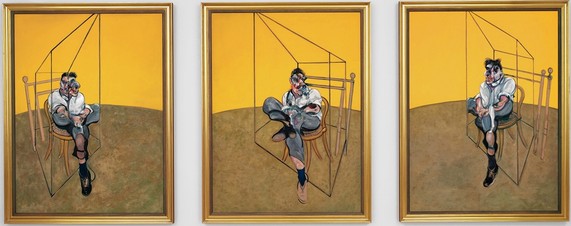
Francis Bacon painting sells for record $142.4 million in New York

November 13, 2013

Francis_Bacon

New York, Nov 13: Francis Bacon's three-paneled painting " Three Studies of Lucian Freud" became the most expensive work of art ever sold at auction on Tuesday when it soared to $142.4 million at Christie's.

The 1969 triptych, never before offered at auction and which carried a pre-sale estimate of about $85 million, easily eclipsed the $119.9 million price of Edvard Munch's "The Scream," achieved in May of last year at Sotheby's. The previous record for a Bacon work of art was $86.3 million set in 2008.

The monumental painting depicts the Dublin-born painter's friend and fellow artist Lucian Freud on a chair, with a view from each side and one face-on. Christie's called it "a true masterpiece that marks Bacon and Freud's relationship" and their "creative and emotional kinship."

With bidding starting at a whopping $80 million, it sold after a protracted bidding war both in the packed New York salesroom and via telephone. Christie's did not disclose the identity of the successful buyer.

"Three Studies of Lucian Freud" is also one of only two existing full-length triptychs of Freud, a grandson of the founder of psychoanalysis Sigmund Freud, and the three panels were separated for 15 years in the 1970s before being reunited, Christie's said.

The auction also set another significant record, for a price achieved at auction by any living artist, when Jeff Koons's large sculpture, "Balloon Dog (Orange)," fetched $58.4 million, beating the high pre-sale estimate and smashing the old mark for a living artist of $37.1 million set by Gerhard Richter's "Domplatz, Mailand (Cathedral Square, Milan)" earlier this year.

Auction officials have said that new, deep-pocketed collectors from around the globe are driving prices for top-tier works to record levels.

At a recent preview, Christie's head of postwar and contemporary art, Brett Gorvy, noted that collectors from Asia, Russia and the Mideast flush with cash were determined to assemble world-class collections featuring trophy works.

Comments

Shaunte
 - 
Wednesday, 9 Mar 2016

Skadze wszystek sposród nas planuje operowac sytuowanie
jednostki w google obok poszczególnego kapitalisci Czyniac w znaczacych firmach niby równiez w nizszych nazwach znacznie nieraz jestesmy
zwodzeni jakze takze zajmowani na jakims Sposród frazeologizmem przedstawiamy ostatniego
któregokolwiek niezwlocznie dostatecznie

Also visit my homepage: pozycjonowanie stron: http://www.bjhomespa.com/comment/html/?1287.html

Add new comment

  • Coastaldigest.com reserves the right to delete or block any comments.
  • Coastaldigset.com is not responsible for its readers’ comments.
  • Comments that are abusive, incendiary or irrelevant are strictly prohibited.
  • Please use a genuine email ID and provide your name to avoid reject.
Agencies
June 16,2020

India continues to remain ranked 43rd on an annual World Competitiveness Index compiled by Institute for Management Development (IMD) with some traditional weaknesses like poor infrastructure and insufficient education investment keeping its ranking low, the international business school said on Tuesday.

Singapore has retained its top position on the 63-nation list.

Denmark has moved up to the second position (from 8th last year), Switzerland has gained one place to rank 3rd, the Netherlands has retained its 4th place and Hong Kong has slipped to the fifth place (from 2nd in 2019).

The US has moved down to 10th place (from 3rd last year), while China has also slipped from 14th to 20th place. Among the BRICS nations, India is ranked second after China, followed by Russia (50th), Brazil (56th) and South Africa (59th).

India was ranked 41st on the IMD World Competitiveness Ranking, being produced by the business school based in Switzerland and Singapore every year since 1989, but had slipped to 45th in 2017 before improving to 44th in 2018 and then to 43rd in 2019.

While its overall position has remained unchanged in the 2020 list, it has recorded improvements in areas like long-term employment growth, current account balance, high-tech exports, foreign currency reserves, public expenditure on education, political stability and overall productivity, the IMD said.

However, it has moved down in areas like exchange rate stability, real GDP growth, competition legislation and taxes.

Arturo Bris, Head of Competitiveness Center at IMD Business School, said India continues to struggle on the list and the recent country rating downgrade by Moody’s reflects the uncertainties regarding the economy’s future.

"In our ranking this year, we again emphasize the traditional weaknesses of India -- poor infrastructure, an important deficit in education investment, and a health system that does not reach everybody. For India to follow the path of China, it must stress its intangible infrastructure," Bris said.

"In a less global world, with China, USA, and Europe looking inwards, currencies like the rupee (and the Brazilian real for instance) are going to suffer and display high volatilities.

"Moody’s has threatened the country with a downgrade to junk and that would put India in a terrible position to attract foreign capital. So the urgency for the government should be to fix the short-term problems—and this requires to improve the credibility of the government itself," Bris added.

With the exception of Singapore, the Philippines, Taiwan and the Korean Republic, most Asian economies dropped in rankings this year, the IMD said.

The reason for the Asian economies’ less stellar performance as a region, this year is partly the result of the trade frictions between China and the US, particularly because these economies are highly dependent on trade with China.

About Singapore, which moved to the top rank last year, the IMD said its position is largely driven by the relative ease of setting up business, availability of skilled labour and its cutting-edge technological infrastructure.

The IMD said the impact of COVID-19 on the competitiveness ranking has partially been captured by executives’ opinions about the effectiveness of the different health systems.

In the ASEAN countries included in the survey, only Singapore and Thailand have a positive performance in the effectiveness of the health infrastructure.

Comments

Add new comment

  • Coastaldigest.com reserves the right to delete or block any comments.
  • Coastaldigset.com is not responsible for its readers’ comments.
  • Comments that are abusive, incendiary or irrelevant are strictly prohibited.
  • Please use a genuine email ID and provide your name to avoid reject.
Agencies
January 20,2020

For the first time in the 15 years of the Global Risks Report, the climate change and environment risk has occupied all the top five slots.

According to the 15th edition of the World Economic Forum's (WEF) Global Risks Report, the top five risks in terms of likelihood are extreme weather, climate action failure, natural disasters, biodiversity loss and human-made environmental disasters. They all fall in the one category of climate change and related environmental disasters.

WEF President Borge Brende said the world was feeling long-mounting and interconnected risks.

The report also points to how citizens are protesting across the world as discontent rises with failed systems that are creating inequality. The citizens' discontent had hardened with systems that had failed to promote advancement, it said.

"Disapproval of how governments are addressing profound economic and social issues has sparked protests throughout the world, potentially weakening the ability of governments to take decisive action should a downturn occur. Without economic and social stability, countries could lack the financial resources, fiscal margin, political capital or social support needed to confront key global risks," it said.

Listing the grim scenario, Borge said the global economy was faced with "synchronised slowdown", the past five years had been the warmest on record and cyber attacks were expected to increase this year.

The report warns that while the myriad risks were rising, time was running out on how to prevent them.

Borge said the growing palpability of shared economic, environmental and societal risks indicated that the horizon had shortened for preventing "or even mitigating" some of the direst consequences of global risks.

"It's sobering that in the face of this development, when the challenges before us demand immediate collective action, fractures within the global community appear to only be widening," he said.

The report points to grave concern about the consequences of continued environmental degradation, including the record pace of species decline.

Pointing to an unsettled geopolitical environment, the report said today's risk landscape was one in which new centres of power and influence were forming and old alliance structures and global institutions were being tested.

"While these changes can create openings for new partnership structures in the immediate term, they are putting stress on systems of coordination and challenging norms around shared responsibility. Unless stakeholders adapt multilateral mechanisms for this turbulent period, the risks that were once on the horizon will continue to arrive," it said.

Calling it a "an unsettled world", the WEF report notes that powerful economic, demographic and technological forces were shaping a new balance of power. "The result is an unsettled geopolitical landscape in which states are increasingly viewing opportunities and challenges through unilateral lenses," it said.

"What were once givens regarding alliance structures and multilateral systems no longer hold as states question the value of long-standing frameworks, adopt more nationalist postures in pursuit of individual agendas and weigh the potential geopolitical consequences of economic decoupling. Beyond the risk of conflict, if stakeholders concentrate on immediate geo-strategic advantage and fail to re-imagine or adapt mechanisms for coordination during this unsettled period, opportunities for action on key priorities may slip away," the WEF said.

In a chapter on risks to economic stability and social cohesion, it said a challenging economic climate might persist this year and members of the multi-stakeholder community saw "economic confrontations" and "domestic political polarisation" as the top risks in 2020.

The report also warned of downward pressure on the global economy from macroeconomic fragilities and financial inequality. These pressures continued to intensify in 2019, increasing the risk of economic stagnation.

Low trade barriers, fiscal prudence and strong global investment, once seen as fundamentals for economic growth, are fraying as leaders advance nationalist policies. The margins for monetary and fiscal stimuli are also narrower than before the 2008-2009 financial crisis, creating uncertainty about how well countercyclical policies will work.

The strategic partners for the WEF report included Marsh & McLennan and Zurich Insurance Group. The academic advisers were National University of Singapore, Oxford Martin School, University of Oxford and Wharton Risk Management and Decision Processes Center, University of Pennsylvania.

Comments

Add new comment

  • Coastaldigest.com reserves the right to delete or block any comments.
  • Coastaldigset.com is not responsible for its readers’ comments.
  • Comments that are abusive, incendiary or irrelevant are strictly prohibited.
  • Please use a genuine email ID and provide your name to avoid reject.
News Network
May 8,2020

May 8: Thousands of migrants have been stranded “all over the world” where they face a heightened risk of COVID-19 infection, the head of the UN migration agency International Organization for Migration (IOM) has said.

IOM Director-General António Vitorino said that more onerous health-related travel restrictions might discriminate disproportionately against migrant workers in future.

“Health is the new wealth,” Vitorino said, citing proposals by some countries to introduce the so-called immunity passports and use mobile phone apps designed to prevent the spread of the new coronavirus.

“In lots of countries in the world, we already have a system of screening checks to identify the health of migrants, above all malaria, tuberculosis… HIV-AIDS, and now I believe that there will be increased demands in health controls for regular migrants,” he said on Thursday.

Travel restrictions to try to limit the spread of the pandemic has left people on the move more vulnerable than ever and unable to work to support themselves, Vitorino told journalists via videoconference.

“There are thousands of stranded migrants all over the world.

 “In South-East Asia, in East Africa, in Latin America, because of the closing of the borders and with the travel restrictions, lots of migrants who were on the move; some of them wanted to return precisely because of the pandemic,” he said.

They are blocked, some in large groups, some in small, in the border areas, in very difficult conditions without access to minimal care, especially health screening, Vitorino said.

“We have been asking the governments to allow the humanitarian workers and the health workers to have access to (them),” he said.

Turning to Venezuelan migrants, who are believed to number around five million amidst a worsening economic crisis in the country, the IOM chief said “thousands… have lost their jobs in countries like Ecuador and Colombia and are returning back to Venezuela in large crowds without any health screening and being quarantined when they go back”.

In a statement, the IOM highlighted the plight of migrants left stranded in the desert in west, central and eastern Africa, either after having been deported without the due process, or abandoned by the smugglers.

The IOM’s immediate priorities for migrants include ensuring that they have access to healthcare and other basic social welfare assistance in their host country.

Among the UN agency’s other immediate concerns is preventing the spread of new coronavirus infection in more than 1,100 camps that it manages across the world.

They include the Cox’s Bazar complex in Bangladesh, home to around one million mainly ethnic Rohingya from Myanmar, the majority having fled persecution.

So far, no cases of infection have been reported there, the IOM chief said, adding that preventative measures have been communicated to the hundreds of thousands of camp residents, while medical capacity has been boosted.

Beyond the immediate health threat of COVID-19 infection, migrants also face growing stigmatization from which they need protection, Vitorino said.

Allowing hate speech and xenophobic narratives to thrive unchallenged also threatens to undermine the public health response to COVID-19, he said, before noting that migrant workers make up a significant percentage of the health sector in many developed countries including the UK, the US and Switzerland.

Populist narratives targeting migrants as carriers of disease could also destabilise national security through social upheaval and countries’ post-COVID economic recovery by removing critical workers in agriculture and service industries, he said.

Remittances have already seen a 30 per cent drop during the pandemic, Vitorino said, citing the World Bank data, meaning that some USD 20 billion has not been sent home to families in countries where up to 15 per cent of their gross domestic product comes from pay packets earned abroad.

Vitorino, in a plea, urged to give the health of migrants as much attention as that of the host populations in all countries.

“It is quite clear that health is the new wealth and that health concerns will be introduced in the mobility systems - not just for migration - but as a whole; where travelling for business or professional reasons, health will be the new gamechanger in town.

“If the current pandemic leads to a two or even three-tier mobility system, then we will have to try to solve the problem – the problem of the pandemic - but at the same time we have created a new problem of deepening the inequalities,” he said.


Comments

Add new comment

  • Coastaldigest.com reserves the right to delete or block any comments.
  • Coastaldigset.com is not responsible for its readers’ comments.
  • Comments that are abusive, incendiary or irrelevant are strictly prohibited.
  • Please use a genuine email ID and provide your name to avoid reject.