


World's longest selfie stick: MIT student Armaan may enter Guinness Book

[email protected] (CD Network)
April 12, 2016

Udupi, Apr 11: An attempt was made to enter the Guinness World Record by a student of Manipal Institute of Technology (MIT) by creating the world's longest selfie stick here on Monday.
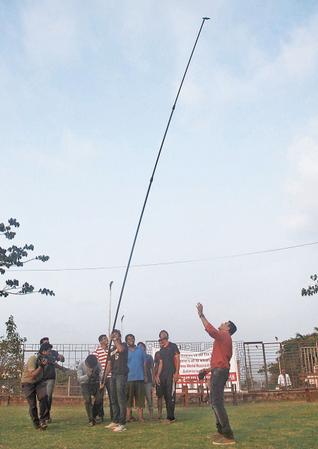
selfieArmaan, a student of sixth semester (B.Tech.) of Electrical and Electronics Engineering at MIT, created the longest selfie stick measuring 10.39 metres, which he demonstrated on the MIT grounds here. A selfie of the authorities of the MIT and others was taken on the occasion.

The present Guinness World Record holder for the world's longest stick is Ben Stiller (USA) for his selfie stick which measured 8.56 metres.

Mr. Stiller made this record at the premiere of Zoolander No. 2' in London, U.K., on February 4, 2016. The selfie taken included the stars of Zoolander No. 2' – Ben Stiller, Owen Wilson, Penelope Cruz, Will Ferrell, Kristen Wiig, Justin Theroux and Christine Taylor.

Mr. Armaan had sent an application to the Guinness World Records about two months ago for creating a new record in longest selfie stick. The application was accepted about a month ago. “After that I started working on it. I made around seven to eight trials,” he said. In the beginning, he created the selfie stick using a steel rod. But it was heavy. Then he used aluminium as it was lighter and stronger. “I was successful after using aluminium,” he said.

He practiced the use of the selfie stick for about a week. “If my present achievement is recognised, I will try doing a 12-metre long selfie stick,” he said.

Asked what inspired him to take to up this endeavour, he said, “When I saw Ben Stiller doing it. I thought even I could do it. That's how I started,” he said.

The demonstration of Mr. Armaan's longest selfie stick was photographed and video-graphed to be sent to Guinness World Records in the presence of six witnesses – S.J. Kumaraswamy, Deputy Superintendent of Police, G.K. Prabhu, Director of MIT, B.H.V. Pai, Joint Director, Narayan Shenoy, Associate Director, B.K. Singh, Professor of Electrical and Electronics Engineering, and Indrali Jayakar Shetty, General Manager of Badagabettu Credit Cooperative Society Ltd.

Mr. Armaan, son of Mohmed Soorinje and Rehana from Mangaluru, is also a member of the student team Formula Manipal' of MIT, which designs the formula racing car.

Comments

Satyameva jayate
 - 
Tuesday, 12 Apr 2016

Would have done something better for mankind...not for the selfie freaks.....grow up...we already are bored to see young people like oldmen walking with sticks in public and also smiling to themselves..now more longer...huh

Mr.KHAN
 - 
Tuesday, 12 Apr 2016

Masha Allah good job keep it up have a good future ....

Mohammed SS
 - 
Tuesday, 12 Apr 2016

Please send one stick to Narendra Modi

Mohammed Jinan
 - 
Tuesday, 12 Apr 2016

selfie freak.

abumohammed
 - 
Tuesday, 12 Apr 2016

Masha Allah keep it up, may have good future

Add new comment

  • Coastaldigest.com reserves the right to delete or block any comments.
  • Coastaldigset.com is not responsible for its readers’ comments.
  • Comments that are abusive, incendiary or irrelevant are strictly prohibited.
  • Please use a genuine email ID and provide your name to avoid reject.
News Network
January 26,2020

New Delhi, Jan 26: On the occasion of the 71st Republic Day, Karnataka state's tableau depicted the philosophy of Basaveshwara and the concept of Anubhava Mantapa (Centre for Experience), which was the socio-religious centre that existed in the present-day Basava Kalyana of Bidar district in Karnataka.

It is regarded as the first religious parliament in the history of mankind.

This 12th-century centre has a special significance in the history of humanity, as it represents composite culture, philosophy, spirituality, equality among other universal human values.

These values were propagated by the saint and social reformer- Basaveshwara and other sharanas- followers of Basava philosophy of the socio-religious movement.

It is significant that representatives of Anubhava Mantapa were nominated based on their spiritual attainment, regardless of caste, class and sect they belonged and thus discarded the differentiation of human beings as higher or lower, on the basis of birth, occupation and gender.

The front part of the tableau has the replica of Basaveshwara preaching his most cherished value - "Work is Worship".

For Republic Day Parade 2020, a total of 56 tableaux proposals (32 from states/UTs and 24 from Ministries/Departments) were received. Out of these, 22 were shortlisted for participation in the Republic Day Parade 2020.

Comments

Add new comment

  • Coastaldigest.com reserves the right to delete or block any comments.
  • Coastaldigset.com is not responsible for its readers’ comments.
  • Comments that are abusive, incendiary or irrelevant are strictly prohibited.
  • Please use a genuine email ID and provide your name to avoid reject.
News Network
April 10,2020

Bengaluru, Apr 10: Karnataka Chief Minister B S Yediyurappa, expressing his concern over the plight of stray animals struggling during lockdown, called upon people to feed the animals near their houses and provide them drinking water.

In a tweet he said "Due to scorching heat and Lockdown, cats, dogs and birds are suffering without water and food. In cities this situation much serious. So I appeal to people that people should see that dogs and birds their get food and water.

Please be kind and take some time off to feed stray animals and birds around your homes. Try providing them with water and leftovers so they're not parched and left hungry. Stray animals depend on wastes and leftovers from hotels and restaurants and have been hit by the Lockdown to check the spread of Corona virus.

Comments

Add new comment

  • Coastaldigest.com reserves the right to delete or block any comments.
  • Coastaldigset.com is not responsible for its readers’ comments.
  • Comments that are abusive, incendiary or irrelevant are strictly prohibited.
  • Please use a genuine email ID and provide your name to avoid reject.
Media Release
February 14,2020

Veteran journalist P. Sainath has said that the nation is in a crisis. And this crisis is not limited to just the rural area. It has become a national crisis at various areas such as agriculture, education, economy, job creation etc.

He was delivering the endowment lecture on the topic ‘Indian democracy at the post-liberalization and post-truth era’ at Media Manthan 2020 organized by the PG department of journalism and mass communication at St Aloysius College (Autonomous). 

Mr Sainath said that the many policies adopted in the 90s led to India becoming unusually unequal. Referring to the speech Ambedkar had made at the Constituent Assembly while handing over the draft of the Constitution, Mr Sainath said, “Ambedkar had warned about the weakness of Indian democracy that liberty without equality allows the supremacy of a few over the multitude. Liberty, equality and fraternity must be kept together as we cannot have one without the other.” 

Mr Sainath stated that the agrarian crisis was no longer about the loss of productivity, employment or about farmer suicide; it was a societal, civilizational crisis. Commenting on the lopsided policies such as cow-slaughter ban, he explained how cow slaughter ban had adversely affected many industries due to their interdependency. While Muslims who slaughtered cows were rendered helpless, the cattle traders who were mostly OBCs lost their earnings as the cattle prices crashed. An important industry like Kolhapur sandals industry in Maharashtra went bankrupt as a result of the cow slaughter ban in Maharashtra. He said the policymakers had no idea how the rural industries were interconnected. Demonetisation too devastated the rural economy as 98 percent of rural transactions happen through cash. 

Mr Sainath also spoke about the crisis of inequality which affects the Dalits and the Adivasis far more than anyone else as 90 percent of the rural households take home less than Rs 10,000/- per month. “Women are yet another group whose labour is never counted in the gross domestic product. Women and girls globally do unpaid work which amounts to about 12.5 billion working hours per year. Monetarily speaking, this is worth 10.8 trillion dollars,” Mr Sainath added. 

Speaking about the crisis of jobs Mr Sainath said that major companies were laying off employees just to create more profits for the investors and the adoption of artificial intelligence in the industry would further destroy millions of jobs.

Rector of St Aloysius College Institutions Fr Dionysius Vaz SJ, Principal Dr (Fr) Praveen Martis SJ, HOD of Journalism and Mass Communication department Dr (Fr) Melwyn Pinto SJ were present.

‘Veerappan and Vijay Mallya’s business models are interesting!’

Addressing the gathering during his endowment lecture on Friday, Mr Sainath made an interesting comment on the so called ‘revenue model’. “Whenever I visit IIMs and IITs for lectures on my PARI project, the students there ask me what my revenue model for my project is. I tell them that I do not have a revenue model. In fact, journalism does not begin with a revenue model. Gandhiji, Ambedkar, Bhagat Singh were all great journalists. But they did not have a revenue model,” Mr Sainath said.

On a lighter note, he said that the best revenue model that he liked was that of forest brigand Veerappan and liquor baron Vijay Mallya. “Veerappan ruled the forest for forty years and from the top ministers to the villagers he could dictate terms and liver royally. Similarly, Mallya’s revenue model was to steal the banks and run away abroad and live like a king,” Mr Sainath added.

Journalism is not and can never be a business. It is a calling, he opined. While newspaper can be a business, television can be a business, journalism per se cannot be reduced to a business. “Unfortunately today, journalists are recruited on a contract basis and they have no bargaining power; and there are no unions to fight for their cause. Hence, they are at the mercy of the corporate media houses for their survival and are made to write stories that cannot be called journalism,” Mr Sainath said.

Answering a question as to the pressures he faced as a journalist, he said that external pressures from the government or others could be very well handled. It is the internal pressures from once own media house that journalists find it difficult to manage.


Comments

Add new comment

  • Coastaldigest.com reserves the right to delete or block any comments.
  • Coastaldigset.com is not responsible for its readers’ comments.
  • Comments that are abusive, incendiary or irrelevant are strictly prohibited.
  • Please use a genuine email ID and provide your name to avoid reject.