Yakshagana veteran Chittani Ramachandra Hegde is no more

coastaldigest.com news network
October 3, 2017

Managluru, Oct 3: Veteran Yakshagana artiste Chittani Ramachandra Hegde passed away at a private hospital in Manipal on Tuesday night, due to pneumonia. He was 84.

He was the first among Yakshagana artistes to receive Padma Shri award. A school dropout who studied up to Class 2, Ramachandra Hegde performed Yakshagana for nearly seven decades and won a national award.

He is survived by his wife, three sons and a daughter. The last rites will be conducted at his village Guddekeri, 19 km from Honnavar, in Uttara Kannada on Wednesday.

Ramachandra Hegde became unconscious after performing the role of Shantanu in “Bheeshmotpatti” prasanga (episode) in Bangaramakki on September 26. Later, he was admitted to a hospital in Honnavar from where he was shifted to Kasturba Medical College Hospital in Manipal on September 29.

His illustrious performance became the subject matter for research works. Keshava Hegde, the author of Yaksha Sinchana, said that Ka. Vem. Shree and Vasudha Hegde obtained their Ph. D by writing on the performance of Ramachandra Hegde.

Ramachandra Hegde’s greatest strength was memorising the “prasangas” as he was not well versed in reading and writing. Many artistes of the present generation have been following the Chittani style of dance, Mr. Keshava Hegde said.

A recipient of many awards, including the Rajyotsava award, Mr. Hegde was known for performing the roles of Bhasmasura, Kaurava, Keechaka, Rudrakopa, Kamsa, Magadha and many other villain roles.

His son Subrahmanya Chittani, also a Yakshagana performer, said that Yakshagana was his father’s life.

Mr. Hegde had described Yakshagana as a “collective form” that came alive with everybody, from the veshadhari (artiste) and bhagavata (background singer) to the chande and maddale (percussion) players.

Comments

Vinod acharya
 - 
Wednesday, 4 Oct 2017

Condolence.. God may give strength  for family to bear his loss

Mohan
 - 
Wednesday, 4 Oct 2017

Great artist. Biggest loss for us

Add new comment

  • Coastaldigest.com reserves the right to delete or block any comments.
  • Coastaldigset.com is not responsible for its readers’ comments.
  • Comments that are abusive, incendiary or irrelevant are strictly prohibited.
  • Please use a genuine email ID and provide your name to avoid reject.
coastaldigest.com news network
August 3,2020

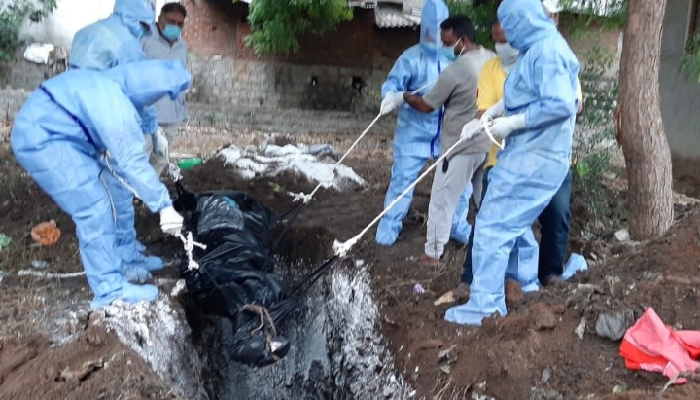
Koppal, Aug 3: The activists of Popular Front of India (PFI) have won the heart of the people by performing the last rites of a local leader of Bharatiya Janata Party in Koppla district of Karnataka. 

Somashekhara Gowda, a senior BJP leader in Koppal’s Gangavathi died of covid-19. His family members were reportedly quarantined. His own party activists also were not ready to participate in the last rite due to the fear of coronavirus infection.

Following requests, a team of PFI comprised of district secretary Fayaz, and members Yaseen, Abdul Aalam, Shamid Razi and Husain Azarauddin performed the last rites as per Veerashaiva Lingayat traditions. 

Speaking to media persons PFI district president Zaheer Abbas lamented that people still have plenty of misconceptions about covid-19. “Due to the misconceptions, performing the last rites of those who die of covid-19 has become a challenge,” he said.

He said that PFI activists followed all the health guidelines and took necessary precautions while performing the last rites. “Under the guidance of district health officials and with the consent of the family members of the deceased, the last rites were performed as per Veerashaiva Lingayat traditions,” he said.

Comments

Add new comment

  • Coastaldigest.com reserves the right to delete or block any comments.
  • Coastaldigset.com is not responsible for its readers’ comments.
  • Comments that are abusive, incendiary or irrelevant are strictly prohibited.
  • Please use a genuine email ID and provide your name to avoid reject.
News Network
June 4,2020

Bengaluru, Jun 4: The Karnataka government has tweaked quarantine requirements for people arriving from Maharashtra, raising the isolation time from a fortnight to three weeks, an official said on Wednesday.

"Returnees from Maharashtra will be sent to institutional quarantine for seven days, followed by 14 days strict home quarantine, total 21 days," tweeted Health Commissioner Pankaj Kumar Pandey.

The 21-day quarantine regimen is for all asymptomatic people returning from Maharashtra, considering most of the Covid cases in Karnataka are having domestic travel history to that state.

If any of the asymptomatic people develop symptoms during the isolation, they will be subjected to a Covid test.

However, some asymptomatic individuals from Maharashtra have been provided some exceptions from the three-week quarantine and designated as special category passengers.

Special category passengers include people who suffered a death in family, pregnant women, children below 10, elderly people above 60, individuals suffering from serious illness and human distress.

Similarly, the department has also made some provisions for business travellers from Maharashtra.

"To establish that one is a business visitor, (that) person should show confirmed return flight or train ticket which should not be more than seven days later from the date of arrival," ordered Chief Secretary T.M. Vijay Bhaskar.

Similarly, if a business visitor is arriving on road, he should provide the address proof of the person in Karnataka he intends to meet.

Additionally, such a person should also produce a Covid negative test certificate which is not more than two days old.

"One does not have a Covid negative test certificate such a person should go for institutional quarantine for two days within which Covid test should be conducted at his own cost. After the test result is negative, that person is exempted from quarantine," he said.

However, business travellers have been exempted from hand stamping.

Amending the Sunday orders, Bhaskar, has enhanced the quarantine requirements for Maharashtra returnees.

Many conditions for visitors from other states remain mostly unchanged as notified on Sunday.

Comments

Add new comment

  • Coastaldigest.com reserves the right to delete or block any comments.
  • Coastaldigset.com is not responsible for its readers’ comments.
  • Comments that are abusive, incendiary or irrelevant are strictly prohibited.
  • Please use a genuine email ID and provide your name to avoid reject.
Ram Puniyani
February 29,2020

Like most of the political phenomenon, even the practice of Nationalism is not a static one. It changes with the changing political equations of the political forces and assumes the expressions which are very diverse. As such the phenomenon of Nationalism has a long journey and various state policies in particular have used it for purposes which relate more to the power of the state ‘vis a vis’ its people, power of the state ‘vis a vis’ the neighboring countries among others.

In India there has been a certain change in the practices of the state which have transformed the meaning of Nationalism during last few years. Particularly with BJP, the Hindu Nationalist outfit gaining simple majority, it has unfolded the policies where one can discern the drastic change in the meaning and application of Nationalism in regard to its citizens, particularly those belonging to minority community, with regard to those who are liberal, and with those who stand with the concept of Human rights.

Our former Prime Minister of Dr. Manmohan Singh hit the nail on the head when he said that “Nationalism and the "Bharat Mata Ki Jai" slogan are being misused to construct a "militant and purely emotional" idea of India that excludes millions of residents and citizens. Former Prime Minister recently stated this in an apparent attack on the BJP.” The occasion was the release of a book, ‘Who is Bharat Mata’, edited by Purushottam Agarwal and Radhakrishna. This is a compilation of significant extracts from writings of Nehru, and important assessments of and contributions of Nehru by prominent personalities.

Dr. Singh went on to add "With an inimitable style…Nehru laid the foundation of the universities, academies and cultural institutions of Modern India. But for Nehru's leadership, independent India would not have become what it is today," This statement of Dr. Singh has great importance in contemporary times, as Nehru is being denigrated by Hindu nationalists for all the problems which India is facing today and attempts are on to undermine his role and glorifying Sardar Vallabh Bhai Patel. This is also significant as it gives us the glimpses of what Nationalism meant for Nehru.

As Singh’s statement captures the present nationalism being practiced by BJP and company, the Hindu nationalists, immediately shot back saying that Dr. Singh is supporting the anti India activities at JNU and Jamia and his party is supporting the anti India nationalists. They asked whether Singh likes the nationalism of the likes of Shashi Tharoor or Manishankar Ayer who are provoking the Shaheen Bagh protest rather than making the protestors quiet. Whether he likes the anti national protests which go on at JNU or Jamia? As per them there is no Nationalism in Congress. One more example being cited is the private visit of Shatrughan Sinha who talked to Pakistani President during his visit there recently!

Most of the arguments being used to oppose Dr. Singh are very superficial. What is being referred to; is not opposition to Indian nationalism and its central values which were the core of anti colonial struggles. While ‘Bharat Mata Ki Jai’ may not be acceptable to a section of population, even the book he was releasing has the title ‘Who is Bharat Mata’. What is being stated by Singh is the twist which slogan ‘Bharat Mata ki Jai’ has been used by Hindu nationalists to frighten the religious minorities.

Indian nation came into being on the values, which later were the foundation of Indian Constitution. Indian Constitution carefully picked up the terminology which was away from the concepts of Hindu or Muslim nationalism. That’s how the country came to be called as ‘India that is Bharat’. The freedom of expression which was the hallmark of freedom movement and it was given a pride of place in our Constitution. It respected the diversity and formulated rules where the nation was not based on particular culture, as Hindu nationalists will like us to believe, but cultural diversity was centrally recognized in the Constitution. In addition promoting good relations with neighbors and other countries of the World was also part of our principles.

JNU, Jamia and AMU are being demonized as most institutions so far regard the freedom of expression as a core part of Indian democracy. These institutions have been thriving on discussions and debates which have base in liberalism. Deliberately some slogans have been constructed to defame these institutions. While Constitution mandates good relations with neighbors, creation of ‘Anti Pakistan hysteria’ is the prime motive of many a channels and sections of other media, which are servile to the ideology of ruling Government. They also violate most of the norms of ethical journalism, where the criticism of the ruling party is an important factor to keep the ruling dispensation in toes.

A stifling atmosphere has been created during last six years. In this the Prime Minster can take a detour, land in Pakistan to have a cup of tea with Pakistan PM, but a Congress leader talking to Pakistani President is a sign of being anti National. Students taking out a march while reading the preamble of Indian Constitution are labeled as anti-national; and are stopped while those openly wielding guns near Jamia or Shaheen Bagh roam freely.

Nationalism should promote amity and love of the people; it should pave the way for growth and development. Currently the nationalism which is dominant and stalking the streets has weakened the very fraternity, which is one of the pillars of our democracy. Nehru did explain that Bharat Mata is not just our mountains, rivers and land but primarily the people who inhabit the land. Which nationalism to follow was settled during the freedom movement when Muslim nationalism and Hindu nationalism were rejected by the majority of people of India in favor of the Nationalism of Gandhi, Nehru, Patel and Maulana Azad, where minorities are equal citizens, deserving affirmative action. In today’s scenario the Hindu nationalists cannot accept any criticism of their policies.


Comments

Add new comment

  • Coastaldigest.com reserves the right to delete or block any comments.
  • Coastaldigset.com is not responsible for its readers’ comments.
  • Comments that are abusive, incendiary or irrelevant are strictly prohibited.
  • Please use a genuine email ID and provide your name to avoid reject.