Yellow paint must for vehicles carrying school kids, rules AB Ibrahim

[email protected] (CD Network)
June 23, 2016

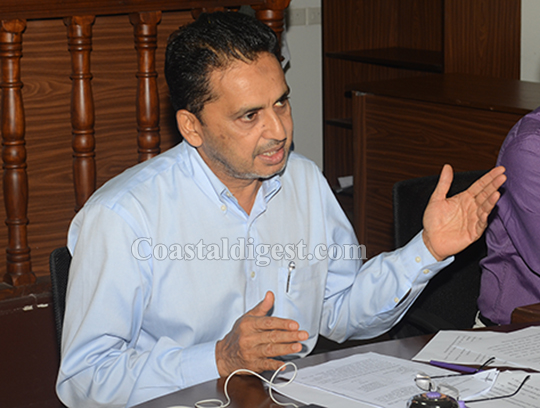
Mangaluru, Jun 23: All school vehicles, including the private vehicles transporting schoolchildren, should have a distinct highway yellow colour with a horizontal strip in green colour in the middle all around the vehicle, ruled A?B?Ibrahim, Deputy Commissioner of Dakshina Kannada.

dcO 1

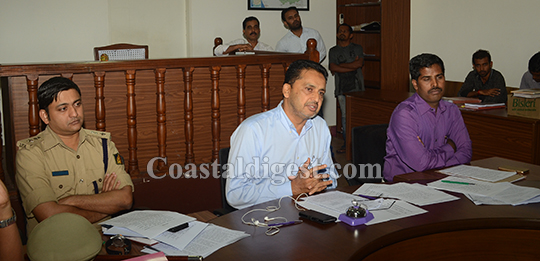
Chairing a meeting on the safety of school vehicles here on Wednesday, he directed the region transport and police officials to initiate stringent action against those vehicles that are crammed with schoolchildren.

The district administration wants to ensure that all safety measures prescribed by the government and courts are strictly adhered to by June 30, he added.

The DC said, “As per the rules, the autorickshaw can accommodate six children (below 12 years) in one trip. The Maruthi Omni can accommodate only eight children. If the children are above 12 years, then the number of children should be as per the carrying capacity of the vehicles.”

“The RTO and the Education Department should act swiftly in this regard. As the safety measures are implemented in the interest of the safety of the children, the parents should cooperate with the authorities,” he added.

Earlier, Udupi Deputy Commissioner Dr Vishal R said that he would try to take stringent measures on road safety, especially on the vans carrying schoolchildren. He would try to secure maximum compensation for the families of victims.

Dr Vishal said, “I will recommend something on humanitarian ground. Regulatory measures will be introduced. There is a need for solution and it would be known in the days to come.”

dcO 3

Comments

Ahamad
 - 
Friday, 24 Jun 2016

Well done Sir..
Even if private vehicles transporting children's school management should make responsible for violations.

Add new comment

  • Coastaldigest.com reserves the right to delete or block any comments.
  • Coastaldigset.com is not responsible for its readers’ comments.
  • Comments that are abusive, incendiary or irrelevant are strictly prohibited.
  • Please use a genuine email ID and provide your name to avoid reject.
Media Release
February 14,2020

Veteran journalist P. Sainath has said that the nation is in a crisis. And this crisis is not limited to just the rural area. It has become a national crisis at various areas such as agriculture, education, economy, job creation etc.

He was delivering the endowment lecture on the topic ‘Indian democracy at the post-liberalization and post-truth era’ at Media Manthan 2020 organized by the PG department of journalism and mass communication at St Aloysius College (Autonomous). 

Mr Sainath said that the many policies adopted in the 90s led to India becoming unusually unequal. Referring to the speech Ambedkar had made at the Constituent Assembly while handing over the draft of the Constitution, Mr Sainath said, “Ambedkar had warned about the weakness of Indian democracy that liberty without equality allows the supremacy of a few over the multitude. Liberty, equality and fraternity must be kept together as we cannot have one without the other.” 

Mr Sainath stated that the agrarian crisis was no longer about the loss of productivity, employment or about farmer suicide; it was a societal, civilizational crisis. Commenting on the lopsided policies such as cow-slaughter ban, he explained how cow slaughter ban had adversely affected many industries due to their interdependency. While Muslims who slaughtered cows were rendered helpless, the cattle traders who were mostly OBCs lost their earnings as the cattle prices crashed. An important industry like Kolhapur sandals industry in Maharashtra went bankrupt as a result of the cow slaughter ban in Maharashtra. He said the policymakers had no idea how the rural industries were interconnected. Demonetisation too devastated the rural economy as 98 percent of rural transactions happen through cash. 

Mr Sainath also spoke about the crisis of inequality which affects the Dalits and the Adivasis far more than anyone else as 90 percent of the rural households take home less than Rs 10,000/- per month. “Women are yet another group whose labour is never counted in the gross domestic product. Women and girls globally do unpaid work which amounts to about 12.5 billion working hours per year. Monetarily speaking, this is worth 10.8 trillion dollars,” Mr Sainath added. 

Speaking about the crisis of jobs Mr Sainath said that major companies were laying off employees just to create more profits for the investors and the adoption of artificial intelligence in the industry would further destroy millions of jobs.

Rector of St Aloysius College Institutions Fr Dionysius Vaz SJ, Principal Dr (Fr) Praveen Martis SJ, HOD of Journalism and Mass Communication department Dr (Fr) Melwyn Pinto SJ were present.

‘Veerappan and Vijay Mallya’s business models are interesting!’

Addressing the gathering during his endowment lecture on Friday, Mr Sainath made an interesting comment on the so called ‘revenue model’. “Whenever I visit IIMs and IITs for lectures on my PARI project, the students there ask me what my revenue model for my project is. I tell them that I do not have a revenue model. In fact, journalism does not begin with a revenue model. Gandhiji, Ambedkar, Bhagat Singh were all great journalists. But they did not have a revenue model,” Mr Sainath said.

On a lighter note, he said that the best revenue model that he liked was that of forest brigand Veerappan and liquor baron Vijay Mallya. “Veerappan ruled the forest for forty years and from the top ministers to the villagers he could dictate terms and liver royally. Similarly, Mallya’s revenue model was to steal the banks and run away abroad and live like a king,” Mr Sainath added.

Journalism is not and can never be a business. It is a calling, he opined. While newspaper can be a business, television can be a business, journalism per se cannot be reduced to a business. “Unfortunately today, journalists are recruited on a contract basis and they have no bargaining power; and there are no unions to fight for their cause. Hence, they are at the mercy of the corporate media houses for their survival and are made to write stories that cannot be called journalism,” Mr Sainath said.

Answering a question as to the pressures he faced as a journalist, he said that external pressures from the government or others could be very well handled. It is the internal pressures from once own media house that journalists find it difficult to manage.


 

Comments

Add new comment

  • Coastaldigest.com reserves the right to delete or block any comments.
  • Coastaldigset.com is not responsible for its readers’ comments.
  • Comments that are abusive, incendiary or irrelevant are strictly prohibited.
  • Please use a genuine email ID and provide your name to avoid reject.
Media Release
May 2,2020

Mangalore, May 2: More than 500 families received ration kits in a distribution drive conducted by St Agnes College in outskirts of Mangaluru on Wednesday.

Since the lockdown was announced, the management, staff and alumni of St Agnes College are playing an active role in ensuring no one is deprived of food and essentials during these challenging pandemic times.

The College as part of its Agnes towards Community (ATC) programme had adopted villages such as Munnur, Harekala, Amlamogaru, Someshwara and Pavur. Various development drives are conducted in these villages by the staff and students. However, due to the COVID-19 lockdown, the activities undertaken in these villages were kept on hold.

The College recently received information from its network that several families in these villages are struggling for food and essentials.

The College management in association with its alumni and well-wishers took-up the initiative to distribute ration kits consisting of rice, dal, spices, tea powder, hygiene products and other essentials to 500 needy families belonging to these villages.

The drive was held in presence of Zilla Panchayat member Dhanalakshmi Gatty and other Gram Panchayat members.

"We were able to provide food to 600 and more families in different villages and to the stranded migrant workers in the city during this time of crisis because of the generous contributions of our staff, alumni and well wishes" says Sr Dr. M. Jeswina A.C.

The College management expresses its gratitude to all donors, especially the staff, alumni and those associated with the college.

Comments

Add new comment

  • Coastaldigest.com reserves the right to delete or block any comments.
  • Coastaldigset.com is not responsible for its readers’ comments.
  • Comments that are abusive, incendiary or irrelevant are strictly prohibited.
  • Please use a genuine email ID and provide your name to avoid reject.
News Network
July 4,2020

A 53-year-old Indian worker in the UAE has missed a special repatriation flight after he dozed off at the Dubai International Airport, a media report said.

P Shajahan, who worked as a storekeeper in Abu Dhabi, was supposed to fly to Thiruvananthapuram on the Emirates jumbo jet chartered by the Kerala Muslim Cultural Centre (KMCC) Dubai, Gulf News reported.

It was the first-ever jumbo jet chartered for repatriation.

Shajahan, who had paid 1,100 dirham (USD 300) for the ticket, said that he did not sleep on the previous night as he kept on waiting for the confirmation of his ticket for the jumbo jet flying 427 stranded Indians to Kerala, it said.

He reached the airport early in the morning and after finishing the check-in procedures and rapid test, he reached the waiting area of the boarding gate at Terminal 3 around 2 PM local time, the report said.

“I sat away from most of the others. But I fell asleep after 4.30 PM,” he said.

S Nizamudeen Kollam, who coordinated the charter flight, said that the airline officials could not trace Shajahan when the flight was to take off.

“He woke up and called us after the flight left. It is sad that he missed the flight, which was the first-ever jumbo jet chartered for repatriation. We are now trying to send him on another Emirates flight that we are chartering on Saturday,” Kollam said.

Since Shajahan did not have any money, Jasimkhan Kallambalam, organising secretary of KMCC Thiruvananthapuram, went to the airport to meet him on Friday.

“Since his visa was cancelled, he could not come out of the airport. He had only eaten the snacks in the kit KMCC had given. We managed to give him some cash for buying food through KMCC volunteer Alamsha Latheef,” Kallambalam said.

In March, another Indian expat had fallen asleep in the same terminal and missed the last flight home before flights were suspended due to the COVID-19 pandemic.

He was stranded here for over 50 days before getting repatriated.

Comments

Add new comment

  • Coastaldigest.com reserves the right to delete or block any comments.
  • Coastaldigset.com is not responsible for its readers’ comments.
  • Comments that are abusive, incendiary or irrelevant are strictly prohibited.
  • Please use a genuine email ID and provide your name to avoid reject.