Yellow paint must for vehicles carrying school kids, rules AB Ibrahim

[email protected] (CD Network)
June 23, 2016

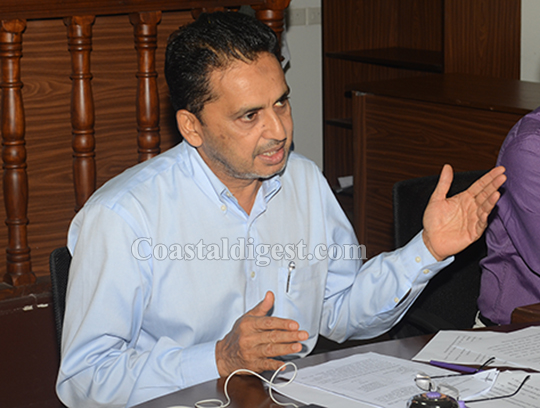
Mangaluru, Jun 23: All school vehicles, including the private vehicles transporting schoolchildren, should have a distinct highway yellow colour with a horizontal strip in green colour in the middle all around the vehicle, ruled A?B?Ibrahim, Deputy Commissioner of Dakshina Kannada.

dcO 1

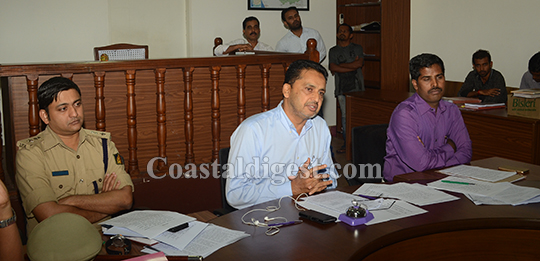
Chairing a meeting on the safety of school vehicles here on Wednesday, he directed the region transport and police officials to initiate stringent action against those vehicles that are crammed with schoolchildren.

The district administration wants to ensure that all safety measures prescribed by the government and courts are strictly adhered to by June 30, he added.

The DC said, “As per the rules, the autorickshaw can accommodate six children (below 12 years) in one trip. The Maruthi Omni can accommodate only eight children. If the children are above 12 years, then the number of children should be as per the carrying capacity of the vehicles.”

“The RTO and the Education Department should act swiftly in this regard. As the safety measures are implemented in the interest of the safety of the children, the parents should cooperate with the authorities,” he added.

Earlier, Udupi Deputy Commissioner Dr Vishal R said that he would try to take stringent measures on road safety, especially on the vans carrying schoolchildren. He would try to secure maximum compensation for the families of victims.

Dr Vishal said, “I will recommend something on humanitarian ground. Regulatory measures will be introduced. There is a need for solution and it would be known in the days to come.”

dcO 3

Comments

Ahamad
 - 
Friday, 24 Jun 2016

Well done Sir..
Even if private vehicles transporting children's school management should make responsible for violations.

Add new comment

  • Coastaldigest.com reserves the right to delete or block any comments.
  • Coastaldigset.com is not responsible for its readers’ comments.
  • Comments that are abusive, incendiary or irrelevant are strictly prohibited.
  • Please use a genuine email ID and provide your name to avoid reject.
News Network
June 6,2020

New Delhi, Jun 6: With the coronavirus pandemic showing no signs of abating, it seems unlikely that Muslims from India will be able to undertake the Hajj pilgrimage this year.

However, the government will take a final decision on the matter only after Saudi Arabia makes its position on hosting the pilgrimage clear.

A circular issued by the Hajj Committee of India on Friday said only a few weeks are left for the preparatory work in India for Hajj 2020, yet the Saudi authorities have not communicated any further development regarding the pilgrimage.

"In view of the several inquiries received and concerns expressed over uncertainty over Hajj 2020, it has been decided by the Hajj Committee of India that, those pilgrims who desire to cancel their Hajj journey this year, their 100 per cent amount paid so far will be refunded without any deductions," the circular issued by Hajj Committee of India CEO Maqsood Ahmed Khan said.

"Coronavirus cases are increasing in Saudi Arabia and two lakh people have to go from here. We had made preparations, but now there is very little time left. We are waiting for an official word from Saudi Arabia," a top source said.

In response to a question, the source said, "This time, it is unlikely that people will be able to undertake Hajj from India."

Uncertainty has been looming large over this year's Hajj in the wake of the coronavirus pandemic and though Saudi Arabia has not made a decision on whether the annual pilgrimage will be held or not, it did ask Muslims to delay their bookings till there is more clarity.

The bilateral annual Hajj 2020 agreement between India and Saudi Arabia was signed last December. In 2020, a total of 2 lakh Indian Muslims were expected to perform Hajj.

Over 95,000 COVID-19 cases and more than 600 deaths have been reported in Saudi Arabia due to the coronavirus pandemic, according to Johns Hopkins University data.

Some countries have decided not to send their people for Hajj this time. The most prominent among these is Indonesia, the country with the largest Muslim population in the world.

The Hajj 2020 is proposed in the period between late July and early August.

The Hajj is one of the five pillars of Islam which every Muslim is required to complete at least once in their lifetime if they are healthy enough and have the means to do so.

Comments

Add new comment

  • Coastaldigest.com reserves the right to delete or block any comments.
  • Coastaldigset.com is not responsible for its readers’ comments.
  • Comments that are abusive, incendiary or irrelevant are strictly prohibited.
  • Please use a genuine email ID and provide your name to avoid reject.
News Network
January 15,2020

Bengaluru, Jan 15: The Indian startups secured 12.7 billion in funding last year -- a 15% growth compared to 2018 - and Bengaluru startup community topped the list, with securing $5.3 billion across 267 deals, a new report said on Tuesday.

In total, the Indian startups attracted 766 deals in 2019, taking total deal count between 2014-2019 to 5,011, said DataLabs by Inc42 in its annual startup funding report.

Sequoia took the top spot as the most active VC in 2019 with 53 deals, followed by Accel that participated in 38 deals. Blume Ventures, Matrix Partners and Tiger Global were in the top five VCs in 2019.

"The Indian startup economy is entering new decade with over $58 billion in fundraising and 2,984 funded startups between 2014-2019," the findings showed.

With an average of $21 million, the ticket size value of funding increased by 15% in 2019.

Ecommerce and fintech -- with $2.6 billion funding each -- took the top slot with 93 deals and 125 deals, respectively.

"Ecommerce continued to remain at the top by the end of 2019. The growing investor confidence towards sub-sectors such as vertical ecommerce, social commerce and private label businesses is one major factor for ecommerce maintaining its lead," a DataLabs spokesperson said in a statement.

According to the estimates, the funding amount and deal count in 2020 will be around $12.6 billion at a 1% decline from 2019.

"Nevertheless, the investment activity is expected to rise in 2021," said the report.

The data suggests that 2019 had lowest number of startups funded (664) in the last five years, with seed-stage funding deals dropping by 53%, compared to 2016.

With $252 million in funding, seed-stage deal value fell by 44% (compared to 2018) as only 306 seed funding deals were recorded, the report said.

The enterprise tech had a blockbuster year with total funding of $1.15 billion across 114 deals in 2019. The sector recorded a 49% surge in total funding amount, compared to 2018.

The Indian startup economy saw 275 unique VCs participating in funding in 2019, said the report.

Comments

Add new comment

  • Coastaldigest.com reserves the right to delete or block any comments.
  • Coastaldigset.com is not responsible for its readers’ comments.
  • Comments that are abusive, incendiary or irrelevant are strictly prohibited.
  • Please use a genuine email ID and provide your name to avoid reject.
News Network
April 19,2020

Kasaragod, Apr 19: Kasaragod, Kerala's COVID-19 hotspot, is the only district in the southern state lacking adequate health infrastructure.

In spite of treating the highest number of COVID-19 patients in the state with meagre infrastructural facilities and even without the support of a medical college in the north Kerala district, no deaths have been reported due to coronavirus.

The state health department views the performance of M Kunhiraman and his team, consisting of Janardhana Naik and Krishna Naik, at the General hospital in Kasaragod as a success story.

"Not only did they control the situation quickly with minimum infrastructure, they also started turning out a large number of negative cases within a few weeks and creditably ensured zero mortality.

This can be showcased as a best global model," Chairman of the Information Education and Communication (IEC) Committee and Project Director Kerala State Aids Control Society, R Ramesh said.

Recalling the ordeal, Janardhana Naik said his first major challenge was the physical examination of a patient with suspected COVID-19.

"Even with the PPE kit, nobody knew how effective they were and it took a whole 30 minutes to wear them properly.

But as time passed, we got accustomed to it," he said.

The traditional method of dealing with a patient involved knowing his or her history, observation and physical examination.

For hundreds of years, the hands-on body approach has been the soul of the doctor-patient relationship -- taking the pulse, tapping on and listening to the chest, feeling lumps.

With the onset of COVID-19 all that has changed.

"In fact, the whole exercise was fraught with grave risks because everything connected with COVID-19 was new.

Doctors have to keep a distance even though the physical examination wearing a Personal Protective Equipment (PPE) is difficult.

Sounds from the body are inaudible, vision is blurred through the smog-covered goggles and a stethoscope seldom has any use," Janardhana Naik said.

It was from March 15 that the hospital started receiving COVID-19 patients, primarily from Dubai.

By the time the first person came, the hospital was ready for him.

Soon, patient numbers began to swell and in a couple of weeks they reached about 91.

From then on, it was teamwork.

Committees were formed for each and every task, including the help desk, IT, treatment, medical board, training, food, waste disposal and data maintenance.

Initially, patients had many misgivings about the hospital.

"Some were disillusioned and even aggressive. Some were not happy with the facilities the hospital had to offer.

But gradually through good treatment and counselling by a psychiatrist, who visited the hospital on alternate days, the confidence and mood of the patients changed and they became friendly with the staff," Naik elaborated.

Counselling was also given to the concerned family members of the patients.

Besides treatment, the medical staff had to spend a considerable amount of time clearing the doubts of patients.

When they got discharged some patients insisted on seeing the faces of the medical staff, who till then were anonymous entities covered from head to toe.

Some even wanted to take selfies with them.

However, the medical team politely turned down their requests and preferred to remain hidden in their work attires.

The mood of the patients also rubbed off on the doctors and hospital staff.

All the physicians and hospital staff are now more confident of dealing with contagious diseases after treating COVID-19 patients.

"Our previous experience of treating H1N1, Chikungunya and Dengue cases helped us a lot.

Words of encouragement from the Health Minister K K Shailaja, Health Principal Secretary Dr Rajan N Khobragade and Health Services Director Dr Sarita R L gave us the impetus to build up confidence.

Moreover, the field health workers did a wonderful job in containing the viral spread," Naik added.

As the number of coronavirus cases rose, the state government on April 5 deputed a 26-member medical team from Thiruvananthapuram to set up a COVID-19 hospital in the district.

They turned a block of the under construction Government Medical College as a hospital-like facility, setting up a 200 bed facility to treat coronavirus patients.


Comments

Add new comment

  • Coastaldigest.com reserves the right to delete or block any comments.
  • Coastaldigset.com is not responsible for its readers’ comments.
  • Comments that are abusive, incendiary or irrelevant are strictly prohibited.
  • Please use a genuine email ID and provide your name to avoid reject.