Yettinahole project: Activists ask DVS, Moily to pass truth test in Dharmasthala

[email protected] (CD Network)
January 4, 2016

Mangaluru, Jan 4: Union Minister for Law D V Sadananda Gowda and former minister M Veerappa Moily have been challenged to pass a truth test in divine presence that the Yettinahole project is ‘clean’.

w3

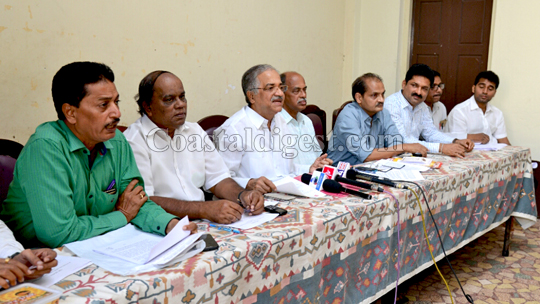
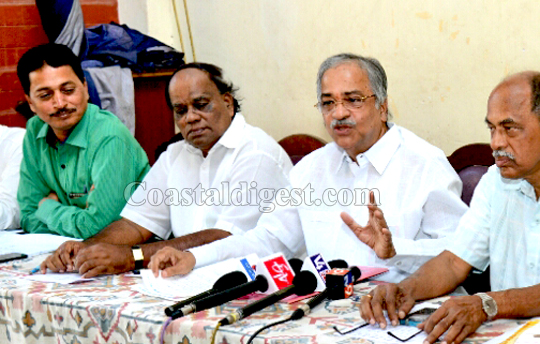
The Yettinahole Virodhi Samiti vice-president M G Hegade has challenged Sadananda Gowda and Moily to visit Sri Kshetra Dharmasthala and pass a ‘truth test’ that not a single rupee has been misappropriated with regard to the Yettinahole project.

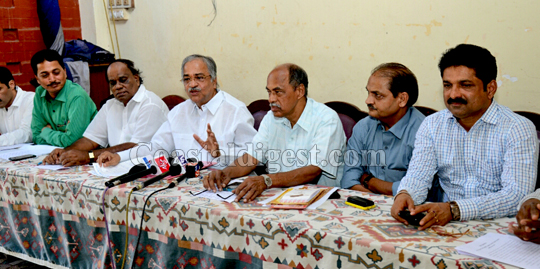
Addressing mediapersons in Mangaluru on Monday, the committee vice-president condemned the vague statements made about the committee by Sadananda Gowda. Hegade said that the Union Minister has called the Samiti members fake environmentalists. “He was unaware of the delegation led by local MP Nalin Kumar Kateel, which visited the Union Minister for Environment and the Union Minister for Water Resources. In addition, Gowda has said that the delegation has insulted him by not meeting him,” said Hegade.

“The words uttered by Sadananda Gowda are below his dignity,” said the vice-president, and urged the minister to apologise for the remarks.

Hegade further alleged that Gowda and Moily were both responsible for the implementation of the unscientific Yettinahole project. “Both the politicians have been disloyal to the people of Dakshina Kannada. While all the people of the district – including the MPs and various religious leaders – are protesting against the projects, Gowda and Moily have turned a blind eye and a deaf ear to the urges. The people of the district should banish them both from the district,” he called upon the people.

Subject expert and NITK former professor S G Mayya said that the minutes of the meeting of the Regional Empowered Committee, Regional Office (SZ), Bengaluru, on December 28, at the office of the Chief Conservator of Forests, Hassan, on Yettinahole project is full of contradictions.

The minutes also vaguely called that the meeting of the Union Ministers by K N Somashekhar and others as ‘pressure tactics’.

Criticising the matter, Mayya has said that nobody has the right to criticise the meeting of an elected representative. “The decision taken at the meeting to clear the forests in the project area is against the Forest Conservation Act. The habitat of the wild animals, the elephant corridor and the non-clearing of forests in the areas are all prone to soil erosion, but this has not been considered. Also, the environment impact report has not been submitted. The argument that only five to six hectares of forest area will be cleared for the project is far from the truth. The government has followed a Term Key Project, without inviting tenders, which will lead to devastation,” warned the former professor.

Mayya further said that the reduction in water content in the rivers will lead to an increase in the salinity of water as per the study of the National Institute of Ocean Technology (NIOT).

Leaders Vijay Kumar Shetty, Shashiraj Shetty Kolambe, Dinakar Shetty, Uttam Alva, Ramachandra Baikampadi, Hussain Katipalla and MCC Deputy Mayor Purushottam Chitrapur were present.

w1

w2

Comments

Augustus
 - 
Thursday, 4 Feb 2016

The very next time I read a website, I really hope that
it doesnt disappoint me around that one. I mean, I know
it had been my choice to learn, but I really thought youd have anything interesting
to say.

My web-site; marvel future Fight
hack online: http://www.realhacks24.com/marvel-future-fight-hack/

True teller
 - 
Tuesday, 5 Jan 2016

If any leader commits offense, it is not a crime for him. He is not unease with his action.
He has no conscience, he can swear anything.

Add new comment

  • Coastaldigest.com reserves the right to delete or block any comments.
  • Coastaldigset.com is not responsible for its readers’ comments.
  • Comments that are abusive, incendiary or irrelevant are strictly prohibited.
  • Please use a genuine email ID and provide your name to avoid reject.
coastaldigest.com news network
July 14,2020

Mangaluru / Dammam, July 14: As many as 180 NRIs from Karnataka who were stranded in Saudi Arabia amid Covid 19 crisis today reached their home country by a flight charted by a Jubail based company KMT.

The Indigo flight carrying 174 adult passengers and 6 infants took off from King Fahad Airport, Dammam at 6:30 a.m. and landed at Mangaluru International Airport at 1:30 p.m.

Pregnant women, people with serious ailments and those who lost jobs are among the passengers. KMT has provided free ticket for some of the passengers who were in dire need of support.

KMT is a company which is head quartered in Jubail, Saudi Arabia was formed by natives of Addoor, Dakshin Kannada -  Shoukath, Abdul Razaq, Siddique and Abdul Rahman.

The CEO of KMT, Mr. Abdul Razaq has thanked Dr. Arathi Krishna, former president of KNRI Forum for her support to KMT in chartering flight.

He has also has expressed his gratitude to D.K district administration, director of SACO  company Mr. Althaf Ullal and KMT operation Manager Mr. Sadiq Ahmed and his team for their cooperation.

Comments

Add new comment

  • Coastaldigest.com reserves the right to delete or block any comments.
  • Coastaldigset.com is not responsible for its readers’ comments.
  • Comments that are abusive, incendiary or irrelevant are strictly prohibited.
  • Please use a genuine email ID and provide your name to avoid reject.
Ram Puniyani
February 10,2020

Noam Chomsky is one of the leading peace workers in the world. In the wake of America’s attack on Vietnam, he brought out his classic formulation, ‘manufacturing consent’. The phrase explains the state manipulating public opinion to have the public approve of it policies—in this case, the attack of the American state on Vietnam, which was then struggling to free itself from French colonial rule.

In India, we are witness to manufactured hate against religious minorities. This hatred serves to enhance polarisation in society, which undermines India’s democracy and Constitution and promotes support for a Hindu nation. Hate is being manufactured through multiple mechanisms. For example, it manifests in violence against religious minorities. Some recent ghastly expressions of this manufactured hate was the massive communal violence witnessed in Mumbai (1992-93), Gujarat (2002), Kandhamal (2008) and Muzaffarnagar (2013). Its other manifestation was in the form of lynching of those accused of having killed a cow or consumed beef. A parallel phenomenon is the brutal flogging, often to death, of Dalits who deal with animal carcasses or leather.

Yet another form of this was seen when Shambhulal Regar, indoctrinated by the propaganda of Hindu nationalists, burned alive Afrazul Khan and shot the video of the heinous act. For his brutality, he was praised by many. Regar was incited into the act by the propaganda around love jihad. Lately, we have the same phenomenon of manufactured hate taking on even more dastardly proportions as youth related to Hindu nationalist organisations have been caught using pistols, while police authorities look on.

Anurag Thakur, a BJP minster in the central government recently incited a crowd in Delhi to complete his chant of what should happen to ‘traitors of the country...” with a “they should be shot”. Just two days later, a youth brought a pistol to the site of a protest at Jamia Millia Islamia university and shouted “take Azaadi!” and fired it. One bullet hit a student of Jamia. This happened on 30 January, the day Nathuram Godse had shot Mahatma Gandhi in 1948. A few days later, another youth fired near the site of protests against the CAA and NRC at Shaheen Bagh. Soon after, he said that in India, “only Hindus will rule”.

What is very obvious is that the shootings by those associated with Hindu nationalist organisations are the culmination of a long campaign of spreading hate against religious minorities in India in general and against Muslims in particular. The present phase is the outcome of a long and sustained hate campaign, the beginning of which lies in nationalism in the name of religion; Muslim nationalism and Hindu nationalism. This sectarian nationalism picked up the communal view of history and the communal historiography which the British introduced in order to pursue their ‘divide and rule’ policy.

In India what became part of “social common sense” was that Muslim kings had destroyed Hindu temples, that Islam was spread by force, and that it is a foreign religion, and so on. Campaigns, such as the one for a temple dedicated to the Hindu god Rama to be built at the site where the Babri masjid once stood, further deepened the idea of a Muslim as a “temple-destroyer”. Aurangzeb, Tipu Sultan and other Muslim kings were tarnished as the ones who spread Islam by force in the subcontinent. The tragic Partition, which was primarily due to British policies, and was well-supported by communal streams also, was entirely attributed to Muslims. The Kashmir conflict, which is the outcome of regional, ethnic and other historical issues, coupled with the American policy of supporting Pakistan’s ambitions of regional hegemony, (which also fostered the birth of Al-Qaeda), was also attributed to the Muslims.

With recurring incidents of communal violence, these falsehoods went on going deeper into the social thinking. Violence itself led to ghettoisation of Muslims and further broke inter-community social bonds. On the one hand, a ghettoised community is cut off from others and on the other hand the victims come to be presented as culprits. The percolation of this hate through word-of-mouth propaganda, media and re-writing of school curricula, had a strong impact on social attitudes towards the minorities.

In the last couple of decades, the process of manufacturing hate has been intensified by the social media platforms which are being cleverly used by the communal forces. Swati Chaturvedi’s book, I Am a Troll: Inside the Secret World of the BJP’s Digital Army, tells us how the BJP used social media to spread hate. Whatapp University became the source of understanding for large sections of society and hate for the ‘Other’, went up by leaps and bounds. To add on to this process, the phenomenon of fake news was shrewdly deployed to intensify divisiveness.

Currently, the Shaheen Bagh movement is a big uniting force for the country; but it is being demonised as a gathering of ‘anti-nationals’. Another BJP leader has said that these protesters will indulge in crimes like rape. This has intensified the prevalent hate.

While there is a general dominance of hate, the likes of Shambhulal Regar and the Jamia shooter do get taken in by the incitement and act out the violence that is constantly hinted at. The deeper issue involved is the prevalence of hate, misconceptions and biases, which have become the part of social thinking.

These misconceptions are undoing the amity between different religious communities which was built during the freedom movement. They are undoing the fraternity which emerged with the process of India as a nation in the making. The processes which brought these communities together broadly drew from Gandhi, Bhagat Singh and Ambedkar. It is these values which need to be rooted again in the society. The communal forces have resorted to false propaganda against the minorities, and that needs to be undone with sincerity.

Combating those foundational misconceptions which create hatred is a massive task which needs to be taken up by the social organisations and political parties which have faith in the Indian Constitution and values of freedom movement. It needs to be done right away as a priority issue in with a focus on cultivating Indian fraternity yet again.


Comments

Add new comment

  • Coastaldigest.com reserves the right to delete or block any comments.
  • Coastaldigset.com is not responsible for its readers’ comments.
  • Comments that are abusive, incendiary or irrelevant are strictly prohibited.
  • Please use a genuine email ID and provide your name to avoid reject.
News Network
February 26,2020

Mumbai, Feb 26: Targetting Shiv Sena's silence over the recent controversial remark by AIMIM leader Waris Pathan, former Maharashtra Chief Minister Devendra Fadnavis on Tuesday said the Uddhav Thackeray-led party might be "wearing bangles" but the BJP was not and knew how to retaliate in the same manner.

"Shiv Sena might be wearing bangles but we are not. If someone says something then he will be given an answer in the same way. BJP has this much power," said Fadnavis while launching a scathing attack on ruling-Shiv Sena in Maharashtra for not taking strict action against Pathan.

Fadnavis was addressing protestors at Azad Maidan where BJP launched a protest against Maharashtra government over issues related to farmers and women.

On February 20, while addressing an anti-CAA rally, at Kalaburagi in Karnataka, Pathan had said, "time has now come for us to unite and achieve freedom. Remember we are 15 crore but can dominate over 100 crores."

"They tell us that we have kept our women in the front - only the lionesses have come out and you are already sweating. You can understand what would happen if all of us come together," he had said.

Facing flak over his remarks Pathan later took back his words and had said he had not targeted any community but had spoken against members of some organisations.

"If any of my words have hurt someone, I take them back as I am a true Indian," Pathan said at a press conference here.

The AIMIM leader said that he was being portrayed as being anti-Indian and anti-Hindu for the past couple of days.

"I want to say that my earlier statement was basically against people who are members of organisations like RSS, BJP, Bajrang Dal, etc. These 100 are those people who want to divide this beautiful nation," he added.

Comments

Add new comment

  • Coastaldigest.com reserves the right to delete or block any comments.
  • Coastaldigset.com is not responsible for its readers’ comments.
  • Comments that are abusive, incendiary or irrelevant are strictly prohibited.
  • Please use a genuine email ID and provide your name to avoid reject.