Yettinahole project: Activists ask DVS, Moily to pass truth test in Dharmasthala

[email protected] (CD Network)
January 4, 2016

Mangaluru, Jan 4: Union Minister for Law D V Sadananda Gowda and former minister M Veerappa Moily have been challenged to pass a truth test in divine presence that the Yettinahole project is ‘clean’.

w3

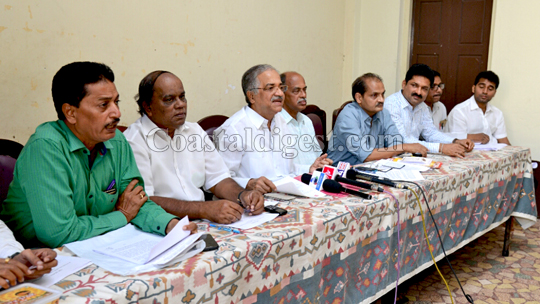
The Yettinahole Virodhi Samiti vice-president M G Hegade has challenged Sadananda Gowda and Moily to visit Sri Kshetra Dharmasthala and pass a ‘truth test’ that not a single rupee has been misappropriated with regard to the Yettinahole project.

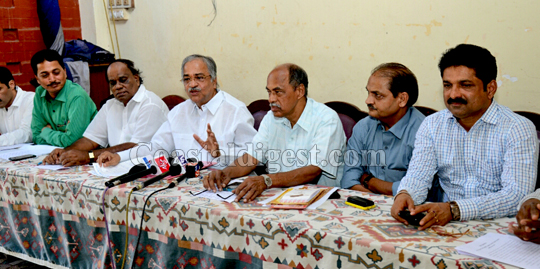
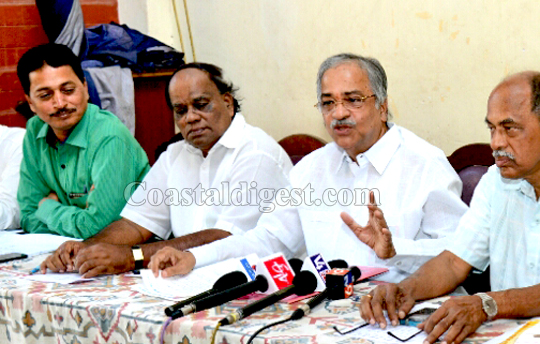
Addressing mediapersons in Mangaluru on Monday, the committee vice-president condemned the vague statements made about the committee by Sadananda Gowda. Hegade said that the Union Minister has called the Samiti members fake environmentalists. “He was unaware of the delegation led by local MP Nalin Kumar Kateel, which visited the Union Minister for Environment and the Union Minister for Water Resources. In addition, Gowda has said that the delegation has insulted him by not meeting him,” said Hegade.

“The words uttered by Sadananda Gowda are below his dignity,” said the vice-president, and urged the minister to apologise for the remarks.

Hegade further alleged that Gowda and Moily were both responsible for the implementation of the unscientific Yettinahole project. “Both the politicians have been disloyal to the people of Dakshina Kannada. While all the people of the district – including the MPs and various religious leaders – are protesting against the projects, Gowda and Moily have turned a blind eye and a deaf ear to the urges. The people of the district should banish them both from the district,” he called upon the people.

Subject expert and NITK former professor S G Mayya said that the minutes of the meeting of the Regional Empowered Committee, Regional Office (SZ), Bengaluru, on December 28, at the office of the Chief Conservator of Forests, Hassan, on Yettinahole project is full of contradictions.

The minutes also vaguely called that the meeting of the Union Ministers by K N Somashekhar and others as ‘pressure tactics’.

Criticising the matter, Mayya has said that nobody has the right to criticise the meeting of an elected representative. “The decision taken at the meeting to clear the forests in the project area is against the Forest Conservation Act. The habitat of the wild animals, the elephant corridor and the non-clearing of forests in the areas are all prone to soil erosion, but this has not been considered. Also, the environment impact report has not been submitted. The argument that only five to six hectares of forest area will be cleared for the project is far from the truth. The government has followed a Term Key Project, without inviting tenders, which will lead to devastation,” warned the former professor.

Mayya further said that the reduction in water content in the rivers will lead to an increase in the salinity of water as per the study of the National Institute of Ocean Technology (NIOT).

Leaders Vijay Kumar Shetty, Shashiraj Shetty Kolambe, Dinakar Shetty, Uttam Alva, Ramachandra Baikampadi, Hussain Katipalla and MCC Deputy Mayor Purushottam Chitrapur were present.

w1

w2

Comments

Augustus
 - 
Thursday, 4 Feb 2016

The very next time I read a website, I really hope that
it doesnt disappoint me around that one. I mean, I know
it had been my choice to learn, but I really thought youd have anything interesting
to say.

My web-site; marvel future Fight
hack online: http://www.realhacks24.com/marvel-future-fight-hack/

True teller
 - 
Tuesday, 5 Jan 2016

If any leader commits offense, it is not a crime for him. He is not unease with his action.
He has no conscience, he can swear anything.

Add new comment

  • Coastaldigest.com reserves the right to delete or block any comments.
  • Coastaldigset.com is not responsible for its readers’ comments.
  • Comments that are abusive, incendiary or irrelevant are strictly prohibited.
  • Please use a genuine email ID and provide your name to avoid reject.
News Network
July 28,2020

Bengaluru, Jul 28: In view of the COVID-19 pandemic, the Bruhat Bengaluru Mahanagara Palike (BBMP) on Monday advised people not to visit temples, mosques and other places of worship during the coming festival season.

"COVID-19 is now spreading rapidly in Karnataka, especially in Bengaluru. The festival season is starting with Varamahalakshmi festival on July 31, followed by Bakrid, Raksha Bandhan, Janmashtami, Gowri Ganesha, Moharram and then Onam. This festival season is the riskiest time for the spread of the coronavirus. Therefore, please STRICTLY follow the rules in order to stay safe. Do not visit religious places even if they are officially declared open," a notification from BBMP said.

In the context of Bakrid, unauthorised animal sacrifice (slaughtering) was prohibited in BBMP limits on roads and sidewalks, religious places, school and college premises, playgrounds and other public areas, as per the Karnataka Municipal Corporation Act of 1976.

"Unauthorised animal sacrifice (slaughtering) is a punishable offence under Section 3 of the Karnataka Prevention of Animal Sacrifices Act 1959 and Rules and the Amendment Act 1975, which provides for a maximum penalty of six months or Rs 1000, or both. According to the Karnataka Prevention of Animal Sacrifices Act 1959, slaughter-worthy animals can only be slaughtered in official slaughterhouses," the notification said.

Comments

Add new comment

  • Coastaldigest.com reserves the right to delete or block any comments.
  • Coastaldigset.com is not responsible for its readers’ comments.
  • Comments that are abusive, incendiary or irrelevant are strictly prohibited.
  • Please use a genuine email ID and provide your name to avoid reject.
News Network
June 20,2020

Bengaluru,  Jun 19: Following the coronavirus outbreak, Bengaluru's Kempegowda International Airport has introduced ultraviolet treatment while scanning outbound baggage apart from other measures to enhance passenger and staff safety.

"Two custom-designed UV tunnels have been created to disinfect trolleys after every use. Two custom-designed UV tunnels have been created to disinfect trolleys after every use. These Tunnels are located at a cordoned-off area of the Terminal," according to a statement by the Bangalore International Airport Limited (BIAL).

The airport plans to use an ultra-low volume (ULV) spray treatment for check-in bags: all outbound passenger baggage is sanitised before dispatch to the aircraft

Authorities also plan to minimise use of additional trays for footwear by introducing specially designed trays; the trays that are in use are UV treated and sanitised manually after every use.

Officials are currently in the process of implementing silver nano-coating for frequently used touchpoints for self disinfection like check-in counters, Immigration counters, ATRS trays, etc. Currently, sanitisation of high-traffic areas and frequently touched surfaces continues to be done every thirty minutes manually without disrupting the flow of passengers.

All high-traffic areas are sanitised once every three hours by using ULV machines - eight times in 24 hours.

Washrooms across the Airport premises are sanitised on a regular basis with dedicated manpower, irrespective of the frequency of use. 456 units of tabletop hand sanitiser and 107 units of sensor-based hand sanitisers have been placed across the Terminal.

120 biowaste bins located across the Airport campus enable passengers and staff to dispose of their masks, gloves and other PPE conveniently and safely. This bio-waste is managed by a dedicated team and handed over to a Pollution Control Board-approved vendor and taken away for incineration.

The Airport said that the passenger feedback for the contactless process has been positive. "The objective of the process is to minimise physical contact and enhance passenger throughput," it said.

These sanitisation measures come in light of the highly infectious COVID-19 pandemic which spreads through person-to-person contact. Small droplets from the nose or mouth can spread the virus when they land on objects and surfaces around the person.

Comments

Add new comment

  • Coastaldigest.com reserves the right to delete or block any comments.
  • Coastaldigset.com is not responsible for its readers’ comments.
  • Comments that are abusive, incendiary or irrelevant are strictly prohibited.
  • Please use a genuine email ID and provide your name to avoid reject.
Ram Puniyani
February 4,2020

As democracy is seeping in slowly all over the world, there is an organization which is monitoring the degree of democracy in the individual countries, The Economist Intelligence Unit. As such in each country there are diverse factors which on one hand work to deepen it, while others weaken it. Overall there is a march from theoretical democracy to substantive one. The substantive democracy will herald not just the formal equality, freedom and community feeling in the country but will be founded on the substantive quality of these values. In India while the introduction of modern education, transport, communication laid the backdrop of beginning of the process, the direction towards deepening of the process begins with Mahatma Gandhi when he led the non-cooperation movement in 1920, in which average people participated. The movement of freedom for India went on to become the ‘greatest ever mass movement’ in the World.

The approval and standards for democracy were enshrined in Indian Constitution, which begins ‘We the people of India’, and was adopted on 26th January 1950. With this Constitution and the policies adopted by Nehru the process of democratization started seeping further, the dreaded Emergency in 1975, which was lifted later restored democratic freedoms in some degree. This process of democratisation is facing an opposition since the decade of 1990s after the launch of Ram Temple agitation, and has seen the further erosion with BJP led Government coming to power in 2014. The state has been proactively attacking civil liberties, pluralism and participative political culture with democracy becoming flawed in a serious way. And this is what got reflected in the slipping of India by ten places, to 51st, in 2019. On the index of democracy India slipped down from the score of 7.23 to 6.90. The impact of sectarian BJP politics is writ on the state of the nation, country.

Ironically this lowering of score has come at a time when the popular protests, the deepening of democracy has been given a boost and is picking up with the Shaheen Bagh protests. The protest which began in Shaheen Bagh, Delhi in the backdrop of this Government getting the Citizenship amendment Bill getting converted into an act and mercilessly attacking the students of Jamia Milia Islamia, Aligarh Muslim University along with high handed approach in Jamia Nagar and neighbouring areas.  From 15th December 2019, the laudable protest is on.

It is interesting to note that the lead in this protest has been taken by the Muslim women, from the Burqa-Hijab clad to ‘not looking Muslim’ women and was joined by students and youth from all the communities, and later by the people from all the communities. Interestingly this time around this Muslim women initiated protest has contrast from all the protests which earlier had begun by Muslims. The protests opposing Shah Bano Judgment, the protests opposing entry of women in Haji Ali, the protests opposing the Government move to abolish triple Talaq. So far the maulanas from top were initiating the protests, with beard and skull cap dominating the marches and protests. The protests were by and large for protecting Sharia, Islam and were restricted to Muslim community participating.

This time around while Narendra Modi pronounced that ‘protesters can be identified by their clothes’, those who can be identified by their external appearance are greatly outnumbered by all those identified or not identified by their appearance.

The protests are not to save Islam or any other religion but to protect Indian Constitution. The slogans are structured around ‘Defence of democracy and Indian Constitution’. The theme slogans are not Allahu Akbar’ or Nara-E-Tadbeer’ but around preamble of Indian Constitution. The lead songs have come to be Faiz Ahmad Faiz’s ‘Hum Dekhenge’, a protest against Zia Ul Haq’s attempts to crush democracy in the name of religion. Another leading protest song is from Varun Grover, ‘Tanashah Aayenge…Hum Kagaz nahin Dikhayenge’, a call to civil disobedience against the CAA-NRC exercise and characterising the dictatorial nature of the current ruling regime.

While BJP was telling us that primary problem of Muslim women is Triple talaq, the Muslim women led movements has articulated that primary problem is the very threat to Muslim community. All other communities, cutting across religious lines, those below poverty line, those landless and shelter less people also see that if the citizenship of Muslims can be threatened because of lack of some papers, they will be not far behind in the victimization process being unleashed by this Government.

While CAA-NRC has acted as the precipitating factor, the policies of Modi regime, starting from failure to fulfil the tall promises of bringing back black money, the cruel impact of demonetisation, the rising process of commodities, the rising unemployment, the divisive policies of the ruling dispensation are the base on which these protest movements are standing. The spread of the protest movement, spontaneous but having similar message is remarkable. Shaheen Bagh is no more just a physical space; it’s a symbol of resistance against the divisive policies, against the policies which are increasing the sufferings of poor workers, the farmers and the average sections of society.

What is clear is that as identity issues, emotive issues like Ram Temple, Cow Beef, Love Jihad and Ghar Wapasi aimed to divide the society, Shaheen Bagh is uniting the society like never before. The democratisation process which faced erosion is getting a boost through people coming together around the Preamble of Indian Constitution, singing of Jan Gan Man, waving of tricolour and upholding the national icons like Gandhi, Bhagat Singh, Ambedkar and Maulana Azad. One can feel the sentiments which built India; one can see the courage of people to protect what India’s freedom movement and Indian Constitution gave them.

Surely the communal forces are spreading canards and falsehood against the protests. As such these protests which is a solid foundation of our democracy. The spontaneity of the movement is a strength which needs to be channelized to uphold Indian Constitution and democratic ethos of our beloved country.


Comments

Add new comment

  • Coastaldigest.com reserves the right to delete or block any comments.
  • Coastaldigset.com is not responsible for its readers’ comments.
  • Comments that are abusive, incendiary or irrelevant are strictly prohibited.
  • Please use a genuine email ID and provide your name to avoid reject.