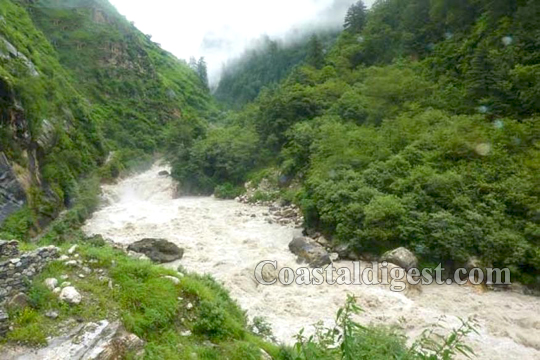
Yettinahole project a blunder; it can't quench the thirst of parched districts'

[email protected] (CD Network)
September 29, 2016

Bengaluru, Sep 29: A new study conducted by a team of the Indian Institute of Science, Bengaluru concluded that the Rs 13,000-crore Yettinahole diversion project doesn't hold much water to quench the thirst of the parched districts of Kolar, Chikkaballapur, Tumakuru and Bengaluru Rural.

Yettinahole

Headed by TV Ramachandra and comprising of experts like Barat Aithal and S Vinay, the study team after visiting spots and using the latest technology, including remote sensors, found that Yettinahole can generate only 9.5 tmcft of water against 24 tmcft as claimed by the state government which is awaiting environmental clearance to go ahead with project. The team has called the project as an "an ecological blunder".

The study, Environment Flow Assessment in a Lotic Ecosystem of Central Western Ghat, was published in international journal Hydrology Current Research. The Karnataka government, some experts and leaders seeking project implementation had slammed its earlier findings saying it lacked conviction.

The government has already spent Rs 1,690 crore for the project and set up a dedicated authority to oversee its implementation. The project is now temporarily halted following a green bench order besides widespread protests in the coastal belt as the Yettinahole project aims at diverting 24.01 tmcft of water from Nethravathi's tributaries.

The report highlights alterations in the catchment integrity (land cover) or water diversions would result in variation in the natural flow, affecting the biodiversity of the riparian and aquatic habitats, and more importantly, people's livelihood dependent on fishing in the downstream.

The sustainable option to meet water requirements in arid regions, the study points out, would be to rejuvenate existing lakes and ponds, reuse treated waste water, recharge groundwater resources, plant native species of plants in the catchment areas and implement soil and water conservation through microwatershed approaches.

Sources in the water resources department, however, said they will not give much credence to the report but wait for the one by an expert committee set up by the government. On June 9, 2016, the government formed a panel under the chairmanship of Central Water Commission former chairman A K Bajaj. "The committee met just once but nothing much has happened after that. I partly endorse the views of the fresh report prepared by IISc scientists that Yettinahole cannot generate 24 tmcft of water and it greatly affects the ecology,'' said environmentalist Yellappa Reddy.

Comments

Mahesh
 - 
Thursday, 29 Sep 2016

from the beginning only we all know about this fraud supported by congress govt to loot all public money, all corrupt politicians will die one day a dog death. so many people are working hard to get their livelihood in this.. these rich people collecting money in the name of tax and misusing for their posh life.

Add new comment

  • Coastaldigest.com reserves the right to delete or block any comments.
  • Coastaldigset.com is not responsible for its readers’ comments.
  • Comments that are abusive, incendiary or irrelevant are strictly prohibited.
  • Please use a genuine email ID and provide your name to avoid reject.
Agencies
February 6,2020

Even more than three years after demonetisation and all-out efforts to make most transactions through electronic, cash is still king, as it thrives in a digital India, said fintech start-up Paytm founder Vijay Sekhar Sharma.

"While cashless economy is not possible in India, less cash economy will be in the future. Less cash is the only solution, not the elimination of cash," Sharma told IANS in an interview after unveiling an all-in-one payment gateway on Tuesday.

Asserting that it would take 5-10 years for India to make the transition to digital payments from the traditional mode of cash, Sharma, 41, said the e-payment industry benefitted more from the November 8, 2016 note ban and withdrawal of old Rs 1,000 and Rs 500 denominations.

"I think it (demonetisation) helped the industry despite lack of specific help. But the world has changed since then. It is about the scale of distribution of merchants that is what is propelling digital payments," said Sharma.

Most of the cash not only came back into circulation, but also remains as the mode of payment for the majority due to its convenience for the people used to such transactions.

Expounding Paytm's zero service charge, Sharma said the strategy is sustainable as it leads to acquiring more customers and merchants, enabling newer business opportunities.

Paytm also does not levy a service charge to small merchants for its payments services, unlike organised players like Uber.

"Though there is a monetisation model, the merchants who are small shopkeepers, become our financial services customers as they open a bank account, which is profitable."

Paytm secured a Payments Bank license from the Reserve Bank of India to offer a savings bank account, Rupay debit card and money transfer services.

"We are banking on payment services acquiring customers and merchants who avail banking, lending, insurance, wealth and software services like billing software and business ledger software services eventually," Sharma noted.

The mobile first bank services include zero balance and zero digital transaction charge accounts.

"Basically, payments, cloud, commerce and financial services are a cohort we follow. So, payments is our customer as well as merchant acquisition. If it breaks even, we are happy because other line items make more money, he affirmed.

Noting that in a market like India, one cannot price services at a premium unlike in a developed country like the US, the billionaire businessman said a consumer in a developing country would not be able to afford such a hefty charge.

Forbes ranked Sharma as India's youngest billionaire in 2017, with a net worth of $2.1 billion.

While several countries operate on the model of higher service charges, Sharma said newer business models have to be discovered in India, as customer lifecycle value is accounted for more stages than in other nations.

Asked about an upscale retailer like Zara not giving a wallet payment option during its recent end of season sale in Bengaluru, Sharma said Paytm was addressing such hiccups with its all-in-one payment solutions.

"It's an opportunity, because if the retailer has our all-in-one point of sale machine, where in they enter the amount, it shows both the Quick Response code (QR) and card payment options," he observed.

Sharma compared older swiping payment machine to feature phones and modern ones to feature-rich smartphones.

"If you notice, they look like feature phones and the modern day card machine is more a smartphone like. You can add the smatphone components, which can add the features," reiterated Sharma.

Though Paytm's all-in-one QR point of sale machine integrates the billing system, its chief executive said it was not ideal to have an independent QR feature.

Paytm has 16 million strong merchant user base, which Sharma aims to raise to 26 million base in the next one year.

Sharma has launched in this tech city an all-in-one payment gateway and Paytm Business Payments solution, which enable digital payments through multiple methods for small and medium enterprises (SMEs) and an Android point of sale machine.

With the new gateway solution, collecting digital payments through multiple methods can be achieved seamlessly while Paytm Business Payments solution enables automated vendor payments, including employee salaries and customer refunds among others.

The One97 Communications-owned Paytm aims to help SMEs streamline and digitise their business activities using its new solutions, which enhance the overall efficiency of both accepting and making payments.

Paytm has a data bank of over 200 million saved cards and bank accounts, a feature which enables partner apps to shorten transaction times and propel faster conversions while using the all-in-one payment gateway.

Complementing the two solutions, Sharma also launched an all-in-one Android point of sale machine, which can accept payments through all forms such as cards, wallets, UPI apps and even cash.

The device has a QR code that supports all contact and contactless payments, coming with integrated billing software customized solutions for different sectors such as catering, ticketing, parking and others.

The handheld Android device is equipped with an in-built printer, scanner and can also generate bills.

Valued at $16 billion, Paytm is not alone in the fiercely competitive Indian fintech space where a dozen players like PhonePe, MobiKwik, Kotak 811 and deep pocketed international giants Google Pay and Amazon Pay are in the fray.


Comments

Add new comment

  • Coastaldigest.com reserves the right to delete or block any comments.
  • Coastaldigset.com is not responsible for its readers’ comments.
  • Comments that are abusive, incendiary or irrelevant are strictly prohibited.
  • Please use a genuine email ID and provide your name to avoid reject.
News Network
April 3,2020

Mysuru/Chamarajanagara, Apr 3: In order to prevent the transmission of Novel Coronavirus though overcrowding, the central jails in Mysuru and Chamarajanagar have begun releasing some of their inmates.

As many as 55 undertrials and convicts were released from Mysuru jail since the last two days, while 18 were released from the prison in Chamarajanagar. The jail inmates had been released on interim bail, for a period of two months.

While the undertrials were facing charges that involved a maximum prison term of seven years, the convicts were facing criminal miscellaneous cases of the family court. Most of the convicts released were prisoners who had not paid the maintenance costs ordered by the family courts in divorce cases.

Comments

Add new comment

  • Coastaldigest.com reserves the right to delete or block any comments.
  • Coastaldigset.com is not responsible for its readers’ comments.
  • Comments that are abusive, incendiary or irrelevant are strictly prohibited.
  • Please use a genuine email ID and provide your name to avoid reject.
News Network
July 14,2020

Bengaluru, July 14: The Karnataka government has allowed some relaxations during the week-long lockdown in Bengaluru urban and rural districts. The lockdown will commence from 8p.m. today (July 14) and end at 5a.m. on July 22.  The government has released the guidelines for lockdown.

Restrictions

*No new flights or trains will be permitted; only flights and trains already scheduled will continue to operate. Flight and train tickets shall serve as passes for movement by taxis/cab aggregators/auto rickshaws.

* Metro rail services prohibited

* Taxis and services of cab aggregators will be prohibited except for emergency and as permitted in guidelines.

* Schools, colleges, educational/training/coaching institutions etc. will remain closed. Online/distance learning shall continue to be permitted. Examination already scheduled shall be permitted

* Hotels, restaurants, and hospitality services, prohibited except those meant for health/police/government officials/healthcare workers. Hotels and restaurants shall be permitted to operate kitchens for takeaway/home delivery of food items only.

* All cinema halls, shopping malls, gymnasiums, sports complexes, stadia, swimming pools, entertainment parks, theatres, bars and auditoriums, assembly halls and similar places.

* All social/political/sports/entertainment/academic/cultural religious functions/other gatherings and large congregations.

* All religious places/places of worship shall be closed for public. Religious congregations are strictly prohibited. Commercial and private establishment shall be closed down

Relaxations (outside containment zone)

* Shops including ration shops (PDS), dealing with food, groceries, fruits and vegetables, etc. to open only from 5 am to 12 noon. Home delivery of essential items shall be encouraged.

* All facilities in the supply chain of essential goods, whether involved in manufacturing, wholesale or retail of such goods through local stores, large brick and mortar stores or e-commerce companies.

* All food processing and related industries.

* Banks, insurance offices and ATM.

* Print and electronic media.

* Telecommunication, internet services, broadcasting and cable services, IT and IT-enabled services with minimum staff for essential purposes. As far as possible, work from home should be encouraged.

* Delivery of essential items such as food, medicines, pharmaceuticals, medical equipment through e-commerce.

* Power generation, transmission and distribution units and services.

* Capital and debt market services and notified by the Securities and Exchange Board of India (Sebi)

* Cold storage and warehousing services.

* Private security services.

* Delivery of goods by E-Commerce companies. Industries/industrial establishments as listed below will be allowed to operate (outside containment zones):

i. Production units which require continuous process, and their supply chain.

ii. Food processing industries, manufacturing of essential goods, including drugs, pharmaceuticals, medical devices, their raw material and intermediates.

iii. Manufacturing of packing materials.

iv. Manufacturing and other industrial establishment with access control in Special Economic Zones (SEZs) or outside municipal limits and Export Oriented Units (EoUs), Industrial townships. Construction activities will be allowed in continuation of works in construction projects, where workers are available on site.

Comments

Add new comment

  • Coastaldigest.com reserves the right to delete or block any comments.
  • Coastaldigset.com is not responsible for its readers’ comments.
  • Comments that are abusive, incendiary or irrelevant are strictly prohibited.
  • Please use a genuine email ID and provide your name to avoid reject.