


Yettinahole project a blunder; it can't quench the thirst of parched districts'

[email protected] (CD Network)
September 29, 2016

Bengaluru, Sep 29: A new study conducted by a team of the Indian Institute of Science, Bengaluru concluded that the Rs 13,000-crore Yettinahole diversion project doesn't hold much water to quench the thirst of the parched districts of Kolar, Chikkaballapur, Tumakuru and Bengaluru Rural.
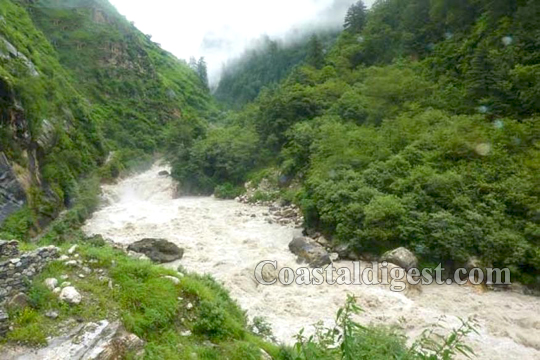
Yettinahole

Headed by TV Ramachandra and comprising of experts like Barat Aithal and S Vinay, the study team after visiting spots and using the latest technology, including remote sensors, found that Yettinahole can generate only 9.5 tmcft of water against 24 tmcft as claimed by the state government which is awaiting environmental clearance to go ahead with project. The team has called the project as an "an ecological blunder".

The study, Environment Flow Assessment in a Lotic Ecosystem of Central Western Ghat, was published in international journal Hydrology Current Research. The Karnataka government, some experts and leaders seeking project implementation had slammed its earlier findings saying it lacked conviction.

The government has already spent Rs 1,690 crore for the project and set up a dedicated authority to oversee its implementation. The project is now temporarily halted following a green bench order besides widespread protests in the coastal belt as the Yettinahole project aims at diverting 24.01 tmcft of water from Nethravathi's tributaries.

The report highlights alterations in the catchment integrity (land cover) or water diversions would result in variation in the natural flow, affecting the biodiversity of the riparian and aquatic habitats, and more importantly, people's livelihood dependent on fishing in the downstream.

The sustainable option to meet water requirements in arid regions, the study points out, would be to rejuvenate existing lakes and ponds, reuse treated waste water, recharge groundwater resources, plant native species of plants in the catchment areas and implement soil and water conservation through microwatershed approaches.

Sources in the water resources department, however, said they will not give much credence to the report but wait for the one by an expert committee set up by the government. On June 9, 2016, the government formed a panel under the chairmanship of Central Water Commission former chairman A K Bajaj. "The committee met just once but nothing much has happened after that. I partly endorse the views of the fresh report prepared by IISc scientists that Yettinahole cannot generate 24 tmcft of water and it greatly affects the ecology,'' said environmentalist Yellappa Reddy.

Comments

Mahesh
 - 
Thursday, 29 Sep 2016

from the beginning only we all know about this fraud supported by congress govt to loot all public money, all corrupt politicians will die one day a dog death. so many people are working hard to get their livelihood in this.. these rich people collecting money in the name of tax and misusing for their posh life.

Add new comment

  • Coastaldigest.com reserves the right to delete or block any comments.
  • Coastaldigset.com is not responsible for its readers’ comments.
  • Comments that are abusive, incendiary or irrelevant are strictly prohibited.
  • Please use a genuine email ID and provide your name to avoid reject.
Agencies
June 30,2020

Washington, Jun 30: Researchers in China have discovered a new type of swine flu that is capable of triggering a pandemic, according to a study published Monday in the US science journal PNAS.

Named G4, it is genetically descended from the H1N1 strain that caused a pandemic in 2009.

It possesses "all the essential hallmarks of being highly adapted to infect humans," say the authors, scientists at Chinese universities and China's Center for Disease Control and Prevention.

The researchers then carried out various experiments including on ferrets, which are widely used in flu studies because they experience similar symptoms to humans -- principally fever, coughing and sneezing. 

G4 was observed to be highly infectious, replicating in human cells and causing more serious symptoms in ferrets than other viruses.

Tests also showed that any immunity humans gain from exposure to seasonal flu does not provide protection from G4.

According to blood tests which showed up antibodies created by exposure to the virus, 10.4 percent of swine workers had already been infected.

The tests showed that as many as 4.4 percent of the general population also appeared to have been exposed.

The virus has therefore already passed from animals to humans but there is no evidence yet that it can be passed from human to human -- the scientists' main worry.

"It is of concern that human infection of G4 virus will further human adaptation and increase the risk of a human pandemic," the researchers wrote.

The authors called for urgent measures to monitor people working with pigs.

"The work comes as a salutary reminder that we are constantly at risk of new emergence of zoonotic pathogens and that farmed animals, with which humans have greater contact than with wildlife, may act as the source for important pandemic viruses," said James Wood, head of the department of veterinary medicine at Cambridge University.

A zoonotic infection is caused by a pathogen that has jumped from a non-human animal into a human.

Comments

Add new comment

  • Coastaldigest.com reserves the right to delete or block any comments.
  • Coastaldigset.com is not responsible for its readers’ comments.
  • Comments that are abusive, incendiary or irrelevant are strictly prohibited.
  • Please use a genuine email ID and provide your name to avoid reject.
News Network
July 31,2020

Bengaluru, Jul 31: An ambulance driver was thrashed by the family members of a 75-year-old COVID-19 patient who passed away on his way to the hospital in Bengaluru on Thursday.

The incident happened after the patient died in the ambulance while waiting in front of the MS Ramaiah Hospital in Bengaluru.

The driver was dragged out of the ambulance and chased around by a relative.

His clothes were ripped off and harangue were hurled at him. The relative was seen shouting and blaming the driver for the patient's death.

Speaking to news agency, the driver said that he was unable to explain the sequence of the protocol which was to be followed while getting the patient to the treatment ward.

Karnataka is one of the worst-affected states by the coronavirus pandemic. According to the Union Ministry of Health and Family Welfare, the state has 67,456 active cases as of Friday.

The state government has been struggling to contain the spread of the disease as it has intermittently imposed and eased lockdown measures, especially in the capital Bengaluru.

Comments

Add new comment

  • Coastaldigest.com reserves the right to delete or block any comments.
  • Coastaldigset.com is not responsible for its readers’ comments.
  • Comments that are abusive, incendiary or irrelevant are strictly prohibited.
  • Please use a genuine email ID and provide your name to avoid reject.
News Network
January 6,2020

Bengaluru, Jan 6: Activist Irom Chanu Sharmila took part in a protest against the Citizenship Amendment Act (CAA), National Register of Citizens (NRC) and National Population Register (NPR) at Sir Puttanna Chetty Town Hall here on Sunday.

Sharmila, who came in the protest along with her child, took part in a 'burqa and bindi' protest marking the birth anniversary of social reformer Savitribai Phule.

Protests have erupted across the country over the CAA which grants citizenship to Hindu, Sikh, Jain, Parsi, Buddhist, and Christian refugees from Pakistan, Afghanistan, and Bangladesh, who came to India on or before December 31, 2014.

Comments

Add new comment

  • Coastaldigest.com reserves the right to delete or block any comments.
  • Coastaldigset.com is not responsible for its readers’ comments.
  • Comments that are abusive, incendiary or irrelevant are strictly prohibited.
  • Please use a genuine email ID and provide your name to avoid reject.