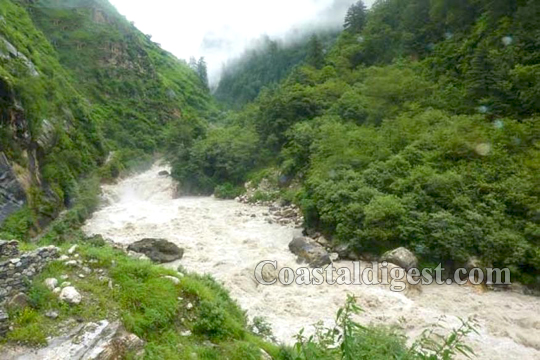
Yettinahole project a blunder; it can't quench the thirst of parched districts'

[email protected] (CD Network)
September 29, 2016

Bengaluru, Sep 29: A new study conducted by a team of the Indian Institute of Science, Bengaluru concluded that the Rs 13,000-crore Yettinahole diversion project doesn't hold much water to quench the thirst of the parched districts of Kolar, Chikkaballapur, Tumakuru and Bengaluru Rural.

Yettinahole

Headed by TV Ramachandra and comprising of experts like Barat Aithal and S Vinay, the study team after visiting spots and using the latest technology, including remote sensors, found that Yettinahole can generate only 9.5 tmcft of water against 24 tmcft as claimed by the state government which is awaiting environmental clearance to go ahead with project. The team has called the project as an "an ecological blunder".

The study, Environment Flow Assessment in a Lotic Ecosystem of Central Western Ghat, was published in international journal Hydrology Current Research. The Karnataka government, some experts and leaders seeking project implementation had slammed its earlier findings saying it lacked conviction.

The government has already spent Rs 1,690 crore for the project and set up a dedicated authority to oversee its implementation. The project is now temporarily halted following a green bench order besides widespread protests in the coastal belt as the Yettinahole project aims at diverting 24.01 tmcft of water from Nethravathi's tributaries.

The report highlights alterations in the catchment integrity (land cover) or water diversions would result in variation in the natural flow, affecting the biodiversity of the riparian and aquatic habitats, and more importantly, people's livelihood dependent on fishing in the downstream.

The sustainable option to meet water requirements in arid regions, the study points out, would be to rejuvenate existing lakes and ponds, reuse treated waste water, recharge groundwater resources, plant native species of plants in the catchment areas and implement soil and water conservation through microwatershed approaches.

Sources in the water resources department, however, said they will not give much credence to the report but wait for the one by an expert committee set up by the government. On June 9, 2016, the government formed a panel under the chairmanship of Central Water Commission former chairman A K Bajaj. "The committee met just once but nothing much has happened after that. I partly endorse the views of the fresh report prepared by IISc scientists that Yettinahole cannot generate 24 tmcft of water and it greatly affects the ecology,'' said environmentalist Yellappa Reddy.

Comments

Mahesh
 - 
Thursday, 29 Sep 2016

from the beginning only we all know about this fraud supported by congress govt to loot all public money, all corrupt politicians will die one day a dog death. so many people are working hard to get their livelihood in this.. these rich people collecting money in the name of tax and misusing for their posh life.

Add new comment

  • Coastaldigest.com reserves the right to delete or block any comments.
  • Coastaldigset.com is not responsible for its readers’ comments.
  • Comments that are abusive, incendiary or irrelevant are strictly prohibited.
  • Please use a genuine email ID and provide your name to avoid reject.
Ram Puniyani
June 29,2020

In Minneapolis, US an African American, George Floyd lost his life as the white policeman, Derek Chauvin, caught hold of him and put his knee on his neck. This is a technique developed by Israel police. For nine long minutes the knee of the while policeman was on the neck of George, who kept shouting, I can’t breathe.

Following this gruesome murder America erupted with protests, ‘Black lives matter’. The protestors were not just African Americans but also a large section of whites. Within US one police Chief apologized for the act of this. In a touching gesture of apology the police force came on its knees. This had reverberations in different parts of the World.

The act was the outcome of the remnants of the racial hatred against blacks by the whites. It is the hatred and the perceptions which are the roots of such acts of violence. What was also touching that the state of democracy in US is so deep that even the police apologized, the nation, whites and blacks, stood up as a sensitive collective against this violence.

US is not the only country where the brutal acts of violence torment the marginalized sections of society. In India there is a list of dalits, minorities and adivasis who are regularly subjected to such acts. But the reaction is very different. We have witnessed the case of Tabrez Ansari, who was tied to the pole by the mob and beaten ruthlessly. When he was taken to police station, police took enough time to take him to hospital and Tabrez died.

Mohsin Sheikh, a Pune techie was murdered by Hindu Rashtra Sena mob, the day Modi came to power in 2014. Afrazul was killed by Shambhulal Regar, videotaped the act released on social media. Regar believed that Muslims are indulging in love Jihad, so deserve such a fate. Mohammad Akhlaq is one among many names who were mob lynched on the issue of beef cow. The list can fill pages after pages.

Recently a young dalit boy was shot dead for the crime of entering a temple. In Una four dalits were stripped above waste and beaten mercilessly. Commenting on this act the Union Minister Ramvilas Paswan commented that it is a minor incident. Again the list of atrocities against dalits is long enough. The question is what Paswan is saying is the typical response to such gruesome murders and tortures. In US loss of one black life, created the democratic and humane response. In India there is a general silence in response to these atrocities. Some times after a good lapse of time, the Prime Minister will utter, ‘Mother Bharati has lost a son’. Most of the time victim is blamed. Some social groups raise their voice in some fora but by and large the deafening silence from the country is the norm.

India is regarded as the largest democracy. Democracy is the rule of law, and the ground on which the injustices are opposed. In America though the present President is insensitive person, but its institutions and processes of democratic articulations are strong. The institutions have deepened their roots and though prejudices may be guiding the actions of some of the officers like the killer of George, there are also police officers who can tell their President to shut up if he has nothing meaningful to say on the issue. The prejudices against Blacks may be prevalent and deep in character, still there are large average sections of society, who on the principles of ‘Black lives matter’. There are large sections of vocal population who can protest the violation of basic norms of democracy and humanism.

In India by contrast there are multiple reasons as to why the lives of Tabrez Ansari, Mohammad Akhlaq, Una dalit victims and their likes don’t matter. Though we claim that we are a democracy, insensitivity to injustices is on the rise. The strong propaganda against the people from margins has become so vicious during last few decades that any violence against them has become sort of a new normal. The large populace, though disturbed by such brutalities, is also fed the strong dose of biases against the victims. The communal forces have a great command over effective section of media and large section of social media, which generates Hate against these disadvantaged groups, thereby the response is muted, if at all.

As such also the process of deepening of our democracy has been weak. Democracy is a dynamic process; it’s not a fixed entity. Decades ago workers and dalits could protest for their rights. Now even if peasants make strong protests, dominant media presents it as blocking of traffic! How the roots of democracy are eroded and are visible in the form where the criticism of the ruling dispensation is labelled as anti National..

Our institutions have been eroded over a period of time, and these institutions coming to the rescue of the marginalized sections have been now become unthinkable. The outreach of communal, divisive ideology, the ideology which looks down on minorities, dalits and Adivasis has risen by leaps and bounds.

The democracy in India is gradually being turned in to a hollow shell, the rule of law being converted in to rule of an ideology, which does not have faith in Indian Constitution, which looks down upon pluralism and diversity of this country, which is more concerned for the privileges of the upper caste, rich and affluent. The crux of the matter is the weak nature of democracy, which was on way to become strong, but from decades of 1980s, as emotive issues took over, the strength of democracy started dwindling, and that’s when the murders of the types of George Floyd, become passé. One does complement the deeper roots of American democracy and its ability to protect the democratic institutions, which is not the case in India, where protests of the type, which were witnessed after George Floyd’s murder may be unthinkable, at least in the present times. 

Comments

Add new comment

  • Coastaldigest.com reserves the right to delete or block any comments.
  • Coastaldigset.com is not responsible for its readers’ comments.
  • Comments that are abusive, incendiary or irrelevant are strictly prohibited.
  • Please use a genuine email ID and provide your name to avoid reject.
News Network
February 11,2020

Bengaluru, Feb 11: A 36-year-old woman who fought back after being stabbed eight times by a helmet-clad intruder succumbed to injuries at a hospital.

Susheela was in shock after she pulled off the attacker’s helmet as it was her own brother-in-law. Before breathing her last, she explained the sequence of events to the police.

She said her brother-in-law attacked her because he was eyeing their ancestral property worth over Rs 10 crore. “Susheela put up a stiff resistance and identified her assailant. But the stab injuries proved to be fatal,” said a police officer. Based on her statement, Ananth Kumar, 42, was arrested on murder charges.

The attack occurred on February 7 at Honaganahatti village in Tavarekere, off Magadi Road. Susheela, whose husband Gangaraju died in a road accident 12 years ago, was living with her 14-year-old daughter and 75-year-old mother, Rudramma.

On Friday, her daughter had gone to school and Rudramma was sitting outside the house when a man walked in wearing a full-faced helmet and attacked Susheela with a knife. She defended herself with a stick used for making ragi balls and by throwing chilli powder at his face. But the attacker stabbed her on the hand, neck and head. He fled when Susheela identified him and raised an alarm. Neighbours rushed her to a hospital.

During questioning, Kumar reportedly confessed to the crime, saying he wanted to get rid of her as she was not agreeing to sell five acres of their ancestral property.

Susheela’s nephew Kiran G said: “The family owned six acres. Kumar sold one acre for Rs 50 lakh a few years ago after convincing Susheela. He, however, paid her only Rs 5 lakh. Lately, he was pestering Susheela to sell the remaining land as buyers were ready to pay Rs 2.5 crore per acre. But she was hesitating as she had been cheated by him earlier.”

Police are now examining the circumstances under which Gangaraju was killed. “We learnt the driver who had been arrested in connection with Gangaraju’s accident is currently working with Kumar,” said an officer.

Comments

Add new comment

  • Coastaldigest.com reserves the right to delete or block any comments.
  • Coastaldigset.com is not responsible for its readers’ comments.
  • Comments that are abusive, incendiary or irrelevant are strictly prohibited.
  • Please use a genuine email ID and provide your name to avoid reject.
Agencies
June 10,2020

Bengaluru, Jun 10: The Karnataka Anti-Corruption Bureau on Wednesday conducted raids at 14 places linked to four government officials in the state.

On receiving received credible information about the officials amassing disproportionate assets, an illegal assets case was registered and raids are being conducted at 14 places linked to them, ACB said in a release.

It said the raids are still on and investigation is being carried out about their assets.

Raids are being conducted on properties linked to L Sathish Kumar, Additional Commissioner, Department of Commercial Tax; N Ramakrishna, Divisional Forest Officer, Srinivasapura, Kolar; Gopalshetty Mallikarjuna, Executive Engineer, District Development Cell, Raichur; Raghappa Lalappa Lamani, Krishna Bhagya Jala Nigam Ltd official in Almatti, Bagalkote, the release said.

Comments

Add new comment

  • Coastaldigest.com reserves the right to delete or block any comments.
  • Coastaldigset.com is not responsible for its readers’ comments.
  • Comments that are abusive, incendiary or irrelevant are strictly prohibited.
  • Please use a genuine email ID and provide your name to avoid reject.