Yogi govt to act against madrasas, where national anthem wasn't sung

Agencies
August 16, 2017

Lucknow, Aug 16: The Uttar Pradesh government is contemplating stern action against 'madrasas' (Islamic Seminaries), where the national anthem was not sung during the Independence Day celebrations on Tuesday in defiance of its directives.

According to the sources here on Tuesday, the government has taken a strong view of the reports that national anthem had not been sung at many 'madrasas', especially those owing allegiance to the Barelvi school of Islamic thought.

''We have received complaints from various quarters that national anthem was not sung at several madrasas,'' said a senior official of the education department here.

The education department would also conduct a probe into the complaints, he said.

''We have asked the complainants to furnish proof in support of their allegation,'' the official said adding that stern action would be taken against the erring madrasas.

Sources said that Tricolour was unfurled at the madrasas but the students did not sing the national anthem despite being made mandatory by the Yogi Adityanath government.

Reports said that instead of the national anthem, the students of the 'madrasas' sang 'sare Jahan seAchha Hindostan Hamara', penned by the famous Urdu poet Mohammed Iqbal.

The managers of these madrasas also did not conduct video recording of the I-Day celebrations, which had also been made mandatory by the state government.

The managers defended their decision not to sing national anthem saying that some of the lines in it were not in accordance with the tenets of Islam.

The clerics owing allegiance to the Barelvi sect had earlier made it clear that neither National Anthem nor ‘Vande Mataram’ would be sung in the ‘Madarsas’ affiliated with them.

The state government had, in a circular issued to all the 'madrasas', directed them to unfurl the Tricolour followed by the recital of the national anthem and national song. The government also directed the ‘madarsas’ to conduct videography of the entire program and submit the video and pictures to the concerned government official.

Comments

Hot & Fair
 - 
Thursday, 17 Aug 2017

He in imposing his thought by force. The constitution does not allow anyone to force to do so (to sing).

The meanings in those songs are against islamic teachings which is contracdicting Oneness of God.

Islam forbids to worship the concept of  multiple God. This type of worship is UNFORGIVABLE BIGGEST SIN.


Unfortunately Hindus also say 1God but worshipping crores of Gods, which does not make any sense.

Islam condemns such imposition on Muslims by any one,  whoever tries to impose his own ideas.

Muslims will not allow anyone to force them to follow their faiths. They will not succeed in doing it.  If trying to impose they have to PAY DEARLY.


Add new comment

  • Coastaldigest.com reserves the right to delete or block any comments.
  • Coastaldigset.com is not responsible for its readers’ comments.
  • Comments that are abusive, incendiary or irrelevant are strictly prohibited.
  • Please use a genuine email ID and provide your name to avoid reject.
coastaldigest.com news network
August 8,2020

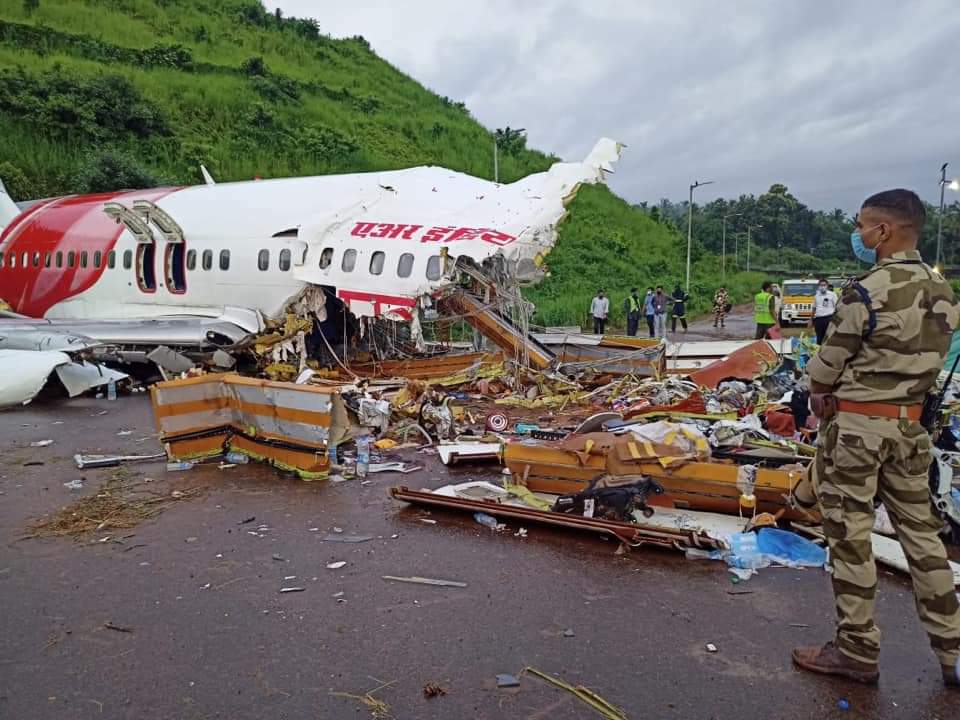
Kozhikode, Aug 8: A tailwind or crosswind could be the reason for the Air India Express flight mishap at Kozhikode international airport in Kerala, according to some aviation experts. 

Team of DGCA and AIE already reached the spot. With the death of the captain and co-pilot in the mishap, the investigation would be focusing mainly on the voice recorders and other technical aspects.

It is learnt that the ill-fated aircraft, IX 1344 with 190 onboard including crew, was initially planning to land on runway-28 of the airport. But later the pilot opted runway-10 which is toward the other direction. Pilots would be taking the decisions on the basis of inputs from ATC.

The questions now doing the rounds are what made the pilot opt runway-10 and whether the tabletop runway lacked adequate safety parameters.

An aviation expert, who didn't want to be quoted, said that Capt Deepak Sathe, who was commandeering the aircraft, was a well-experienced pilot and was also familiar with the terrains. Hence the chances of any error from his part was very unlikely. Hence a fair in-depth probe was required to find the exact cause.

Though the Kozhikode airport has an Instrument Landing System, it was of category-I for which pilot's visibility is very crucial toward a touchdown. Since it is a tabletop airport and rough weather prevailing in the region, the chances of tailwind was also high, said sources.

There had been safety concerns about the airport over quite some time. In 2011 aviation safety consultant captain Mohan Ranganathan reportedly gave a report citing the safety issues, especially the buffer zones at the end of the runway.

However, an AAI officer said that rectification steps were already done by last year by widening the Runway End Safety Area (RESA) from 90 metre to 240 metre. However, the length of the runway had to be reduced to 2,700 metre from 2,850. The AAI was also constantly pressing for increasing the runway length to 3,150 metres. But that was getting delayed due to land acquisition issues pending with the state government.

stm88 info live rtp slot

slot auto scatter hitam

Comments

Add new comment

  • Coastaldigest.com reserves the right to delete or block any comments.
  • Coastaldigset.com is not responsible for its readers’ comments.
  • Comments that are abusive, incendiary or irrelevant are strictly prohibited.
  • Please use a genuine email ID and provide your name to avoid reject.
News Network
April 14,2020

Thiruvananthapuram, Apr 14: Only three fresh COVID-19 cases were reported in Kerala on April 13, while 19 confirmed patients, who were undergoing treatment, tested negative for the infection, according to the COVID-19 Outbreak Control and Prevention State Cell, Health and Family Welfare Department, Kerala government.

As of Monday evening, there are just 178 positive COVID-19 cases in the State.

Twelve patients from Kasargod district, three each from Pathanamthitta and Thrissur districts, and one from Kannur district are among those who have recovered from COVID-19 and tested negative.

To date, there have been a total of 378 confirmed cases of coronavirus in Kerala.
Meanwhile, Kerala Chief Minister Pinarayi Vijayan has demanded that State Relief Funds be made eligible for Corporate Social Responsibility (CSR) funding by making changes to the Companies Act.

Addressing the media, the Chief Minister said, "The Government of Kerala is of the opinion that contributions to the Chief Minister's Disaster Relief Funds should be included as an eligible expenditure under CSR. In a federal setup, the Relief Funds set up by the States for a public purpose cannot be excluded from the eligibility criteria when the same is available for a Central Fund set up with similar objectives and aims."

The Kerala CM said that he has written to the Prime Minister in this regard urging him to make the necessary changes.

Vijayan once again reiterated the demand of the State government to bring back stranded Keralites from overseas and added that, "We will extend all possible help and support to the Pravasi Malayalees when they come back also including rehabilitation of those who would lose their jobs in the backdrop of the pandemic outbreak."

He added that a decision on extending the lockdown in the State will be taken after taking into account the decision of the Central government in the address by the Prime Minister scheduled for April 14.

Comments

AJS
 - 
Tuesday, 14 Apr 2020

HATS-OFF TO BOLD CHIEF MINISTER OF KERALA MR. VIJAYAN... BAHUBALI

THE ONLY CHIEF MINISTER TO APPROACH GCC FOR HIS PEOPLE.... A ROLL MODEL FOR OTHER STATES AND CENTER

Add new comment

  • Coastaldigest.com reserves the right to delete or block any comments.
  • Coastaldigset.com is not responsible for its readers’ comments.
  • Comments that are abusive, incendiary or irrelevant are strictly prohibited.
  • Please use a genuine email ID and provide your name to avoid reject.
News Network
February 19,2020

New Delhi, Feb 19: India will switch to the world's cleanest petrol and diesel from April 1 as it leapfrogs straight to Euro-VI emission compliant fuels from Euro-IV grades now - a feat achieved in just three years and not seen in any of the large economies around the globe.

India will join the select league of nations using petrol and diesel containing just 10 parts per million of sulphur as it looks to cut vehicular emissions that are said to be one of the reasons for the choking pollution in major cities.

Sanjiv Singh, Chairman of Indian Oil Corp (IOC) - the firm that controls roughly half of the country's fuel market, said almost all refineries began producing ultra-low sulphur BS-VI (equivalent to Euro-VI grade) petrol and diesel by the end of 2019 and oil companies have now undertaken the tedious task of replacing every drop of fuel in the country with the new one.

"We are absolutely on track for supplying BS-VI fuel from April 1. Almost all refineries have begun supplying BS-VI fuel and the same has reached storage depots across the country," he said.

From storage depots, the fuel has started travelling to petrol pumps and in the next few weeks all of them will only have BS-VI grade petrol and diesel, he said. "We are 100 per cent confident that fuel that will flow from nozzles at all the petrol pumps in the country on April 1 will be BS-VI emission compliant fuel."

India adopted Euro-III equivalent (or Bharat Stage-III) fuel with a sulphur content of 350 ppm in 2010 and then took seven years to move to BS-IV that had a sulphur content of 50 ppm. From BS-IV to BS-VI it took just three years.

"It was a conscious decision to leapfrog to BS-VI as first upgrading to BS-V and then shifting to BS-VI would have prolonged the journey to 4 to 6 years. Besides, oil refineries, as well as automobile manufacturers, would have had to make investments twice - first to producing BS-V grade fuel and engines and then BS-VI ones," he said.

State-owned oil refineries spent about Rs 35,000 crore to upgrade plants that could produce ultra-low sulphur fuel. This investment is on top of Rs 60,000 crore they spent on refinery upgrades in the previous switchovers.

BS-VI has a sulphur content of just 10 ppm and emission standards are as good as CNG.

Originally, Delhi and its adjoining towns were to have BS-VI fuel supplies by April 2019 and the rest of the country was to get same supplies from April 2020.

But oil marketing companies switched over to supply of BS-VI grade fuels in the national capital territory of Delhi on April 1, 2018.

The supply of BS-VI fuels was further extended to four contiguous districts of Rajasthan and eight of Uttar Pradesh in the National Capital Region (NCR) on April 1, 2019, together with the city of Agra.

BS-VI grade fuels were made available in 7 districts of Haryana from October 1, 2019.

Singh said the new fuel will result in a reduction in NOx in BS-VI compliant vehicles by 25 per cent in petrol cars and by 70 per cent in diesel cars.

The switchover, he said, is a tedious task as every drop of old, higher-sulphur content fuel has to be flushed out in depots, pipelines and tanks before being replaced by BS-VI.

"We are confident of disruption-free switchover to BS-VI supplies across the country," he said. "What we will be supplying is the best quality available anywhere in the world. You don't have any better fuel that is supplied in any part of the world. Perhaps our BS-VI fuel will be better than equivalent fuel in some parts of the US and Europe."

India adopted a fuel upgradation programme in the early 1990s. Low lead gasoline (petrol) was introduced in 1994 in Delhi, Mumbai, Kolkata and Chennai. On February 1, 2000, unleaded gasoline was mandated nationwide.

Similarly, BS-2000 (Euro-I equivalent, BS-1) vehicle emission norms were introduced for new vehicles from April 2000. BS-II (Euro-II equivalent) emission norms for new cars were introduced in Delhi from 2000 and extended to the other metro cities in 2001.

Benzene limits have been reduced progressively from 5 per cent in 2000 to 1 per cent nationwide. Lead content in gasoline was removed in phases and only unleaded gasoline is being produced and sold from February 1, 2000.

The octane number of gasoline signifies the improved performance of the engine. Loss in octane number due to phasing out of lead was made up by installing new facilities in the refinery and changes in refinery operation. RON (Research Octane Number) of gasoline for BS-2000 spec was increased to 88. This has over time been increased to 91.

Singh said sulphur reduction will reduce Particulate Matter (PM) emissions even in the in-use older generation diesel vehicles.


Comments

Add new comment

  • Coastaldigest.com reserves the right to delete or block any comments.
  • Coastaldigset.com is not responsible for its readers’ comments.
  • Comments that are abusive, incendiary or irrelevant are strictly prohibited.
  • Please use a genuine email ID and provide your name to avoid reject.