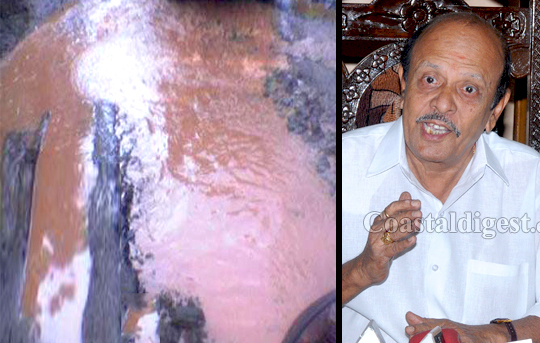
Your giant vehicles spoiled Suratkal-Kana road; repair it now: Mayor to MRPL

[email protected] (CD Network)
October 5, 2016

Mangaluru: Oct 5: Holding giant vehicles operating to and from Mangalore Refinery and Petrochemicals Ltd responsible for the pathetic condition of the Suratkal-Kana-MRPL Road, Mangaluru Mayor Harinath has exhorted the subsidiary of ONGC to take up the repair works.

mayor3

Speaking to media persons here, Mr Harinath said that he set a deadline of 20 days for MRPL. “The 4.5-km stretch from Suratkal to Kana towards MRPL is dilapidated due to the heavy motor vehicles that use the stretch. It will cost not less than Rs 3 crore, and it would be better the authorities concerned take up the works themselves,” he said.

He also said that the city corporation did not have enough fund to be spent on it. The company should use its corporate social responsibility fund for the purpose.

"I have written letters to MRPL management, Karnataka chief minister and Dakshina Kannada deputy commissioner in this regard," Harinath said, adding the under secretary to the CM has directed the DC to take suitable action in this regard. "I am hopeful that the DC will direct the MRPL authorities to take action," Harinath said.

He also warned that councillors of the Mangaluru city corporation would protest against the MRPL for not repairing the road. “Some organisations are planning to stage a protest over the issue on October 6. I, along with all the corporators, will join the protest, if the MRPL?authorities continue to remain nonchalant,” he said.

Also Read: Sorry, no money to repair Suratkal-Kana road: MRPL replies to MCC

Comments

Satyameva jayate
 - 
Wednesday, 5 Oct 2016

Smart administration would do the required work done and send a bill to MRPL......and give them a deadline to pay or face closure consequences......

Karthik
 - 
Wednesday, 5 Oct 2016

i request mayor to please do the road work soon, its a totally waste to wait for MRPL to do the work, they will file the case to sc and road work will be pending for almost 20years,

ganesh
 - 
Wednesday, 5 Oct 2016

yenchi savuda road marre, bega sama manpule pokadijjandala yerda yerda nattunek, kass ejjida bele ejjandina employees deppule.

Harinakshi
 - 
Wednesday, 5 Oct 2016

really a worst road

jeevan
 - 
Wednesday, 5 Oct 2016

ora bega sama manpule MRPL dakulu road g kass paduna athete undu.

Rakshith
 - 
Wednesday, 5 Oct 2016

It's true that MRPL vehicles are doing most damages to this road and it's their social responsibility to keep this road safe and drive worthy..coz of MRPL, locals suffered lot..atleast this much favor MRPL should do..

Mayor Saab dont forget that this road is part of MANAGALORE corporation and locals pay tax to corporation,,so atleast you have to repair it temporarily until MRPL fix it for permanently. now its condition is pathetic...and need all elected members to push MRPL to do the needful immediately. Both our MP & MLA are in deep sleep..pour some water on them also so that let them wake up..

Indian
 - 
Wednesday, 5 Oct 2016

Good move Mr. Harinath, rather after 20 days don't let the vehicle going to and from of MRPL to use the road unless cleared by MRPL.

Narasimha Shenoy
 - 
Wednesday, 5 Oct 2016

good move this plan should be implemented everywhere, and more thing i agree they used road more in that location so it got damaged, what about the normal two wheeler and all like time road tax u will receive and vehicle will not run that much whatever u charge is more than that, always common people suffer.

Add new comment

  • Coastaldigest.com reserves the right to delete or block any comments.
  • Coastaldigset.com is not responsible for its readers’ comments.
  • Comments that are abusive, incendiary or irrelevant are strictly prohibited.
  • Please use a genuine email ID and provide your name to avoid reject.
News Network
August 7,2020

Bengaluru, Aug 7: Amid the rising number of COVID-19 cases in Karnataka, the state's health department issued fresh guidelines for the disposal of bodies of COVID patients.

"Although an increased risk of COVID infection from a dead body to health workers or family members who follow standard precautions while handling the body is unlikely, the lack of scientific data requires the utmost care to avoid the inadvertent spread of COVID-19 during these times," the statement from the health department's press release read, emphasising on the dignity of the dead and the religious and cultural tradition.

The 23-page press release elaborated on guidelines regarding testing, handling of dead bodies and other specificities in relation to the management of COVID-19 bodies.

"Testing should not be insisted in every case of death, but only when they have a recorded history of influenza-like symptoms. The body should be handed over to the family members/ relatives in a dignified manner immediately after swab collection and hospitals should provide handouts with a list of dos and don'ts in English and Kannada laying down relevant information," the statement said.

It added, "At the mortuary, health care workers, mortuary staff and the family of the deceased body shall not come in direct contact with the dead body and must wear full personal protective equipment (PPE). If the family or relative are for any reason unable to cremate or bury the body, the local health authority shall arrange for the dignified last rites as per the religious traditions of the family."

Regarding autopsies (post mortem) on COVID-19 bodies, the state department said that they should be avoided, except in necessary circumstances.

The statement also gave detailed guidelines regarding the appropriate recording of COVID-19 deaths in line with the Indian Council of Medical Research (ICMR) guidelines.

Additionally, the health department made a statement about the admission procedure for COVID positive patients referred by other district administrations saying, "It is now mandatory for all the referrals from the BBMP admission and discharge of COVID positive patients to be done through the online COVID Hospital Bed Management System (CHBMS)."

The state's count of coronavirus cases was 1,51,449 in the past 24 hours.

So far, a total of 2,804 people have died due to COVID-19 in the state, while the average recovery rate in Karnataka is 49.3 per cent.

Comments

Add new comment

  • Coastaldigest.com reserves the right to delete or block any comments.
  • Coastaldigset.com is not responsible for its readers’ comments.
  • Comments that are abusive, incendiary or irrelevant are strictly prohibited.
  • Please use a genuine email ID and provide your name to avoid reject.
News Network
January 18,2020

Bengaluru, Jan 18: Amidst the ongoing probe into the multi-billion IMA ponzi scam, another similar scam has come to light in the city wherein around 2500 depositors, most of them Muslims, are fearing that them may lose Rs 350 crore.

Shockingly, Shafiullah, Rafiullah, and Zabiullah, three brothers who run the Baraka Investment Consultant Private Limited, have accused the police of taking over 10 crore rupees bribe from them.

The depositors say that when they recently demanded their investments back from the accused the trio, they allegedly told them that they had paid the Central Crime Branch (CCB) and the RT Nagar police over 10 crores and they could collect that money from the police.

The aggrieved investors alleges that the RT Nagar police have charge-sheeted the three accused only on the complaints of 13 affected depositors who lost precisely Rs 97 lakh and the case is being probed under the Prize Chits and Money Circulation Schemes (Banning) Act, 1978 instead of Karnataka Protection of Interest of Depositors in Financial Institutions Act, 2004 (KPID Act) or the Banning of Unregulated Deposit Schemes Ordinance, 2019 (BUDS) Ordinance.

Aggrieved victims alleged that when the Baraka Investment Consultants had a Registration Certificate of Establishments from Department of Labour issued on November 28, 2017. The CCB took up a suo-motu case against Tellnet Computers on August 16, 2018, after they received complaints from Baraka investors.

Apparently, the CCB knew that Baraka Investment Consultants and Tellnet Computers was one and the same and operating from the same office, but they did not mention the name of Baraka in the case initially for reasons best known to them, said the victims of the Ponzi scheme. A few victims who wished to remain anonymous told BM that a CCB police inspector and one of the accused, Zabiullah, were childhood friends, neighbours and both hailed from Chikkaballapur. This is one of the reasons, they allege, the inspector has protected the accused by downplaying the scam.

The case registered by the CCB states that there are only 500 to 600 depositors who deposited amounts between Rs 50,000 to Rs 1 lakh expecting returns ranging from Rs 5000 to Rs 7000 a month, but in reality there are more than 2500 investors who have deposited amounts ranging from Rs 50,000 to Rs 50 lakh, expecting returns between 12% to 24%, said the victims. Despite this, the CCB was sitting on the case and making no investigations, the victims alleged.

It was later on in May 9, 2019, an FIR was registered by the RT Nagar police when many victims approached the police commissioner and petitioned him. “Even in this case, the accused Zabiullah was not arrested. Zabiullah’s two brothers, Shafiullah and Rafiullah, and his father Abdul Rahman were arrested, but were later granted conditional bails,” one of the victims Mohammed Yahya (42), a software engineer said.

Yahya had invested Rs 10 lakh with Baraka. “Though this case has been charge-sheeted, the police have not made any recoveries or they have not confiscated any properties of the accused,” alleged victim Habibur Rehman (42) who had invested Rs 5 lakh in Baraka. “There is clear-cut evidence that the accused was dealing in foreign exchange using the investors’ money without their knowledge and was offshoring and parking crores and crores in countries like Russia, Dubai, Malaysia, and Singapore. Though the police knew about this, they did nothing to stop it or bring it back,” said Azgar Pasha (44), a businessman who had invested Rs 41 lakh.

Comments

Add new comment

  • Coastaldigest.com reserves the right to delete or block any comments.
  • Coastaldigset.com is not responsible for its readers’ comments.
  • Comments that are abusive, incendiary or irrelevant are strictly prohibited.
  • Please use a genuine email ID and provide your name to avoid reject.
News Network
July 28,2020

Hounde, Jul 28: Coronavirus and its restrictions are pushing already hungry communities over the edge, killing an estimated 10,000 more young children a month as meager farms are cut off from markets and villages are isolated from food and medical aid, the United Nations warned Monday.

In the call to action shared with The Associated Press ahead of publication, four UN agencies warned that growing malnutrition would have long-term consequences, transforming individual tragedies into a generational catastrophe.

Hunger is already stalking Haboue Solange Boue, an infant from Burkina Faso who lost half her former body weight of 5.5 pounds (2.5 kilograms) in just a month. Coronavirus restrictions closed the markets, and her family sold fewer vegetables. Her mother was too malnourished to nurse.

“My child,” Danssanin Lanizou whispered, choking back tears as she unwrapped a blanket to reveal her baby's protruding ribs.

More than 550,000 additional children each month are being struck by what is called wasting, according to the UN — malnutrition that manifests in spindly limbs and distended bellies. Over a year, that's up 6.7 million from last year's total of 47 million. Wasting and stunting can permanently damage children physically and mentally.

“The food security effects of the COVID crisis are going to reflect many years from now,” said Dr. Francesco Branca, the WHO head of nutrition. “There is going to be a societal effect.”

From Latin America to South Asia to sub-Saharan Africa, more poor families than ever are staring down a future without enough food.

In April, World Food Program head David Beasley warned that the coronavirus economy would cause global famines “of biblical proportions” this year. There are different stages of what is known as food insecurity; famine is officially declared when, along with other measures, 30% of the population suffers from wasting.

The World Food Program estimated in February that one Venezuelan in three was already going hungry, as inflation rendered salaries nearly worthless and forced millions to flee abroad. Then the virus arrived.

“Every day we receive a malnourished child,” said Dr. Francisco Nieto, who works in a hospital in the border state of Tachira.

In May, Nieto recalled, after two months of quarantine, 18-month-old twins arrived with bodies bloated from malnutrition. The children's mother was jobless and living with her own mother. She told the doctor she fed them only a simple drink made with boiled bananas.

“Not even a cracker? Some chicken?” he asked.

“Nothing,” the children's grandmother responded. By the time the doctor saw them, it was too late: One boy died eight days later.

The leaders of four international agencies — the World Health Organization, UNICEF, the World Food Program and the Food and Agriculture Organization — have called for at least dollar 2.4 billion immediately to address global hunger.

But even more than lack of money, restrictions on movement have prevented families from seeking treatment, said Victor Aguayo, the head of UNICEF's nutrition program.

“By having schools closed, by having primary health care services disrupted, by having nutritional programs dysfunctional, we are also creating harm,” Aguayo said. He cited as an example the near-global suspension of Vitamin A supplements, which are a crucial way to bolster developing immune systems.

In Afghanistan, movement restrictions prevent families from bringing their malnourished children to hospitals for food and aid just when they need it most. The Indira Gandhi hospital in the capital, Kabul, has seen only three or four malnourished children, said specialist Nematullah Amiri. Last year, there were 10 times as many.

Because the children don't come in, there's no way to know for certain the scale of the problem, but a recent study by Johns Hopkins University indicated an additional 13,000 Afghans younger than 5 could die.

Afghanistan is now in a red zone of hunger, with severe childhood malnutrition spiking from 690,000 in January to 780,000 — a 13% increase, according to UNICEF.

In Yemen, restrictions on movement have blocked aid distribution, along with the stalling of salaries and price hikes. The Arab world's poorest country is suffering further from a fall in remittances and a drop in funding from humanitarian agencies.

Yemen is now on the brink of famine, according to the Famine Early Warning Systems Network, which uses surveys, satellite data and weather mapping to pinpoint places most in need.

Some of the worst hunger still occurs in sub-Saharan Africa. In Sudan, 9.6 million people live from one meal to the next — a 65% increase from the same time last year.

Lockdowns across Sudanese provinces, as around the world, have dried up work and incomes for millions. With inflation hitting 136%, prices for basic goods have more than tripled.

“It has never been easy but now we are starving, eating grass, weeds, just plants from the earth,” said Ibrahim Youssef, director of the Kalma camp for internally displaced people in war-ravaged south Darfur.

Adam Haroun, an official in the Krinding camp in west Darfur, recorded nine deaths linked with malnutrition, otherwise a rare occurrence, over the past two months — five newborns and four older adults, he said.

Before the pandemic and lockdown, the Abdullah family ate three meals a day, sometimes with bread, or they'd add butter to porridge. Now they are down to just one meal of “millet porridge” — water mixed with grain. Zakaria Yehia Abdullah, a farmer now at Krinding, said the hunger is showing “in my children's faces.”

“I don't have the basics I need to survive,” said the 67-year-old, who who hasn't worked the fields since April. “That means the 10 people counting on me can't survive either.”


Comments

Add new comment

  • Coastaldigest.com reserves the right to delete or block any comments.
  • Coastaldigset.com is not responsible for its readers’ comments.
  • Comments that are abusive, incendiary or irrelevant are strictly prohibited.
  • Please use a genuine email ID and provide your name to avoid reject.