


Youth carries father's body in hand cart as hospital denies vehicle

September 24, 2016

Pilibhit (UP), Sep 24: A youth had to carry his father's body in a hand cart as he was allegedly refused a vehicle by the district hospital to take the body home in Uttar Pradesh's Pilibhit town.Boy
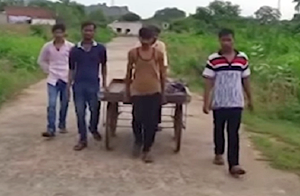
A video showing Suraj, who is a labourer belonging to Madinashah locality, carrying the body of his 70-year-old father Tulsiram who died in the district hospital yesterday, in a hand cart went viral in the social media today.

Suraj claimed that he had rushed his father on a private vehicle to the government hospital around 8 AM but was told to wait for an hour and half before the doctors attended to the patient.

According to the death certificate issued by the hospital, the deceased was admitted at 9.40 AM and he died at 11 AM.

"The hospital staff then asked me to take away the body and said that no vehicle was available for taking the body home," Suraj claimed, adding that he was left with no other option but to arrange a hand cart.

Suraj alleged that he had made several phone calls to get an ambulance for taking his father to hospital in the morning but to no avail.

The superintendent of district hospital Dr RC Sharma when contacted, however, said that he was not contacted by the family of any deceased for the vehicle for carrying the body.

The District Magistrate Masoom Ali Sarwar has said he will order an inquiry if a complaint is made to him in this regard.

Similar videos of a man carrying his dead wife in Odisha and patients being carried by their family members in Uttar Pradesh have been viral on the social media in the recent past.

Comments

Viren Kotian
 - 
Saturday, 24 Sep 2016

No one will help you. You will not going to get any fund from anyone

hammii
 - 
Saturday, 24 Sep 2016

dont worry suraj, Mr. Modi is going to sponsr u 10 lck

Add new comment

  • Coastaldigest.com reserves the right to delete or block any comments.
  • Coastaldigset.com is not responsible for its readers’ comments.
  • Comments that are abusive, incendiary or irrelevant are strictly prohibited.
  • Please use a genuine email ID and provide your name to avoid reject.
Wafa Sultana
April 4,2020

Over the last couple of days when the world was occupied with unifying efforts to fight the deadly Covid19 pandemic, sections of Indian media provided viewers a familiar scapegoat – the Indian Muslims – who are often stereotyped as a community being constantly at loggerheads with the citizenry and the State. Biased media channels were quick to resort to blaming the entire Muslim community for the spread of the disease in the country, thanks to an ill-timed Tablighi Jamaat gathering at its international headquarters in Delhi’s Nizamuddin. Unsurprisingly, the opprobrium was also marked by a sudden spike in WhatsApp forwards of videos with people wearing skullcaps licking spoons and performing Sufi breathing rituals, suggesting some sort of wild conspiracy on the part of the community to spread the virus.  Some media channels were quick to formulate, hypothesize and provide loose definitions of a newly discovered form of Jihad i.e. ‘Corona Jihad ’ thereby vilifying the Islamic faith and its followers.

While the investigation on the culpability of the organizers of the Nizamuddin event is still ongoing, there is enough information to suggest that the meeting was held before any lockdown was in force, and the problem began when there was no way of getting people out once the curfew was announced. Be that as it may, there is little doubt that organizing a meet of such a scale when there is a global pandemic smacks of gross misjudgment, and definitely the organizers should be held accountable if laws or public orders were defied. Attendees who attempt to defy quarantine measures must be dealt with strictly. However, what is alarming is that the focus and narrative have now shifted from the unfortunate event at Nizamuddin to the Tablighi Jamaat itself.

For those not familiar with the Tablighi Jamaat, the organization was founded in 1926 in Mewat by scholar Maulana Mohammad Ilyas. The Jamaat’s main objective was to get Muslim youth to learn and practice pristine Islam shorn of external influences. This is achieved through individuals dedicating time for moral and spiritual upliftment secluded from the rest of the world for a brief period of time. There is no formal membership process. More senior and experienced participants typically travel from one mosque to other delivering talks on religious topics, inviting local youth to attend and then volunteer for a spiritual retreat for a fixed number of days to a mosque in a nearby town or village to present the message to their co-religionists. Contrary to ongoing Islamophobic rhetoric, the movement does not actively proselytize. The focus is rather on getting Muslims to learn the teachings and practices of Islam.  This grassroots India-based movement has now grown to almost all countries with substantial Muslim populations. Its annual meets, or ‘ijtemas’ are among the largest Islamic congregations in the world after the annual Haj. One of the reasons for its popularity and wide network in the subcontinent and wordwide is the fact that it has eschewed the need for scholarly intervention, focusing on peer learning of fundamental beliefs and practice rather than high-falutin ideological debates. The Tablighi Jamaat also distinguishes itself from other Islamic movements through its strictly apolitical nature, with a focus on individual self-improvement rather than political mobilization. Hardships and difficulty in the world are expected to be face through ‘sabr’ (patience) and ‘dua’ (supplication),  than through quest for political power or influence. In terms of ideology, it is very much based on mainstream Sunni Islamic principles derived from the Deobandi school.

So, why is all this background important in the current context? While biased media entities have expectedly brought out their Islamophobic paraphernalia out for full display, more neutral commentators have tried to paint the Tablighi Jamaat as a fringe group and have tried to distance it from 'mainstream Muslims'. While the intent is no doubt innocent, this is a trap we must not fall into. This narrative, unfortunately, is also gaining ground due to apathy some Muslims have for the group, accusing it of being “disconnected from the realities of the world”. Unlike other Muslim organizations and movements, the Tablighi Jamat, by virtue of its political indifference, does not boast of high-profile advocates and savvy spokespersons who can defend it in mainstream or social media.  The use of adjectives such as 'outdated' and 'orthodox' by liberal columnists to describe the Jamaat feeds into the malignant attempt to change the narrative from the control of the spread of the pandemic due to the Nizamuddin gathering to 'raison d'etre' of the organization itself.

A large mainstream religious group like the Tablighi Jamaat with nearly a hundred-year history, normally considered to be peaceful, apolitical and minding its own business is now suddenly being villainized owing to unfortunate circumstances. Biased media reactions filled with disgust and hate seem to feed the Indian public conscience with a danngerous misconception - to be a nominal Muslim is okay but being a practicing one is not.  For those committed to the truth and fighting the spread of Islamophobia, the temptation to throw the entire Tablighi Jamaat under the bus must be resisted.

The writer is a lawyer and research scholar at Qatar University. Her research interests include Islamic law and politics.

Comments

zahoorahmed
 - 
Saturday, 4 Apr 2020

great article! provides a great perspective on tableeg jamat

Add new comment

  • Coastaldigest.com reserves the right to delete or block any comments.
  • Coastaldigset.com is not responsible for its readers’ comments.
  • Comments that are abusive, incendiary or irrelevant are strictly prohibited.
  • Please use a genuine email ID and provide your name to avoid reject.
News Network
June 20,2020

Bengaluru,  Jun 19: Following the coronavirus outbreak, Bengaluru's Kempegowda International Airport has introduced ultraviolet treatment while scanning outbound baggage apart from other measures to enhance passenger and staff safety.

"Two custom-designed UV tunnels have been created to disinfect trolleys after every use. Two custom-designed UV tunnels have been created to disinfect trolleys after every use. These Tunnels are located at a cordoned-off area of the Terminal," according to a statement by the Bangalore International Airport Limited (BIAL).

The airport plans to use an ultra-low volume (ULV) spray treatment for check-in bags: all outbound passenger baggage is sanitised before dispatch to the aircraft

Authorities also plan to minimise use of additional trays for footwear by introducing specially designed trays; the trays that are in use are UV treated and sanitised manually after every use.

Officials are currently in the process of implementing silver nano-coating for frequently used touchpoints for self disinfection like check-in counters, Immigration counters, ATRS trays, etc. Currently, sanitisation of high-traffic areas and frequently touched surfaces continues to be done every thirty minutes manually without disrupting the flow of passengers.

All high-traffic areas are sanitised once every three hours by using ULV machines - eight times in 24 hours.

Washrooms across the Airport premises are sanitised on a regular basis with dedicated manpower, irrespective of the frequency of use. 456 units of tabletop hand sanitiser and 107 units of sensor-based hand sanitisers have been placed across the Terminal.

120 biowaste bins located across the Airport campus enable passengers and staff to dispose of their masks, gloves and other PPE conveniently and safely. This bio-waste is managed by a dedicated team and handed over to a Pollution Control Board-approved vendor and taken away for incineration.

The Airport said that the passenger feedback for the contactless process has been positive. "The objective of the process is to minimise physical contact and enhance passenger throughput," it said.

These sanitisation measures come in light of the highly infectious COVID-19 pandemic which spreads through person-to-person contact. Small droplets from the nose or mouth can spread the virus when they land on objects and surfaces around the person.

Comments

Add new comment

  • Coastaldigest.com reserves the right to delete or block any comments.
  • Coastaldigset.com is not responsible for its readers’ comments.
  • Comments that are abusive, incendiary or irrelevant are strictly prohibited.
  • Please use a genuine email ID and provide your name to avoid reject.
News Network
April 9,2020

Bengaluru, Apr 9: The Karnataka government is currently engaged in discussions with experts, specialists and other stakeholders to decide on its lockdown exit strategy and would take a final view by April 13, a key Minister said on Thursday.

"Day after tomorrow we have a VC (videoconference) with the Prime Minister," Medical Education Minister Sudhakar K, who is in-charge of all matters related to COVID-19, noted when asked about the States strategy.

He said a task force of specialist doctors on Wednesday submitted its report to the government, giving its recommendations.

"We are meeting lot of stakeholders of the society taking their views," the Minister said, adding, the Cabinet would also hold discussions.

"Finally, day after tomorrow, after discussing with the Prime Minister during the VC, the government will take a view on this by April 13 or so. As of now, we have not taken any view on it. We are studying all the reports," Sudhakar told PTI.

The Minister observed that the COVID-19 cases were slowly spiking in India but not multiplying the way they have in some other countries like Italy, Spain and the United States as the government had declared 21-day national lockdown early and taken other strict measures. "Let's see for one week and see."

"We need to fight this out collectively and by strictly following the quarantine methods and social distancing," Sudhakar stressed.

The Chief Minister B S Yediyurappa had on Wednesday said his government was in favour of lifting lock-down in districts which remained free from COVID-19 after April 14 subject to approval from the Centre.

"If the Prime Minister suggests to States to take decision (on lock-down) based on the situation in their respective States, my position is to take a call (on roll- back) in districts free from COVID-19," he had said.

"This is to allow people to go about their business and move about within the district and not from one district to another, after April 14, after taking the approval of the Prime Minister."

According to State officials, as many as 12 districts continue to remain free from COVID-19.

The task force has recommended continuation of lockdown at "hot spots" beyond April 14.

It has suggested that schools and colleges be shut till May 31, while non-air-conditioned shops can be opened.

Also, IT/BT companies, government offices providing essential services and factories can function with 50 per cent staff, the task force said in its recommendations for 15-day period after April 14.

Comments

Add new comment

  • Coastaldigest.com reserves the right to delete or block any comments.
  • Coastaldigset.com is not responsible for its readers’ comments.
  • Comments that are abusive, incendiary or irrelevant are strictly prohibited.
  • Please use a genuine email ID and provide your name to avoid reject.