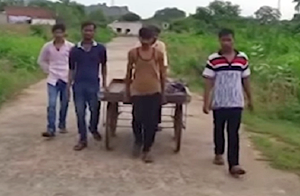
Youth carries father's body in hand cart as hospital denies vehicle

September 24, 2016

Pilibhit (UP), Sep 24: A youth had to carry his father's body in a hand cart as he was allegedly refused a vehicle by the district hospital to take the body home in Uttar Pradesh's Pilibhit town.Boy

A video showing Suraj, who is a labourer belonging to Madinashah locality, carrying the body of his 70-year-old father Tulsiram who died in the district hospital yesterday, in a hand cart went viral in the social media today.

Suraj claimed that he had rushed his father on a private vehicle to the government hospital around 8 AM but was told to wait for an hour and half before the doctors attended to the patient.

According to the death certificate issued by the hospital, the deceased was admitted at 9.40 AM and he died at 11 AM.

"The hospital staff then asked me to take away the body and said that no vehicle was available for taking the body home," Suraj claimed, adding that he was left with no other option but to arrange a hand cart.

Suraj alleged that he had made several phone calls to get an ambulance for taking his father to hospital in the morning but to no avail.

The superintendent of district hospital Dr RC Sharma when contacted, however, said that he was not contacted by the family of any deceased for the vehicle for carrying the body.

The District Magistrate Masoom Ali Sarwar has said he will order an inquiry if a complaint is made to him in this regard.

Similar videos of a man carrying his dead wife in Odisha and patients being carried by their family members in Uttar Pradesh have been viral on the social media in the recent past.

Comments

Viren Kotian
 - 
Saturday, 24 Sep 2016

No one will help you. You will not going to get any fund from anyone

hammii
 - 
Saturday, 24 Sep 2016

dont worry suraj, Mr. Modi is going to sponsr u 10 lck

Add new comment

  • Coastaldigest.com reserves the right to delete or block any comments.
  • Coastaldigset.com is not responsible for its readers’ comments.
  • Comments that are abusive, incendiary or irrelevant are strictly prohibited.
  • Please use a genuine email ID and provide your name to avoid reject.
News Network
June 2,2020

Udupi, June 2: The number of positive cases may continue to be more in Udupi district since the results of more than 3,000 samples are pending with Labs.

The district total cases to 260. The figure had seemed far-fetched on May 15, when the number of cases stood at just three. The latest spike has been attributed to the return of migrants from other States as well as from abroad. These samples are from people who returned to the district in the last two weeks.

This delay is because the laboratories testing samples from Udupi are burdened with a high case-load after more than 8,500 people returned to the district, particularly from the neighbouring state of Maharashtra.

"Samples have piled up after the influx of people returning from other states and from abroad," says Dr Prashant Bhat, nodal officer for COVID-19 in Udupi. This delay has caused returnees in institutional quarantine to stay on for as long as 18 days.

The designated laboratory for coronavirus testing in Udupi is Wenlock District Hospital in Mangaluru. The district administration also sends samples to laboratories at the Kasturba Hospital in Manipal, Yenepoya Medical College, Mangaluru, KS Hegde Medical Academy, Mangaluru, and Viral Diagnostic Laboratory in Shivamogga. Apart from Udupi, the laboratory in Manipal is also testing samples from Uttara Kannada district. The laboratory in Shivamogga is also testing samples from Shivamogga and Bijapur districts. The laboratories in Mangaluru, similarly, have samples from Dakshina Kannada district.

Dr Avinash Shetty, Medical Superintendent of Kasturba Hospital in Manipal, one of the private laboratories being used by the Udupi district administration, said that they are testing samples in batches. "We received around 600 samples today and we will be testing them now. The backlog of samples should be cleared in the next few days," Dr Avinash said.

All 73 cases reported in Udupi on Monday were patients with travel history of returning from Maharashtra or patients with travel history of returning from abroad.

In cases of some patients who tested coronavirus positive in the past week, people were released from institutional quarantine after a stipulated period only to be tracked down again and admitted in hospitals after their results returned positive.

While two such cases emerged in Belapu and Belman in the district, the administration is now following up with others who were released from institutional quarantine to ensure they remain in home quarantine till their test results are confirmed.

The spike in cases among returning migrants in Udupi also comes at a time the Karnataka government reduced restrictions on interstate travel.

Comments

Add new comment

  • Coastaldigest.com reserves the right to delete or block any comments.
  • Coastaldigset.com is not responsible for its readers’ comments.
  • Comments that are abusive, incendiary or irrelevant are strictly prohibited.
  • Please use a genuine email ID and provide your name to avoid reject.
coastaldigest.com news network
May 31,2020

Mangaluru, May 31:  Even as the worst locust attack on India in recent years raised concerns over its impact on crops, swarms of locusts have triggered panic in Karnataka’s Dakshina Kannada too. 

Farmers in the coastal district were taken aback when they found the swarms of locusts, which they feared as the arrival of desert locusts in the region.

According to reports, Renjalady village under the limits of Nuji Baltila Gramp Panchayats in Kadaba taluk and Shirlalu village in Belthangady taluk witnessed locust attacks in last couple of days. 

“Locust swarms were seen in many areas. We have also alerted agriculture department. Already insects have destroyed crops of many farmers,” said a farmer in Shirlalu village.  

Joint director of Dakshina Kannada district agriculture department MC Seetha confirmed that officials have received information from villagers about the locust scare and entemologists have already visited the place to collect more information.

Not Desert Locusts?

“We contacted entemologists and forwarded the pictures that farmers sent to us. Looking at the picture, entemologists have opined that it may be calotropis locust or colour grasshopper. Desert locusts usually arrive in lakhs,” said Ms Seetha. Desert locusts that are destroying crops in other parts of India may not come to Dakshina Kannada, she added.

Comments

Add new comment

  • Coastaldigest.com reserves the right to delete or block any comments.
  • Coastaldigset.com is not responsible for its readers’ comments.
  • Comments that are abusive, incendiary or irrelevant are strictly prohibited.
  • Please use a genuine email ID and provide your name to avoid reject.
News Network
March 15,2020

While it makes perfect sense for IT employees to work from remote locations via video conferencing and collaboration tools seamlessly - especially in the case of tech giants like Google or Microsoft -- workers from the non-IT companies and small and medium enterprises (SMBs) are the worst-hit in India as most of them have little or no clue about how these messaging and collaboration tools work amid the coronavirus pandemic.

Small companies -- from corporate to education verticals -- are scrambling to get their act together as new coronavirus threat has reached their premises, prompting them to send employees home who have age-old laptops, poor network and connectivity with no UPS backups and little knowledge about how to handle group chat and collaboration software like Zoom, Google Hangouts Meet, Microsoft Teams and Flock etc.

Instead of halting operations, however, businesses can choose to shift towards remote working methods with teaching non-IT staff on how to use the latest digital software to connect and work, say industry experts.

The training will take some time and may hamper productivity in the short run but is a win-win situation for the non-tech companies in the long run, in case any such global emergency arises in the future.

According to a latest report by Gartner, 54 per cent of HR leaders have cited that poor technology and/or infrastructure for remote working is the biggest barrier to effective remote working.

Sandy Shen, Senior Director Analyst, Gartner, says that with COVID-19 disrupting the business landscape, CIOs should relook at the digital fulfillment of market demand.

"The value of digital channels, products and operations is immediately obvious to companies everywhere right now. This is a wake-up call for organisations that have placed too much focus on daily operational needs at the expense of investing in digital business and long-term resilience," warned Shen.

Businesses that can shift technology capacity and investments to digital platforms will mitigate the impact of the outbreak and keep their companies running smoothly now, and over the long term.

"Videoconferencing, messaging, collaboration tools and document sharing are just a few examples of technologies that facilitate remote work. Additional bandwidth and network capacity may also be needed, given the increasing number of users and volume of communications," informed Shen.

The IT industry's apex body Nasscom has asked the government to relax norms for a month to allow work-from-home for technology and back-office employees as a measure to deal with the spread of Covid-19 in India.

Networking giant Cisco said that it has seen "significant growth" in the usage of its web conferencing and video-conferencing service Webex in India.

According to Muneer Ahmad, Business Head, ViewSonic India, due to COVID-19 pandemic, the corporate and educational sector is severely getting affected in the country.

"ViewSonic IFP has a cloud-based software which help teachers and corporates to connect through video conferencing to multiple people at the same time and can split the screen into six screens. It can also connect with various tools like Skype, Cisco WebEx, Zoom, Google Hangouts and GoToMeeting," Ahmad told IANS.

Co-working sector has also taken a hit and the industry is looking at several measures to tackle it -- from ensuring supply of juices rich in Vitamin C to supply of disinfectants and giving work from home facilities.

"The scheduled visits of the clients at our co-working offices have been postponed. Few of our clients have cancelled their outstation meetings and have now started audio/video conferencing for virtual meetings," said Nakul Mathur, MD, Avanta India.

According to reports, India has approximately 1,000 co-working locations (as of September 2019) and is the second-largest market for the co-working industry after China.

As India's first licensed B2B Virtual Network Operator, CloudConnect Communications offers a collaborative platform that allows companies to overcome the COVID-19 threat while maintaining seamless business continuity and optimum employee productivity.

"We offer a secure, robust, reliable, scalable and trackable mobile-first unified communication infrastructure that aids remote teleworking so that businesses can continue operating even under any unforeseen circumstances," said Gokul Tandon, Executive Chairman, CloudConnect Communications.


Comments

Add new comment

  • Coastaldigest.com reserves the right to delete or block any comments.
  • Coastaldigset.com is not responsible for its readers’ comments.
  • Comments that are abusive, incendiary or irrelevant are strictly prohibited.
  • Please use a genuine email ID and provide your name to avoid reject.