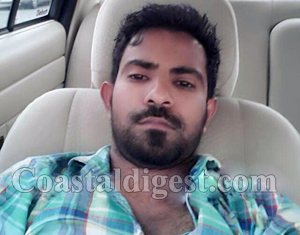
Youth from Uppinangady dies in Saudi Arabia

[email protected] (CD Network)
April 1, 2016

asifattackMangaluru, Apr 1: An Indian expatriate worker hailing from Uppinangady in Dakshina Kannada died of cardiac arrest in Saudi Arabia on Thursday.

Mohammed Asif, Son of Abbas Thekkaru is the deceased. He had flown into Saudi Arabia eight months ago in search of a job. Within a few days he had secured a house driver job in Dammam.

It is learnt that he had planned to visit his hometown within a few days to attend his brother's wedding. The reason for sudden cardiac arrest is not yet known.

He is survived by his parents, five brothers and a sister. His last rites were carried out in Saudi Arabia after obtaining permission from family members.

Comments

shaima umar farooq
 - 
Saturday, 2 Apr 2016

Innalillahi wainnailahi rajihoon. May hi soul rest in peace . may allah grant him jannatul firdous. Ameen yarrabal alameen

Thanzeel
 - 
Saturday, 2 Apr 2016

INNA LILLAHI WA INNA ILAIHI RAAJIOON

Ahmed
 - 
Saturday, 2 Apr 2016

Now a days, too many young people die because of Cardiac arrest. I believe this is happening because of our food intakes, lack of exercises etc., must keep track on cholesterol, BP, Blood glucose etc.,

Add new comment

  • Coastaldigest.com reserves the right to delete or block any comments.
  • Coastaldigset.com is not responsible for its readers’ comments.
  • Comments that are abusive, incendiary or irrelevant are strictly prohibited.
  • Please use a genuine email ID and provide your name to avoid reject.
News Network
April 14,2020

Bengaluru, Apr 14: The Karnataka government has decided to adopt “remote monitoring” of COVID-19 positive patients in order to ensure the safety of healthcare professionals - the frontline warriors against the pandemic.

Two doctors treating COVID-19 patients tested positive recently and in to check such instances in future, the Department of Medical Education is planning remote monitoring, which reduces doctors’ exposure to patients.

Medical Education Minister Dr K Sudhakar has consulted some of the doctors in the United States who are already using this technology to treat the COVID-19 positive cases. The minister is also having a meeting with representatives of some of the companies which provide such technology.

“I spoke to a team of epidemiologists and heads of certain departments at the United States to know about the remote monitoring technology they are using. I am also meeting the representatives of a few such companies which can provide us with the technology at our hospitals,”  Dr Sudhakar said.

Track state-wise coronavirus cases here

The minister added, “We have heard reports of many doctors and other health professionals succumbing to COVID-19. We don’t want to take risk.” Explaining the technology, Dr Sachidanand, Vice Chancellor of Rajiv Gandhi University of Health Sciences said that remote monitoring uses a software with which specialist doctors can monitor health condition of patients and treat them by not getting exposed directly.

The presence of all the doctors in COVID-19 is not necessary when patients are monitored remotely. 

Comments

Add new comment

  • Coastaldigest.com reserves the right to delete or block any comments.
  • Coastaldigset.com is not responsible for its readers’ comments.
  • Comments that are abusive, incendiary or irrelevant are strictly prohibited.
  • Please use a genuine email ID and provide your name to avoid reject.
Agencies
May 8,2020

Washington D.C., May 8: The prime time for brain development in a child's life is the first year, where the infant spends most of the time asleep. It is the time when neural connections form and sensory memories are encoded.

However, when sleep is disrupted, as occurs more often among children with autism, brain development may be affected, too.

New research led by the University of Washington finds that sleep problems in a baby's first 12 months may not only precede an autism diagnosis but also may be associated with altered growth trajectory in a key part of the brain, the hippocampus.

The study, which was published in the American Journal of Psychiatry, researchers report that in a sample of more than 400 taken of 6- to 12-month-old infants, those who were later diagnosed with autism were more likely to have had difficulty falling asleep.

It also states that this sleep difficulty was associated with altered growth trajectories in the hippocampus.

"The hippocampus is critical for learning and memory, and changes in the size of the hippocampus have been associated with poor sleep in adults and older children.

As many as 80 per cent of the children with autism spectrum disorder have sleep problems," said Annette Estes, director of the UW Autism Center and senior author of the study.

"In our clinical experience, parents have a lot of concerns about their children's sleep, and in our work on early autism intervention, we observed that sleep problems were holding children and families back," added Estes, who is also a UW professor of speech and hearing sciences.

"It could be that altered sleep is part-and-parcel of autism for some children. One clue is that behavioural interventions to improve sleep don't work for all children with autism, even when their parents are doing everything just right. This suggests that there may be a biological component to sleep problems for some children with autism," said Estes.

To consider links among sleep, brain development, and autism, researchers at the IBIS Network looked at MRI scans of 432 infants, surveyed parents about sleep patterns, and measured cognitive functioning using a standardized assessment.

At the outset of the study, infants were classified according to their risk for developing autism: Those who were at higher risk of developing autism -- about two-thirds of the study sample -- had an older sibling who had already been diagnosed.

Infant siblings of children with autism have a 20 per cent chance of developing autism spectrum disorder -- a much higher risk than children in the general population.

In the current study, 127 of the 432 infants were identified as "low risk" at the time the MRI scans were taken because they had no family history of autism.

They later evaluated all the participants at 24 months of age to determine whether they had developed autism. Of the roughly 300 children originally considered "high familial risk," 71 were diagnosed with autism spectrum disorder at that age.

Problems with sleep were more common among the infants later diagnosed with an autism spectrum disorder, as were larger hippocampi. No other subcortical brain structures were affected, including the amygdala, which is responsible for certain emotions and aspects of memory, or the thalamus, a signal transmitter from the spinal cord to the cerebral cortex.

The authors note that while parents reported more sleep difficulties among infants who developed autism compared to those who did not, the differences were very subtle and only observed when looking at group averages across hundreds of infants.

Sleep patterns in the first years of life change rapidly as infants transition from sleeping around the clock to a more adult-like sleep/wake cycle. Until further research is completed, Estes said, it is not possible to interpret challenges with sleep as an early sign of increased risk for autism.


Comments

Add new comment

  • Coastaldigest.com reserves the right to delete or block any comments.
  • Coastaldigset.com is not responsible for its readers’ comments.
  • Comments that are abusive, incendiary or irrelevant are strictly prohibited.
  • Please use a genuine email ID and provide your name to avoid reject.
Media Release
July 31,2020

Mangaluru, July 31: Kanara Chamber of Commerce and Industry (KCCI) has unveiled a campaign both on digital media and outdoor billboards on bringing awareness on the right usage of masks, social distancing and hand washing in the fight against COVID19. The campaign has received very good response and attention on social media and with the citizens of Mangaluru.

While the numbers of Covid-19 infected people were increasing and a vaccine would take some more time it was observed that norms of social distancing and other precautionary practices were thrown to the wind. Many people in Dakshina Kannada were found using masks inappropriately. Wearing a mask in a scientific way by covering both the nose and mouth is imperative to control droplets that spread the virus. We need to rise above our inconvenience to fight the virus.

Considering this the KCCI found an immediate need to bring awareness and constant reminder to people on the right usage of masks, social distancing, washing hands and other dos and don’ts to stay ahead of the virus and beat the pandemic.

A digital campaign and an outdoor advertisement campaign were planned by the chamber to remind and encourage people to follow best practices when interacting with others. 

The theme of the Campaign was decided to be “Let’s Fight Back Together” Origin Designext a Creative Agency in Mangalore was roped in to do the creative for the campaign and a team from KCCI worked with the Agency to shape up the campaign with their inputs. In the meantime Indian Red Cross Society Dakshina Kannada and Rotary Mangaluru expressed their interest to support the Campaign. 

Mangaluru based outdoor agencies like Jyothi Advertisers, Kalkura Advertisers and Gee Dee Advertisers agreed to provide outdoor space gratis to this community service campaign. Presented both in English and Kannada, the campaign has been creating waves on social media and on the street, a sign that it is being very well received by the populace of Mangalore city. 

The creative of Half Covered or Half exposed where a model is shown with a mask that exposes the nose and KA-19 v/s COVID-19 (KA-19 being the Vehicle Registration Code for the District) have been particularly making a buzz in the community. All together 14 hoardings are currently on display with various Covid-19 awareness messages. Many business houses have shown interest to participate in this public awareness campaign.

The Chamber hopes this campaign would go a long way in the fight of the city against COVID-19 and play its role in putting the pandemic behind us. “Businesses and our economy has suffered enough, we need to work together to fight this virus, we need to rise above minor inconvenience and win this war,” says Isaac Vas the President to KCCI.

Comments

Add new comment

  • Coastaldigest.com reserves the right to delete or block any comments.
  • Coastaldigset.com is not responsible for its readers’ comments.
  • Comments that are abusive, incendiary or irrelevant are strictly prohibited.
  • Please use a genuine email ID and provide your name to avoid reject.