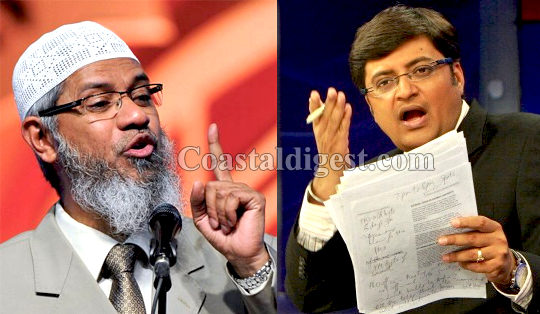
Zakir Naik slaps Goswami with Rs 500-cr defamation notice for hate campaign'

[email protected] (CD Network)
July 29, 2016

Mumbai, July 29: Islamic scholar Dr Zakir Naik, against whom a series of allegations were levelled by media post attack in Bangladesh's capital Dhaka, has sent a defamation notice to Times Now news channel.

zakirnThe founder of Islamic Research Foundation has sought Rs 500 crore as damages from Arnab Goswami, Editor in Chief of Times Now and other office bearers.

On his popular show The Newshour Debate' on Times Now, Arnab Goswami has been running stories against Dr Naik since a report surfaced that one of the terrorists involved in Dhaka attack had liked the Facebook page of Dr Naik. Besides, Mr Goswami had portrayed Dr Naik as the guru of terrorists across the world.

Dr Naik, in his press conference through Skype from Saudi Arabia, accused a section of media of carrying out media trial against him. He also gave an open challenge to Arnab Goswami for a debate on a neutral platform over the allegations against him.

Comments

Rikaz
 - 
Saturday, 30 Jul 2016

Aranab is stinking......good job Zakir Naik Sir!.....he should make this person to sell his underwear to pay this money....

REALITY
 - 
Saturday, 30 Jul 2016

Need of the hour... such a cases should be booked as these (news channels) are deceiving people from knowing the reality .. and misguiding the people from the truth in all the matters.

True indian
 - 
Saturday, 30 Jul 2016

Zakir naik has no case against him. So why to come india for the dongi cow swami.

If cow swami is arrested who will bark on barking news.

Times now might be called as lie now.

shahid
 - 
Friday, 29 Jul 2016

I request income tax dept to kindly check what arnab goswamis total wealth, what he earns & how much is his asset.... i can assure you there will be lot of illegal wealth with him....who sponsored u people very well know

thinker
 - 
Friday, 29 Jul 2016

Most of these converted/( they are reverted ) are highly qualified in India.

in West -Europe and US daily people flock into 95% of them are
high highly qualified.
Yes you may disagree with section of sects of Muslims, but it is nothingto do with Islam. Islam itself doesn't allow any forcible conversion. Acceptance should come by their heart and belief.
Please note conversion does not benefit others. The holy quran clearly discourage any compulsion.

In brief Dr. Naik is fully complies islamic propagation
Guidelines
His friends are senior qualified Hindu celebrities

Please come for debate

Satyameva jayate
 - 
Friday, 29 Jul 2016

If media interviews can judge a person and decide then why do we have courts....all bla bla comments from gaaf jale sangheez and porbooz....
So do you accept modiji as killer of Gujarat which was also a media issue....watch on YouTube and enjoy the interview between modi and Karan tappar on CNN IBN....

suvin
 - 
Friday, 29 Jul 2016

you dont worth 5 rs frame so wt is there to defame..........notice india aneeko fathat hey cupha huva hey bill mey

Add new comment

  • Coastaldigest.com reserves the right to delete or block any comments.
  • Coastaldigset.com is not responsible for its readers’ comments.
  • Comments that are abusive, incendiary or irrelevant are strictly prohibited.
  • Please use a genuine email ID and provide your name to avoid reject.
Wafa Sultana
April 4,2020

Over the last couple of days when the world was occupied with unifying efforts to fight the deadly Covid19 pandemic, sections of Indian media provided viewers a familiar scapegoat – the Indian Muslims – who are often stereotyped as a community being constantly at loggerheads with the citizenry and the State. Biased media channels were quick to resort to blaming the entire Muslim community for the spread of the disease in the country, thanks to an ill-timed Tablighi Jamaat gathering at its international headquarters in Delhi’s Nizamuddin. Unsurprisingly, the opprobrium was also marked by a sudden spike in WhatsApp forwards of videos with people wearing skullcaps licking spoons and performing Sufi breathing rituals, suggesting some sort of wild conspiracy on the part of the community to spread the virus.  Some media channels were quick to formulate, hypothesize and provide loose definitions of a newly discovered form of Jihad i.e. ‘Corona Jihad ’ thereby vilifying the Islamic faith and its followers.

While the investigation on the culpability of the organizers of the Nizamuddin event is still ongoing, there is enough information to suggest that the meeting was held before any lockdown was in force, and the problem began when there was no way of getting people out once the curfew was announced. Be that as it may, there is little doubt that organizing a meet of such a scale when there is a global pandemic smacks of gross misjudgment, and definitely the organizers should be held accountable if laws or public orders were defied. Attendees who attempt to defy quarantine measures must be dealt with strictly. However, what is alarming is that the focus and narrative have now shifted from the unfortunate event at Nizamuddin to the Tablighi Jamaat itself.

For those not familiar with the Tablighi Jamaat, the organization was founded in 1926 in Mewat by scholar Maulana Mohammad Ilyas. The Jamaat’s main objective was to get Muslim youth to learn and practice pristine Islam shorn of external influences. This is achieved through individuals dedicating time for moral and spiritual upliftment secluded from the rest of the world for a brief period of time. There is no formal membership process. More senior and experienced participants typically travel from one mosque to other delivering talks on religious topics, inviting local youth to attend and then volunteer for a spiritual retreat for a fixed number of days to a mosque in a nearby town or village to present the message to their co-religionists. Contrary to ongoing Islamophobic rhetoric, the movement does not actively proselytize. The focus is rather on getting Muslims to learn the teachings and practices of Islam.  This grassroots India-based movement has now grown to almost all countries with substantial Muslim populations. Its annual meets, or ‘ijtemas’ are among the largest Islamic congregations in the world after the annual Haj. One of the reasons for its popularity and wide network in the subcontinent and wordwide is the fact that it has eschewed the need for scholarly intervention, focusing on peer learning of fundamental beliefs and practice rather than high-falutin ideological debates. The Tablighi Jamaat also distinguishes itself from other Islamic movements through its strictly apolitical nature, with a focus on individual self-improvement rather than political mobilization. Hardships and difficulty in the world are expected to be face through ‘sabr’ (patience) and ‘dua’ (supplication),  than through quest for political power or influence. In terms of ideology, it is very much based on mainstream Sunni Islamic principles derived from the Deobandi school.

So, why is all this background important in the current context? While biased media entities have expectedly brought out their Islamophobic paraphernalia out for full display, more neutral commentators have tried to paint the Tablighi Jamaat as a fringe group and have tried to distance it from 'mainstream Muslims'. While the intent is no doubt innocent, this is a trap we must not fall into. This narrative, unfortunately, is also gaining ground due to apathy some Muslims have for the group, accusing it of being “disconnected from the realities of the world”. Unlike other Muslim organizations and movements, the Tablighi Jamat, by virtue of its political indifference, does not boast of high-profile advocates and savvy spokespersons who can defend it in mainstream or social media.  The use of adjectives such as 'outdated' and 'orthodox' by liberal columnists to describe the Jamaat feeds into the malignant attempt to change the narrative from the control of the spread of the pandemic due to the Nizamuddin gathering to 'raison d'etre' of the organization itself.

A large mainstream religious group like the Tablighi Jamaat with nearly a hundred-year history, normally considered to be peaceful, apolitical and minding its own business is now suddenly being villainized owing to unfortunate circumstances. Biased media reactions filled with disgust and hate seem to feed the Indian public conscience with a danngerous misconception - to be a nominal Muslim is okay but being a practicing one is not.  For those committed to the truth and fighting the spread of Islamophobia, the temptation to throw the entire Tablighi Jamaat under the bus must be resisted.

The writer is a lawyer and research scholar at Qatar University. Her research interests include Islamic law and politics.

Comments

zahoorahmed
 - 
Saturday, 4 Apr 2020

great article! provides a great perspective on tableeg jamat

Add new comment

  • Coastaldigest.com reserves the right to delete or block any comments.
  • Coastaldigset.com is not responsible for its readers’ comments.
  • Comments that are abusive, incendiary or irrelevant are strictly prohibited.
  • Please use a genuine email ID and provide your name to avoid reject.
coastaldigest.com news network
May 13,2020

Mangaluru, May 13: Coastal district of Dakshina Kannada today reported a fresh covid-19 positive case. According to sources, this case also linked to Manglauru’s First Neuro Hospital, which has emerged as the corona hub of coastal Karnataka.

Health and Family Welfare department in its today’s bulletin revealed that a 38-year-old woman from Darandabagilu near Someshwara in Mangaluru taluk of Dakshina Kannada was tested coronavirus positive.

It is said that the woman was in touch with P-507, an octogenarian, who was being treated for neurological issues at First Neuro Hospital.

With this the total number of coronavirus positive cases reported in Dakshina Kannada rose to 34. Among them only 26 are residents of Dakshina Kannada. Four are from Kasaragod, three from Udupi and one from Bhatkal.

Among 34, currently there only 17 active cases. The condition of two among them is said to be critical.

Comments

Add new comment

  • Coastaldigest.com reserves the right to delete or block any comments.
  • Coastaldigset.com is not responsible for its readers’ comments.
  • Comments that are abusive, incendiary or irrelevant are strictly prohibited.
  • Please use a genuine email ID and provide your name to avoid reject.
Agencies
June 17,2020

Riyadh, Jun 17: Saudi Arabia is expected to scale back or call off this year's hajj pilgrimage for the first time in its modern history, observers say, a perilous decision as coronavirus cases spike.

Muslim nations are pressing Riyadh to give its much-delayed decision on whether the annual ritual will go ahead as scheduled in late July.

But as the kingdom negotiates a call fraught with political and economic risks in a tinderbox region, time is running out to organise logistics for one of the world's largest mass gatherings.

A full-scale hajj, which last year drew about 2.5 million pilgrims, appears increasingly unlikely after authorities advised Muslims in late March to defer preparations due to the fast-spreading disease.

"It's a toss-up between holding a nominal hajj and scrapping it entirely," a South Asian official in contact with Saudi hajj authorities said.

A Saudi official said: "The decision will soon be made and announced."

Indonesia, the world's most populous Muslim nation, withdrew from the pilgrimage this month after pressing Riyadh for clarity, with a minister calling it a "very bitter and difficult decision".

Malaysia, Senegal and Singapore followed suit with similar announcements.

Many other countries with Muslim populations -- from Egypt and Morocco to Turkey, Lebanon and Bulgaria -- have said they are still awaiting Riyadh's decision.

In countries like France, faith leaders have urged Muslims to "postpone" their pilgrimage plans until next year due to the prevailing risks.

The hajj, a must for able-bodied Muslims at least once in their lifetime, represents a major potential source of contagion as it packs millions of pilgrims into congested religious sites.

But any decision to limit or cancel the event risks annoying Muslim hardliners for whom religion trumps health concerns.

It could also trigger renewed scrutiny of the Saudi custodianship of Islam's holiest sites -- the kingdom's most powerful source of political legitimacy.

A series of deadly disasters over the years, including a 2015 stampede that killed up to 2,300 worshippers, has prompted criticism of the kingdom's management of the hajj.

"Saudi Arabia is caught between the devil and the deep blue sea," Umar Karim, a visiting fellow at the Royal United Services Institute in London, told AFP.

"The delay in announcing its decision shows it understands the political consequences of cancelling the hajj or reducing its scale."

"Buying time"

The kingdom is "buying time" as it treads cautiously, the South Asian official said.

"At the last minute if Saudi says 'we are ready to do a full hajj', (logistically) many countries will not be in a position" to participate, he said.

Amid an ongoing suspension of international flights, a reduced hajj with only local residents is a likely scenario, the official added.

A decision to cancel the hajj would be a first since the kingdom was founded in 1932.

Saudi Arabia managed to hold the pilgrimage during previous outbreaks of Ebola and MERS.

But it is struggling to contain the virus amid a serious spike in daily cases and deaths since authorities began easing a nationwide lockdown in late May.

In Saudi hospitals, sources say intensive care beds are fast filling up and a growing number of health workers are contracting the virus as the total number of cases has topped 130,000. Deaths surpassed 1,000 on Monday.

To counter the spike, authorities this month tightened lockdown restrictions in the city of Jeddah, gateway to the pilgrimage city of Mecca.

"Heartbroken"

"The hajj is the most important spiritual journey in the life of any Muslim, but if Saudi Arabia proceeds in this scenario it will not only exert pressure on its own health system," said Yasmine Farouk from the Carnegie Endowment for International Peace.

"It could also be widely held responsible for fanning the pandemic."

A cancelled or watered-down hajj would represent a major loss of revenue for the kingdom, which is already reeling from the twin shocks of the virus-induced slowdown and a plunge in oil prices.

The smaller year-round umrah pilgrimage was already suspended in March.

Together, they add $12 billion to the Saudi economy every year, according to government figures.

A negative decision would likely disappoint millions of Muslim pilgrims around the world who often invest their life savings and endure long waiting lists to make the trip.

"I can't help but be heartbroken -- I've been waiting for years," Indonesian civil servant Ria Taurisnawati, 37, told AFP as she sobbed.

"All my preparations were done, the clothes were ready and I got the necessary vaccination. But God has another plan."


Comments

Add new comment

  • Coastaldigest.com reserves the right to delete or block any comments.
  • Coastaldigset.com is not responsible for its readers’ comments.
  • Comments that are abusive, incendiary or irrelevant are strictly prohibited.
  • Please use a genuine email ID and provide your name to avoid reject.