


ZP/TP polls: BJP manifesto promises to eradicate corruption

February 7, 2016

Bengaluru, Feb 7: The State BJP, in its manifesto for the zilla and taluk panchayat polls, has sought to give a thrust to capacity building at the local bodies level and also take the NDA model of development to the grassroots.
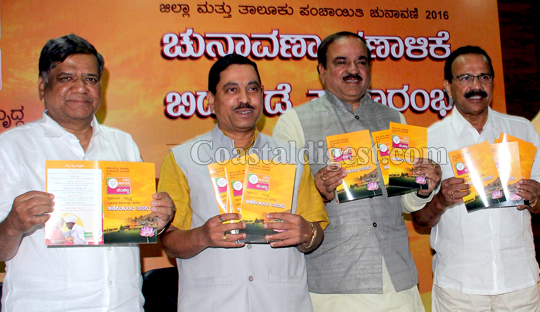
BJPmanifesto

Launched in the presence of State leaders in Bengaluru on Saturday, the manifesto also lists priorities across 20 sectors, including administration, social welfare, agriculture, education and housing in rural local bodies.

The elections for the zilla and taluk panchayats are scheduled to be held across 30 districts in two phases on February 13 and 20.

BJP?State president Pralhad Joshi said the Congress government had failed to keep its promise made ahead of the Assembly elections of decentralisation of administration and providing more power to panchayat raj institutions.

The NDA government has successfully launched several welfare and development schemes after coming to power in May 2014, Joshi said and added that the party would strive to replicate these schemes at the grassroots.

Former minister Vishweshwara Hegde Kageri, who headed a committee to draft the manifesto, said the document was also a pointer to BJP’s priorities to panchayat raj institutions if it comes to power in the 2018 Assembly polls. Union?Ministers Ananth Kumar, D?V?Sadananda Gowda and former ministers Suresh Kumar and R?Ashoka were among those present during the manifesto launch.

Key agenda

Pressure the government to increase annual grants to zilla and taluk panchayats to Rs 10 crore and Rs 5 crore, respectively

Eradicate corruption in panchayat bodies by setting up vigilance cells

Constitution of planning boards at ZP/TP level to chalk out annual development action plan

Construction of student hostels with good infrastructure and amenities in rural

areas

Provide thrust to solar power to energise pumpsets

Upgrading of village roads

Drinking water facilities and toilets in all rural schools

Better facilities in rural primary health centres

Comments

suresh
 - 
Sunday, 7 Feb 2016

ha ha ha corruption!!! Vyapam Scam, Anar Patel - Gujarat Scam, Food supply scam, chikki scam-Maharastra, Modi -Rajasthan Scam. Mining scam-, land denotification - Karnataka, which corruption you are going to stop? Do you have the guts to punish these anti nationalists?

Deepak Kumar
 - 
Sunday, 7 Feb 2016

Chunavi Jumla..
Shameless liars.
Anti national pudaris

Add new comment

  • Coastaldigest.com reserves the right to delete or block any comments.
  • Coastaldigset.com is not responsible for its readers’ comments.
  • Comments that are abusive, incendiary or irrelevant are strictly prohibited.
  • Please use a genuine email ID and provide your name to avoid reject.
News Network
June 26,2020

Bengaluru, Jun 26: The National Restaurant Association of India (NRAI) on Thursday came up with a Standard Operating Procedure (SOP) for restaurants whereby among other physical distancing norms, it has suggested a 2-metre gap between tables.

Formulated in partnership with Releski, a Bengaluru based skill-tech company, the SoP suggests that in case of back-to-back seating, people sitting with their backs towards each other will have their seats divided by 'Plexiglass' divider raised up to 2 meters from the ground.

"In a typical restaurant, the improvised seating plan should have a minimum distance of 2 metres between tables. The distance of 2 metres (6 feet) between tables should measure from one edge of the table to the other table's edge," it said.

In case of loose or free seating such as in banquet style or food court style seating, a minimum 2 meters of distance should be maintained between tables.

The guidelines noted that, to encourage physical distancing, restaurants have to sacrifice their seating capacity, to promote health and safety, and also to gain trust from their patrons.

"In order to perform this, divide your restaurants under different sectors. Pull out your restaurant's floor plan and colour code different sections red and yellow. Red sections are potential areas where maximum footfall or traffic is observed. Yellow sections are areas where the footfalls are average," it said.

All the red sections are encircled or bordered by placing barricades or Q manager and will open at specific points to access the yellow section and all the opening points will have hand sanitisers and sprays, and every guest who walks from red zones to yellow zones will sanitise himself/herself to reduce the chances of contamination.

For air conditioning, the guidelines of CPWD shall be followed which inter alia emphasises that the temperature setting of all air conditioning devices should be in the range of 24-30 degree Celsius, relative humidity should be in the range of 40- 65 per cent, intake of fresh air should be as much as possible and cross ventilation should be adequate, the guidelines suggested.

The industry body has also suggested appointment of a COVID-free Ambassador who would operate as the Chief Health Officer within the restaurant team, preferably from the management team in each shift.

The ambassador's would put the new daily work routines into practice, to monitor compliance with good practice and to lead the preventative measures, adapt to health & safety recommendations and requirements of the restaurant and oversee the implementation of the norms.

Anurag Katriar, President of NRAI and CEO & Executive Director of deGustibus Hospitality, said: "Every restaurant cutting across formats is facing the harsh reality of subdued to shut business volumes in the present and the uncertainty of business environment in the future. One thing is certain that hygiene and safety will be a key differentiator in the post-pandemic restaurant operations."

Comments

Add new comment

  • Coastaldigest.com reserves the right to delete or block any comments.
  • Coastaldigset.com is not responsible for its readers’ comments.
  • Comments that are abusive, incendiary or irrelevant are strictly prohibited.
  • Please use a genuine email ID and provide your name to avoid reject.
Agencies
July 25,2020

New Delhi, Jul 25: Nearly a year after Cafe Coffee Day founder V.G. Siddhartha's death, the probe committee appointed by the Board of Coffee Day Enterprises Ltd (CDEL) has given a virtual clean chit to private equity investors and the Income Tax Department who were named in his last letter.
The investigation report noted that Siddhartha may have felt "aversive behavioural stimulus" due to persistent reminders from the PE investors and other lenders.

"However, such reminders and follow-ups by the PE investors and lenders are not something which are beyond normal industry practices and we believe that PE investors were acting as per accepted legal and business norms," said that report.

It further said that the investigators were not provided with any documentary evidence to show any "advertent or inadvertent harassment" from the Income Tax Department.

It however, said that the financial records suggest a serious liquidity crunch which may have arisen due to the attachment of Mindtree shares by the IT Department.

Further, the probe revealed that MACEL, a private firm of Siddhartha, owes Rs 2,693 crore to Coffee Day Enterprises, which the report says, "needs to be addressed".

The Cafe Coffee Day founder's body was fished out of the Netravathi river in Karnataka by a group of fishermen on July 31 last year, a day after he went missing.

His last note raised several questions about the role of investors, and tax officials.

He had written: "Tremendous pressure from other lenders lead to me succumbing to the situation. There was a lot of harassment from the previous DG Income Tax in the form of attaching our shares on two separate occasions to block our Mindtree deal and then taking possession of our Coffee Day shares, although the revised returns have been filed by us. This was very unfair and has led to a serious liquidity crunch."

The massive shock to the industry and the country also led the government to assure that tax officials would not harass businessmen and the situation would improve.

Comments

Add new comment

  • Coastaldigest.com reserves the right to delete or block any comments.
  • Coastaldigset.com is not responsible for its readers’ comments.
  • Comments that are abusive, incendiary or irrelevant are strictly prohibited.
  • Please use a genuine email ID and provide your name to avoid reject.
News Network
March 5,2020

Bengaluru, Mar 5: Karnataka government on Thursday set aside Rs 400 crore to construct twin towers building with 25 floors here at Anand Rao Circle to facilitate all government departments to function at one place.

"To facilitate all the Government Departments to function in one building, a "Twin-Towers" building with 25 storeys will be constructed at Arland Rao Circle, Bengaluru, with an expenditure of Rs 400 crore," said Karnataka Chief Minister Yediyurappa while presenting the budget in the state Assembly.

He further said that the road cross-over facility for pedestrians other than metro commuters will be provided through 24 metro stations.

"The construction of 56 km long Outer Ring Road - Airport Metro from Central Silk Board junction to Bengaluru International Airport via K R Puram and Hebbala at an estimated cost of Rs 14,500 crore will be commenced during the year 2020-21," he said.

Rs 1,000 crore budget each have been announced for the restoration of Bengaluru roads for two years, 276 Karnataka public school for their infrastructure development.

Comments

Add new comment

  • Coastaldigest.com reserves the right to delete or block any comments.
  • Coastaldigset.com is not responsible for its readers’ comments.
  • Comments that are abusive, incendiary or irrelevant are strictly prohibited.
  • Please use a genuine email ID and provide your name to avoid reject.