


ZP/TP polls: BJP manifesto promises to eradicate corruption

February 7, 2016

Bengaluru, Feb 7: The State BJP, in its manifesto for the zilla and taluk panchayat polls, has sought to give a thrust to capacity building at the local bodies level and also take the NDA model of development to the grassroots.
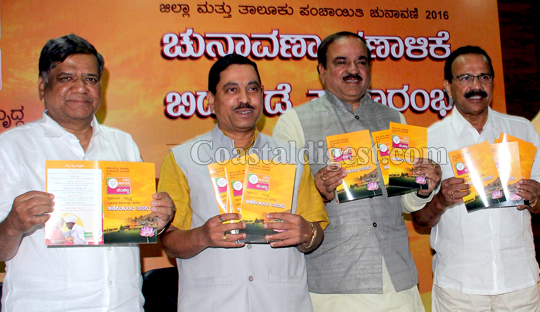
BJPmanifesto

Launched in the presence of State leaders in Bengaluru on Saturday, the manifesto also lists priorities across 20 sectors, including administration, social welfare, agriculture, education and housing in rural local bodies.

The elections for the zilla and taluk panchayats are scheduled to be held across 30 districts in two phases on February 13 and 20.

BJP?State president Pralhad Joshi said the Congress government had failed to keep its promise made ahead of the Assembly elections of decentralisation of administration and providing more power to panchayat raj institutions.

The NDA government has successfully launched several welfare and development schemes after coming to power in May 2014, Joshi said and added that the party would strive to replicate these schemes at the grassroots.

Former minister Vishweshwara Hegde Kageri, who headed a committee to draft the manifesto, said the document was also a pointer to BJP’s priorities to panchayat raj institutions if it comes to power in the 2018 Assembly polls. Union?Ministers Ananth Kumar, D?V?Sadananda Gowda and former ministers Suresh Kumar and R?Ashoka were among those present during the manifesto launch.

Key agenda

Pressure the government to increase annual grants to zilla and taluk panchayats to Rs 10 crore and Rs 5 crore, respectively

Eradicate corruption in panchayat bodies by setting up vigilance cells

Constitution of planning boards at ZP/TP level to chalk out annual development action plan

Construction of student hostels with good infrastructure and amenities in rural

areas

Provide thrust to solar power to energise pumpsets

Upgrading of village roads

Drinking water facilities and toilets in all rural schools

Better facilities in rural primary health centres

Comments

suresh
 - 
Sunday, 7 Feb 2016

ha ha ha corruption!!! Vyapam Scam, Anar Patel - Gujarat Scam, Food supply scam, chikki scam-Maharastra, Modi -Rajasthan Scam. Mining scam-, land denotification - Karnataka, which corruption you are going to stop? Do you have the guts to punish these anti nationalists?

Deepak Kumar
 - 
Sunday, 7 Feb 2016

Chunavi Jumla..
Shameless liars.
Anti national pudaris

Add new comment

  • Coastaldigest.com reserves the right to delete or block any comments.
  • Coastaldigset.com is not responsible for its readers’ comments.
  • Comments that are abusive, incendiary or irrelevant are strictly prohibited.
  • Please use a genuine email ID and provide your name to avoid reject.
News Network
June 20,2020

Bengaluru, Jun 20: The Karnataka Health Department has issued guidelines on the admission of COVID-19 patients in private hospitals after clinical assessment, mandating that the district surveillance officer (DSO) should be first informed to initiate further procedures, an official said on Friday.

"A health team sent by the DSO should visit the home or hospital where the patient is staying. The team should conduct a rapid assessment of his or her health condition," said Karnataka's Additional Chief Secretary Jawaid Akhtar.

In the rapid health condition assessment, the team should first check the patient's body temperature, followed by SpO2 (oxygen saturation) level and confirm if there are any comorbidities such as hypertension, diabetes, tuberculosis, HIV, cancer, stroke etc.

Depending on the health condition of patients, Akhtar said, two categories have been made.

"Those who have body temperature greater than 37.5 degrees Celsius, SpO2 level below 94 percent, elderly (above 60 years) and suffering from known comorbid conditions should be taken to a dedicated Covid hospital (DCH)," he said.

"All other patients, even if older but not suffering from co-morbidities, those below 60 and suffering from co-morbidities and asymptomatic cases should be taken to a dedicated Covid health centre (DCHC) or a private hospital as opted by the patient," he added.

Private hospitals have been asked to pitch in due to the rising number of cases in Karnataka. Currently, there are 2943 active cases in the state after 337 cases were reported on Friday.

"The patients are assessed clinically and evaluated at DCHCs or private hospitals with appropriate diagnostic tests. After evaluation, if the patients are asymptomatic, they are shifted to a COVID Care Centre (CCC) for further management," said Akhtar.

CCCs are expected to be equipped with ventilated rooms, pulse oximeters, handheld thermal scanners and blood pressure apparatus.

A nurse has to be present round the clock for every 50 patients and should visit each patient twice a day for assessment whereas the medical officer has to visit the CCC once a day. He should also be available on call in case of an emergency.

Staff serving food and others should wear personal protective equipment and an N-95 mask. Explaining the procedures at DCHCs, Akhtar said general examinations for medical conditions like body temperature, BP, pulse, oxygen saturation and urine output should be in place.

Investigations such as complete blood count, fasting blood sugar, random blood sugar, liver function tests, renal function tests, ECG and chest X-ray facilities should be available.

"DCHCs should ensure that above examinations are over in an orderly timeline of 24 hours and depending on the examination, the patient is continued to be lodged at the DCHC or sent to DCH or CCC," said the senior officer.

Likewise, the discharge policy should be done as per the protocols issued by the Health Department from time to time.

The Karnataka government is yet to fix an upper limit on the cost of treating COVID-19 patients in private hospitals. While reports indicated that this could be capped at Rs 5200 per day, health officials are yet to specify this is the case. Private hospitals in the state have asked the government to take a collaborative approach in deciding the fixed cap on treatment cost.

Comments

Add new comment

  • Coastaldigest.com reserves the right to delete or block any comments.
  • Coastaldigset.com is not responsible for its readers’ comments.
  • Comments that are abusive, incendiary or irrelevant are strictly prohibited.
  • Please use a genuine email ID and provide your name to avoid reject.
News Network
June 9,2020

Bengaluru, Jun 9: A 42-year-old founding director of an engineering consultancy firm lost Rs 65,000 to online fraudsters who posed as representatives of a mobile service provider and lured him with the offer of a fancy number recently.

Asif (name changed) received a text message on May 19, informing him that a platinum number, 9099999999, was available and interested people could dial a mobile number to avail it.

“Asif, who runs a mechanical, electrical, plumbing (MEP) engineering consultancy near Shivajinagar, decided to get the fancy mobile number. He called the number and the receiver said they would generate an invoice for his request. After a fake invoice for Rs 64,900 was generated, Asif paid the money through online transaction that day. Asif waited for two weeks for the SIM card with the fancy number to reach him,” an officer said.

East CEN Crime police registered a case of cheating under section 420 of IPC and sections under the Information Technology Act after Asif lodged a complaint on June 6.

Comments

Add new comment

  • Coastaldigest.com reserves the right to delete or block any comments.
  • Coastaldigset.com is not responsible for its readers’ comments.
  • Comments that are abusive, incendiary or irrelevant are strictly prohibited.
  • Please use a genuine email ID and provide your name to avoid reject.
News Network
February 6,2020

Kalaburagi, Feb 6: The State government will take steps to ensure that Kannada as a language is taught in all private schools, Chief Minister B.S. Yediyurappa announced today at the 85th Akhila Bharata Kannada Sahitya Sammelana in Kalaburagi.

This comes in the wake of the demand by some Kannada activists for making Kannada medium compulsory in all schools in the State. Sammelana president H.S. Venkatesh Murthy, who spoke after the Chief Minister, also made this demand.

The Chief Minister said “We are committed to putting in place a series of steps to see that Kannada is taught in all schools, aided and private, as a language. Kannada should be taught as the first or second language. We will also take steps to strengthen government schools. However, the government alone cannot do much. The community and parents should offer support to make sure that government schools provide quality education to all.”

To inculcate the spirit of scientific inquiry, the State government is setting up mobile planetariums. This will increase the interest of children in space technology and India’s efforts in space exploration.

The government is committed to protecting the interests of the State in Mahadayi and other river water disputes. It will take the border row issue, based on the Mahajan Commission report pending in the Supreme Court, to its logical end.

The government will also address backwardness and related issues. It will make sure that adequate funds are allocated to the development of Kalyana Karnataka. Among other things, it will establish a hostel for students from Kalaburagi region in Bengaluru. Land has been allotted in Nagarabavi for the hostel that can accommodate around 200 students. The government has decided to celebrate Kalyana Karnataka Utsav once every two years. This will showcase the culture of the region.

“We are working towards forging sentimental and emotional unity of the State other than unity based on language or administration. Our dream is to see that Karnataka remains a homogeneous unit with equality and equal opportunity for all,’’ the Chief Minister added.

Kambar bats for technology

Chandrashekar Kambar, Sahitya Akademi president and former president of the Akhila Bharata Kannada Sahitya Sammelana, favoured effective implementation of technology in administration and for universal use of Kannada in computing and e-governance.

Speaking at the Sammelana inauguration, he said “Several years ago, at the insistence of writer Poornachandra Tejaswi, I appealed to the State government to give a push to Kannada computing. We were convinced that no language can survive without the use of modern technology and use of the language in computers. The Department of Kannada and Culture, headed by then director Manu Baligar, released ₹2 crore for the project. The work began in earnest and teams of technologists came up with software and fonts. Some departments started using Kannada software. But this work has stopped or slowed down at some level. I appeal to Chief Minister B.S. Yediyurappa to continue the work and ensure that computerised Kannada is used at all levels of government and in e-governance.’’

Supports dubbing

Mr. Kambar batted for content dubbing of informative TV channels in Kannada. Channels such as Discovery and History produce good quality content that can be educative and informative. They are very useful for children. These channels are now available in Tamil, Telugu and Hindi and some other Indian languages. But they are not available in Kannada. That is because some people in the film industry are opposing dubbing. Such opposition is not good. Informative channels are our window to the world and allowing dubbing will enhance our knowledge base. There is no merit in not allowing dubbing. I appeal to C.T. Ravi, Minister for Kannada and Culture, to allow dubbing in Kannada, he said.

Mr. Kambar favoured primary education in the mother tongue of the child and urged the State government to introduce universal and compulsory education in Kannada medium in all schools. “This will help preserve our culture. Nothing else can,’’ he said.

He blamed the East India Company administration for inculcating a craze for English education among the people. “The introduction of English education by the British was strongly welcomed by the masses in India as they had been denied the opportunity for education for millenia. The deprived classes and Dalits who had not been exposed to education till then, were excited about the opportunity. However, along with English education, the British were successful in introducing inferiority in our minds. We are yet to escape from this inferiority complex.”

Quoting from Greek mythology, Mr. Kambar said that Hercules had killed his children and relatives in a fit of alcohol-induced rage. “We should not behave like that. We may be very strong, but we should not kill our mother tongue, in our power-induced rage,’’ he said.

Comments

Add new comment

  • Coastaldigest.com reserves the right to delete or block any comments.
  • Coastaldigset.com is not responsible for its readers’ comments.
  • Comments that are abusive, incendiary or irrelevant are strictly prohibited.
  • Please use a genuine email ID and provide your name to avoid reject.