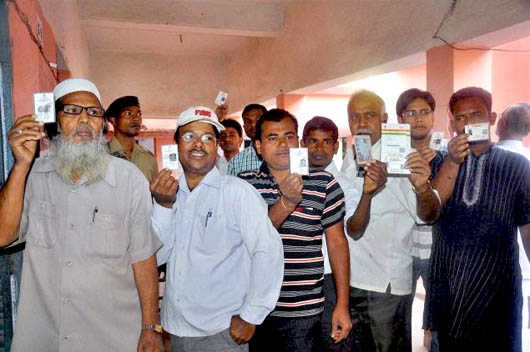
14 p.c. voting till 10 a.m. in Jharkhand

April 10, 2014

Voting_in_Jharkhand

Ranchi, Apr 10: An estimated 14 per cent voters exercised their franchise till 10 a.m. in four Lok Sabha seats of Jharkhand where Maoists exploded a series of landmines before polling began.

Barring an incident of a voter attacking a polling official with a knife in Lohardaga, polling in Palamau (SC), Chatra, Koderma and Lohardaga (ST) seats is going on peacefully, police said.

Hours before polling, Maoists exploded a series of landmines near a police picket in Latehar under Chatra constituency, and a brief gunbattle followed, Latehar SP Michael Raj said.

There was no casualty on any side, he said.

In Gumla, which comes under Lohardaga constituency, a constable of India Reserve Battalion Bikash Tiwari allegedly shot dead three of his colleagues in Gurdari area last night, Superintendent of Police Bhimsen Tuti said.

Later, Palamau SP Y.S. Ramesh said Mr. Tiwari surrendered in Medininagar police station with his weapon.

Comments

Add new comment

  • Coastaldigest.com reserves the right to delete or block any comments.
  • Coastaldigset.com is not responsible for its readers’ comments.
  • Comments that are abusive, incendiary or irrelevant are strictly prohibited.
  • Please use a genuine email ID and provide your name to avoid reject.
News Network
January 1,2020

New Delhi, Jan 1: In the backdrop of huge losses borne by airlines, Aviation Minister Hardeep Singh Puri has said the government is concerned that more airlines will shut down if predatory pricing continues. "Some predatory pricing is taking place" in airfares, the minister told reporters on Tuesday. Mr Puri however ruled out any plan by the government to regulate airfares. The remarks come amid high competition in the country's aviation sector, struggling against high fuel prices and other operating costs.

"The interesting thing that we have observed is that on Delhi-Mumbai route 20 years ago, the average fare was Rs 5,100. Today, the average fare is Rs 4,600. Some predatory pricing is taking place. It means people are selling tickets below their cost," he said.

"One of our concerns is that if there is predatory pricing, then the airlines will stop functioning. This is not Air India's problem only. Jet Airways got shut down. Before that, it was Kingfisher airline," he said.

IndiGo and SpiceJet - two of the country's biggest airlines - reported losses of Rs 1,062 crore and Rs 463 crore respectively in the second quarter of 2019-20. Other airlines have also reported losses in the quarter that ended on September 30, 2019.

Asked if predatory pricing is the reason for the ill health of the airlines, the minister said, "No, there are many reasons... Predatory pricing is one of the factors. But the profitability of an airline is dependent on (a) number of things."

Asked if the trend of predatory pricing has come down after regular discussion with the airlines, he said, "Yes, absolutely."

"It is (a) constant battle. An ideal situation from an airline's point of view is that they grow and they are also able to charge more fares. What fares they charge is their business. Our advice to them is to charge realistic fares," he added. "It should not be too high. And it is not in your business interests if you are imposing predatory fares."

The minister also said that the government is not planning to regulate fares. "No regulation. It has to be done within deregulation system.... If I put a cap on fare, the airline will start charging that cap only... that cap will become the normal fare... So, within a deregulated structure, we have to bring about an equilibrium," the minister said.

"Government, periodically, at my level or at secretary''s level, we sit down with the main aircraft operators and tell them it is in your interest not to allow such practices which undermine the civil aviation sector."

Comments

Add new comment

  • Coastaldigest.com reserves the right to delete or block any comments.
  • Coastaldigset.com is not responsible for its readers’ comments.
  • Comments that are abusive, incendiary or irrelevant are strictly prohibited.
  • Please use a genuine email ID and provide your name to avoid reject.
News Network
April 27,2020

New Delhi, Apr 27: A private hospital here claimed that a coronavirus patient, who was administered plasma therapy for the first time in the facility, was discharged on Sunday after being completely cured.

The 49-year-old man had tested positive for COVID-19 on April 4 and was admitted to Max Hospital, Saket, it said in a statement.

As his condition deteriorated, he was put on ventilator support on April 8, the hospital added.

When the patient showed no signs of improvement, his family requested for administration of plasma therapy on compassionate grounds, it said, adding that the family arranged a donor for extracting plasma.

The patient was administered fresh plasma as a treatment modality as a side-line to standard treatment protocols on the night of April 14, the statement said.

Subsequently, the patient showed improvement and by the fourth day, was weaned off ventilator support and continued on supplementary oxygen. He was shifted to a room with round-the-clock monitoring on Monday after testing negative twice within 24 hours, it said.

He has now fully recovered and was discharged, the hospital said, adding that he will stay at home for another two weeks.

Group medical director of Max Healthcare and senior director of the Institute of Internal Medicine Dr Sandeep Budhiraja said, "We can say that plasma therapy could have worked as a catalyst in speeding up his recovery. We cannot attribute 100 per cent recovery to plasma therapy only, as there are multiple factors which carved his path to recovery."

Comments

Add new comment

  • Coastaldigest.com reserves the right to delete or block any comments.
  • Coastaldigset.com is not responsible for its readers’ comments.
  • Comments that are abusive, incendiary or irrelevant are strictly prohibited.
  • Please use a genuine email ID and provide your name to avoid reject.
Agencies
January 9,2020

The World Bank says that a lack of credit and drop in private consumption have led to a gloomy growth outlook for India with a steep cut in growth rate for the current fiscal year and only a modest gain projected for the next year.

India's growth rate is forecast to be only 5 per cent for the current fiscal year, weighed down by a growth of only 4.5 per cent in the July-September quarter, according to the 2020 Global Economic Prospects report released on Wednesday.

"In India, [economic] activity was constrained by insufficient credit availability, as well as by subdued private consumption," the Bank said.

The growth rate is forecast by the Bank to pick up to 5.8 per cent in the next fiscal year and to 6.1 per cent in 2021-22.

India's growth rate was 6.8 per cent in 2018-19.

The 5 per cent growth rate projection for the current financial year is a sharp cut of 2.5 per cent from the 7.5 per cent forecast made by the Bank in January last year, toppling it from the rank of the world's fastest growing economy.

India's performance follows a global trend of lowered growth weighed down by developed economies.

The report estimated world economic growth rate to be only 2.4 per cent last year and forecast it to edge up 0.1 per cent to 2.5 per cent in the current year.

Even with the lower growth rate of 5 per cent in the current fiscal year and 5.8 per cent forecast for the next, India holds the second rank among large economies, behind only China with an estimated growth rate of 6.1 per cent for 2019 and 5.9 per cent this year.

The report blamed "weak confidence, liquidity issues in the financial sector" and "weakness in credit from non-bank financial companies" for India's slowdown.

The Bank predicated India's recovery to 5.8 per cent in the coming financial year for India but "on the monetary policy stance remaining accommodative" and the assumption that "the stimulative fiscal and structural measures already taken will begin to pay off."

It also warned that sharper-than-expected slowdown in major external markets such as United States and Europe, would affect South Asia through trade, financial, and confidence channels, especially for countries with strong trade links to these economies."

The Bank said that the growth of advanced economies was 1.6 per cent last year and "is anticipated to slip to 1.4 per cent in 2020 in part due to continued softness in manufacturing."

In contrast the growth of emerging market and developing countries is expected to accelerate from 3.5 per cent last year to 4.1 per cent this year, the report said.

In South Asia, Bangladesh is estimated to have the highest growth rate of 7.2 per cent in the current fiscal year, although down from 8.1 per cent last fiscal year.

But its higher regional growth rates are coming off a lower base with a per capital gross domestic product of $1,698 compared to $2,010 for India.

Bangladesh is expected to grow by 7.3 per cent in the next financial year.

Pakistan's growth rate is estimated at only 2.4 per cent in the current fiscal year and is projected to rise to 3 per cent in the next, according to the Bank.

The Bank blamed monetary tightening in Pakistan for a sharp deceleration in fixed investment and a considerable softening in private consumption for the fall in growth rate from 3.3 per cent in the 2018-19 fiscal year.

Sri Lanka's growth rate was estimated to be 2.7 per cent last year and forecast to grow to 3.3 per cent this year.

Nepal grew by an estimated 6.4 per cent in the current fiscal year and will rise to 6.5 per cent in the next.


Comments

Add new comment

  • Coastaldigest.com reserves the right to delete or block any comments.
  • Coastaldigset.com is not responsible for its readers’ comments.
  • Comments that are abusive, incendiary or irrelevant are strictly prohibited.
  • Please use a genuine email ID and provide your name to avoid reject.