



140 killed, 100 injured as oil tanker explodes in Pak

Agencies
June 25, 2017

Lahore, Jun 25: At least 140 people were today charred to death and over 100 others injured after an oil tanker overturned and burst into flames as crowds rushed to collect petrol that spilled out to a highway in the Bahawalpur district of Pakistan's Punjab Province.
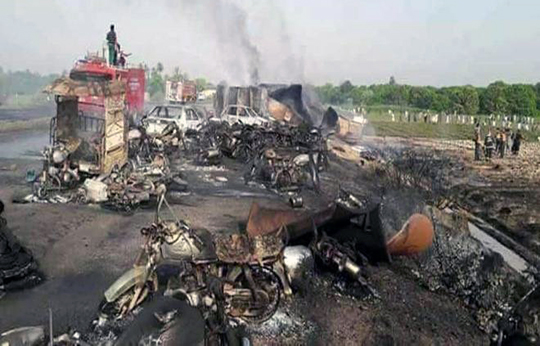
tankr

The oil tanker coming from Karachi to Lahore overturned early this morning on the national highway at the Ahmedpur Sharqia area of the district, some 400 km from Lahore, after its tyre burst. The fire was apparently caused by someone who lit a cigarette after people from nearby localities gathered on the highway to collect spilt petrol, officials said.

The blaze from the oil spill engulfed scores of residents, killing 140 people and injuring over 100 others. District Coordination Officer (DCO) Bahwalpur Rana Salim Afzal termed it a "huge tragedy" in the history of Pakistan.

"At least 123 people were killed before getting any medical help while the rescue officials shifted more than 100 injured to the district headquarters hospital and Victoria Hospital in Bahawalpur where the condition of most of them is critical," Afzal said, adding some 50,000 litre petrol spilled from the oil tanker.

He said women and children are among the victims. Rescue 1122 official Jam Sajjad said 140 people were killed in the fire and the toll may rise further as a number of injured are in critical condition.

He said most of the dead bodies are completely charred and they will be identified only by DNA test. Muhammad Hanif, 40, who suffered burns, told reporters at Victoria Hospital that he was present at his house when his cousin called him informing that the village people were rushing to the highway to collect "free oil".

"My cousin told me to pick bottles and come out of the house. When I came out of the house I saw many people rushing towards the highway and some going there by motorcycles. Me and my cousin Rashid reached the highway and joined the people busy in collecting the petrol spilling from the tanker. Suddenly the tanker burst and the people gathered near it were burnt alive. Rashid and I were a little away from the tanker therefore we are alive," Hanif said.

He said it was "greed" of the villagers which took them to the "valley of death". The Punjab government said three helicopters are shifting the critically burnt people to Multan’s combined military hospital and Nishter Hospital for providing better health facilities.

Regional Police Officer Bahawalpur Raja Rifat said the motorway police personnel had reached the spot when the oil tanker overturned. "The people from nearby village Mauza Ramzan had also gathered there. The police personnel asked them to leave the place but they started collecting petrol. Suddenly the tanker exploded and within seconds the fire erupted giving no chance to the people present there to leave the place,” Rifat said.

Dozens of motorcycles and cars were also burnt at the site. "Most people reached the site on motorcycles to collect spilling petrol," he said. Punjab Chief Minister Shahbaz Sharif directed the authorities to ensure best medical treatment to the injured. He also sent his chopper for shifting the injured to Multan hospitals.

Prime Minister Nawaz Sharif President Mamnoon Hussain, PTI chairman Imran Khan and PPP chairman Bilawal Bhutto condoled the tragedy.

Army chief Gen Qamar Javed Bajwa ordered the Army to assist the civil administration in the rescue effort.
Army helicopters have been deployed in the rescue operations. The tragedy came a day ahead of Eid ul-Fitr celebrations in the country, marking the end of the holy fasting month of Ramazan.

Comments

Add new comment

  • Coastaldigest.com reserves the right to delete or block any comments.
  • Coastaldigset.com is not responsible for its readers’ comments.
  • Comments that are abusive, incendiary or irrelevant are strictly prohibited.
  • Please use a genuine email ID and provide your name to avoid reject.
News Network
February 26,2020

Feb 26: Looking out over the world’s largest cricket stadium, the seats jammed with more than 100,000 people, India’s prime minister heaped praise on his American visitor.

“The leadership of President Trump has served humanity,” Prime Minister Narendra Modi said Monday, highlighting Trump’s fight against terrorism and calling his 36-hour visit to India a watershed in India-U.S. relations.

The crowds cheered. Trump beamed.

“The ties between India and the U.S. are no longer just any other partnership,” Modi said. “It is a far greater and closer relationship.”

India, it seems, loves Donald Trump. It seemed obvious from the thousands who turned out to wave as his motorcade snaked through the city of Ahmedabad, and from the tens of thousands who filled the city’s new stadium. It seemed obvious from the hug that Modi gave Trump after he descended from Air Force One, and from the hundreds of billboards proclaiming Trump’s visit.

But it’s not so simple.

Because while Trump is genuinely popular in India, his clamorous and carefully choreographed welcome was also about Asian geopolitics, China’s growing power and a masterful Indian politician who gave his American visitor exactly what he wanted.

Modi “is doing this not necessarily because he loves Trump,” said Tanvi Madan, the director of the India Project at the Brookings Institution in Washington, D.C. “It’s very much about Trump as the leader of the U.S. and recognizing what it is that Trump himself likes.”

Trump likes crowds — big crowds — and the foot soldiers of India’s political parties have long known how to corral enough people to make any politician look popular. In a city like Ahmedabad, the capital of Modi’s home state of Gujarat and the center of his power base, it wouldn’t take much effort to fill a cavernous sports stadium. It was more surprising that a handful of seats remained empty, and that some in the stands had left even before Trump had finished his speech.

For India, good relations with the U.S. are deeply important: They signal that India is a serious global player, an issue that has long been important to New Delhi, and help cement an alliance that both nations see as a counterweight to China’s rise.

“For both countries, their biggest rival is China,” said John Echeverri-Gent, a professor at the University of Virginia whose research often focuses on India. “China is rapidly expanding its presence in the Indian Ocean, which India has long considered its backyard and its exclusive realm for security concerns.”

“It’s very clearly a major concern for both India and the United States,” he said.

Trump isn’t the first U.S. president that Modi has courted. In 2015, then-President Barack Obama was the first American chief guest at India’s Republic Day parade, a powerful symbolic gesture. Obama also got a Modi hug, and the media in both countries were soon writing about the two leaders’ “bromance.”

Trump is popular in India, even if some of that is simply because he’s the U.S. president. A 2019 Pew Research Center poll showed that 56% of Indians had confidence in Trump’s abilities in world affairs, one of only a handful of countries where he has that level of approval. But Obama was also popular: Before he left office, he had 58% approval in world affairs among Indians.

The Pew poll also indicated that Trump’s support was higher among supporters of Modi’s Hindu nationalist party.

That’s not surprising. Both men have fired up their nationalist bases with anti-Muslim rhetoric and government policies, from Trump’s travel bans to Modi’s crackdown in Kashmir, India’s only Muslim-majority state.

And Trump’s Indian support is far from universal. Protests against his trip roiled cities from New Delhi to Hyderabad to the far northeastern city of Gauhati, although those demonstrations were mostly overshadowed by protests over a new Indian citizenship law that Modi backs.

Modi, who is widely popular in India, has faced weeks of protests over the law, which provides fast track naturalization for some foreign-born religious minorities — but not Muslims. While Trump talked about ties with India on Tuesday, Hindus and Muslims fought in violent clashes that left at least 10 people dead over two days.

In some ways, Modi and Trump are powerful echoes of each other.

They have overlapping political styles. Both are populists who see themselves as brash, rule-breaking outsiders who disdain their countries’ traditional elites. Both are seen by their critics as having authoritarian leanings. Both surround themselves with officials who rarely question their decisions.

But are they friends?

Trump says yes. “Really, we feel very strongly about each other,” he said at a New Delhi press briefing.

But many observers aren’t so sure.

“The question is how much of this is real chemistry, as opposed to what I’d call planned chemistry” orchestrated for diplomatic reasons, said Madan. “It’s so hard to know if you’re not in the room.”

Certainly, Modi understands America’s importance to India. While the two countries continue to bicker about trade issues, the prime minister organized a welcome that impressed even India’s news media, which have watched countless choreographed mass political rallies.

“There is no other country for whose leader India would hold such an event, and for which an Indian prime minister would lavish such rhetoric,” the Hindustan Times said in an editorial.

“The spectacle and the sound were worth a thousand agreements.”

Comments

Add new comment

  • Coastaldigest.com reserves the right to delete or block any comments.
  • Coastaldigset.com is not responsible for its readers’ comments.
  • Comments that are abusive, incendiary or irrelevant are strictly prohibited.
  • Please use a genuine email ID and provide your name to avoid reject.
Agencies
January 12,2020

Washington, Jan 12: The US State Department has described the recent visit of envoys of 15 countries to Jammu and Kashmir as an "important step" but expressed concern over the continued detention of political leaders and restrictions on internet in the region.

Alice Wells, the Acting Assistant Secretary of State for South Asia, tweeted on Saturday that she was "closely following" the visit of the envoys to Kashmir, describing it an "important step".

Wells, who will be visiting India this week, added: "We remain concerned by detention of political leaders and residents and Internet restrictions. We look forward to a return to normalcy."

The group of diplomats made a two-day visit to the Union Territory on Thursday and Friday to see the conditions thereafter Jammu and Kashmir's special constitutional status was removed last August.

While some US politicians and media have criticised the action by Prime Minister Narendra Modi's government, the US has officially appeared to support the abrogation of the Constitution's Article 370 on the special status.

Last October, Wells told the House of Representatives Subcommittee on Asia and the Pacific that the State Department supported the objectives behind it, while not directly mentioning the abrogation.

"The Indian government has argued that its decision on Article 370 was driven by a desire to increase economic development, reduce corruption, and uniformly apply all national laws in Jammu and Kashmir, particularly in regard to women and minorities.

"While we support these objectives, the Department remains concerned about the situation in the Kashmir Valley, where daily life for the nearly eight million residents has been severely impacted since August 5," she had said.

Washington has banked on India's democratic institutions - the judiciary and public debates - being able to steer the country.

Bearing this out, the Supreme Court last week ordered the government to review its decision to shut down the internet in Kashmir, which it declared was a fundamental right, thus taking a step to address Wells's concern.

Comments

Add new comment

  • Coastaldigest.com reserves the right to delete or block any comments.
  • Coastaldigset.com is not responsible for its readers’ comments.
  • Comments that are abusive, incendiary or irrelevant are strictly prohibited.
  • Please use a genuine email ID and provide your name to avoid reject.
News Network
May 28,2020

May 28: Boeing is cutting more than 12,000 jobs through layoffs and buyouts as the coronavirus pandemic seizes the travel industry, and more cuts are coming.

One of the nation's biggest manufacturers will lay off 6,770 U.S. employees this week, and another 5,520 workers are taking buyout offers to leave voluntarily in the coming wee

Air travel within the U.S. tumbled 96% by mid-April, to fewer than 100,000 people on some days. It has recovered slightly. The Transportation Security Administration said it screened 264,843 people at airports on Tuesday, a drop of 89% compared with the same Tuesday a year ago.

Boeing had said it would cut 10% of a work force that numbered about 160,000. A Boeing spokesperson said Wednesday's actions represent the largest number of job cuts, but several thousand additional jobs will be eliminated in the next few months.

The layoffs are expected to be concentrated in the Seattle area, home to Boeing's commercial-airplanes business. The defense and space division is stable and will help blunt the impact of the decline in air travel and demand for passenger jets, the company said.

Boeing said additional job cuts will be made in international locations, but it did not specify numbers.

"The COVID-19 pandemic's devastating impact on the airline industry means a deep cut in the number of commercial jets and services our customers will need over the next few years, which in turn means fewer jobs on our lines and in our offices," CEO David Calhoun said Wednesday in a memo to employees.

Calhoun said the company faces the challenges of keeping employees safe and working with suppliers and airlines "to assure the traveling public that it can fly safe from infection."

Calhoun warned that Boeing will have to adjust business plans constantly because the pandemic makes it hard to predict the impact on the company's business.

Boeing's crisis began with two crashes of its 737 Max, which led regulators around the world to ground the jetliner last year. The company's problems have deepened with the coronavirus, which has cut global air traffic by up to 90% and caused airlines to postpone or cancel orders and deliveries for new planes.

Comments

Add new comment

  • Coastaldigest.com reserves the right to delete or block any comments.
  • Coastaldigset.com is not responsible for its readers’ comments.
  • Comments that are abusive, incendiary or irrelevant are strictly prohibited.
  • Please use a genuine email ID and provide your name to avoid reject.