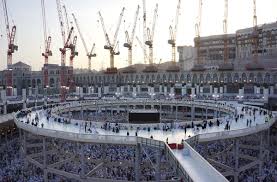
150 Masjid-ul-Haram gates remain open in Ramadan

June 29, 2014

masjidulharamMakkah, Jun 29: The head of the Doors Department at the Presidency of the Two Holy Mosques said 150 doors of Masjid-ul-Haram in Makkah will remain open to receive Umrah pilgrims and visitors during the holy month of Ramadan.

Abdullah Al-Temaih said 19 doors are designated for special needs visitors. In addition, 10 escalators around the Grand Mosque will help ensure the smooth flow of worshipers to the mosque's higher levels, he said.

Al-Temaih pointed out that all doors are equipped with green and red signs to indicate availability of space.

He asked all visitors to refrain from bringing food or drinks inside and to deposit their luggage and other belongings at the safety deposit lockers in the mosque's courtyards.

Comments

Add new comment

  • Coastaldigest.com reserves the right to delete or block any comments.
  • Coastaldigset.com is not responsible for its readers’ comments.
  • Comments that are abusive, incendiary or irrelevant are strictly prohibited.
  • Please use a genuine email ID and provide your name to avoid reject.
News Network
June 30,2020

Dubai, June 30: The United Arab Emirates is all set to reopen mosques and other places of worship at 30 per cent capacity from July 1.

However, Friday prayers will remain suspended in the country, said Saif Al Dhaheri, Spokesperson for the National Crisis & Emergency Management Authority (NCEMA) during a virtual press briefing on Monday.

The official said certain mosques in industrial areas, labor residential areas, shopping malls and public parks will remain closed until further notice.

He said health authorities already conducted Covid-19 tests for Imams and workers serving at the mosque to ensure health and safety of the worshippers.

Al Dhaheri also spelt out guidelines that worship centres have to follow to welcome worshippers.

A distance of three metres should be observed between each worshippers and no handshakes are allowed. Worshippers will have to perform ablutions at home. People should bring their own personal copies of Holy Quran or read from digital copies. It is also mandatory for all worshippers to download and activate contract tracing app AlHosn.

"We urge the public to cooperate by following precautionary measures including social distancing. Children under 12 years old, the elderly as well as individuals with chronic diseases should avoid going to mosques," said the official.

The UAE first announced the suspension of public prayers in all places of worship on March 16, which was extended until further notice on April 9.

As Khaleej Times reported, places of worship had been preparing to reopen since the last few weeks by sanitizing parking lots and outdoor areas, entrances, main prayer halls and ablution areas.

The spokesperson also announced that the Private and commercial boat trips and water sports will be allowed to operate at reduced capacity of 50 per cent but by following precautionary measures.

The total number of recovered cases of Coronavirus (Covid-19) in the UAE has reached 37,076 with 665 cases recovered today after receiving treatment. Since the beginning of June, UAE has had a daily recovery average of 660 cases, said Dr. Amna Al Shamsi, Spokesperson for the UAE government.

Guidelines

1. Maintain a distance of 3 metres between worshippers.

2. No handshakes allowed.

3. Ablutions must be performed at home.

4. To read the Holy Quran, worshippers must bring their own copies.

5. All worshippers must download and activate contact tracing app AlHosn

6. People in vulnerable categories like those with chronic diseases and the elderly must not visit the mosques.

Comments

Add new comment

  • Coastaldigest.com reserves the right to delete or block any comments.
  • Coastaldigset.com is not responsible for its readers’ comments.
  • Comments that are abusive, incendiary or irrelevant are strictly prohibited.
  • Please use a genuine email ID and provide your name to avoid reject.
Agencies
April 8,2020

Riyadh, Apr 8: Saudi Arabia's health minister has warned the number of COVID-19 cases in the country could reach 200,000 in coming weeks.

As of Tuesday, the kingdom registered a total of 2,795 coronavirus infections, including 41 deaths.

"Within the next few weeks, studies predict the number of infections will range from a minimum of 10,000 to a maximum of 200,000," health minister Tawfiq al-Rabiah was cited as saying by the official Saudi Press Agency on Tuesday.

On Monday, Saudi Arabia extended the duration of daily curfews in four governorates and five cities to 24 hours.

The kingdom imposed round-the-clock lockdowns in the capital Riyadh, Tabuk, Dammam, Dhahran and Hofuf, the interior ministry said on Twitter.

The same measures were also imposed on the governorates of Jeddah, Taif, Qatif and Khobar, the ministry added.

Authorities had already sealed off the holy cities of Mecca and Medina, barring people from entering and exiting as well as prohibiting movement between all provinces.

Last month, Saudi Arabia suspended the year-round "Umrah" pilgrimage over fears of the coronavirus pandemic spreading to Islam's holiest cities.

Authorities are yet to announce whether they will proceed with this year's Hajj, scheduled for the end of July. Last week, authorities urged Muslims to temporarily defer preparations for the annual pilgrimage.

Last year, about 2.5 million people travelled to Saudi Arabia to take part in the Hajj, which all Muslims must perform at least once in their lives if able.

The Arab world's biggest economy has also closed down cinemas, malls and restaurants and halted flights as it steps up efforts to contain the virus.

King Salman has warned of a "more difficult" fight ahead against the virus, as the kingdom faces the economic double blow of virus-led shutdowns and crashing oil prices

Comments

Add new comment

  • Coastaldigest.com reserves the right to delete or block any comments.
  • Coastaldigset.com is not responsible for its readers’ comments.
  • Comments that are abusive, incendiary or irrelevant are strictly prohibited.
  • Please use a genuine email ID and provide your name to avoid reject.
News Network
April 26,2020

Abu Dhabi, Apr 26: Indian Ambassador to the UAE Pavan Kapoor says he is appalled after the bodies of three Indians flown back to India were returned to Abu Dhabi on Friday.

The three deceased Indian nationals had died of non-coronavirus causes and were flown to Delhi on Thursday but were promptly returned by authorities there.

“We are appalled at what has happened,” Kapoor told Gulf News. “We do not know if the bodies were returned because of coronavirus-related restrictions, but we are obviously not sending the remains of people [who have passed away from COVID-19],” he added.

“[As we understand], it happened because of new protocols at the airport and we are trying to sort it out,” he said.

Sent back a few hours later

“The remains were not offloaded from the plane, and were sent back a few hours later,” Kapoor explained.

The deceased were Kamlesh Bhatt, who passed away on April 17, and Sanjeev Kumar and Jagsir Singh who both died on April 13.

According to reports in Indian media, Kamlesh Bhat was 23 years old, and hailed from Tehri Garhwal district. He allegedly died of cardiac arrest. Along with the remains Kumar and Singh, Bhatt’s body was initially repatriated on an Etihad Airways flight, then sent back, even though his relatives had been on their way to collect them.

Kapoor explained the procedure through which remains are normally returned to family members back home, saying that the worker’s employer typically makes arrangements with cargo companies to repatriate bodies on cargo aircraft.

The employer applies for a No Objection Certificate from the Indian Embassy, which is granted once the Embassy ensures that all local formalities have been completed. The cargo company then applies for airport clearance, and the airline obtains approvals from the receiving airport.

“If airport protocols have changed, it means cargo companies have to be more careful about the clearance they’re getting,” Kapoor advised.

Additional costs
The ambassador added there may eventually be additional costs to repatriate the bodies but that it is first necessary to sort out the concerns.

The global coronavirus outbreak has spawned difficulties in repatriating mortal remains as a result of the travel restrictions imposed by countries. Remains of people dying from COVID-19 are not being sent back, but the caution surrounding the handling of bodies often affects the repatriation of those who succumb to other causes.

As Gulf News reported, Kerala chief minister Pinarayi Vijayan reached out to Indian Prime Minister Narendra Modi on Friday for intervention in bringing back the bodies of Keralites who have died in the Gulf from non-COVID-19 causes.

“I would like to draw your attention to the grievances received from Non-resident Keralites Associations (NRKs) in the Gulf Cooperation Council (GCC) countries on the delay caused in bringing home the mortal remains of NRKs who had expired due to reasons other than the COVID-19 infection,” read the letter by the CM.

“It is learnt that a ‘clearance certificate’ from the Indian Embassies is required to process the application of bringing home the mortal remains of the dead. The Embassies are [further] insisting on the production of a no-objection certificate from the Ministry of Home Affairs (MHA), New Delhi. To enable to bring back the bodies of the NRIs whose deaths occurred due to reasons other than COVID-19 infection, without necessary procedural hassles, I request your kind intervention,” Vijayan has requested.


Comments

Add new comment

  • Coastaldigest.com reserves the right to delete or block any comments.
  • Coastaldigset.com is not responsible for its readers’ comments.
  • Comments that are abusive, incendiary or irrelevant are strictly prohibited.
  • Please use a genuine email ID and provide your name to avoid reject.