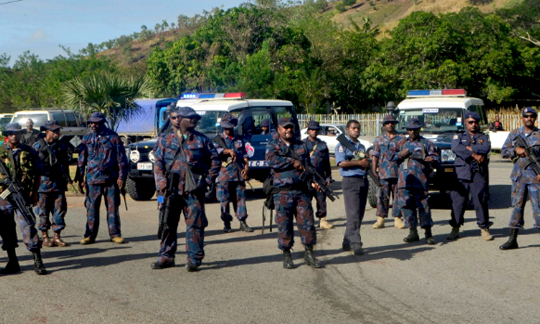
17 shot dead in Papua New Guinea prison breakout: reports

May 15, 2017

Sydney, May 15: Seventeen prisoners have been shot dead after a mass breakout at a jail in Papua New Guinea, reports said on Monday, with 57 still on the run.

prison

Inmates from the Buimo jail in the Pacific nation's second largest city Lae made a dash for freedom after breaking out of their compound on Friday, with prison warders opening fire.

Papua New Guinea Post-Courier and The National newspapers both cited local police as confirming 17 were killed, three were caught and 57 were still at large.

‘Threat to the community'

“These are undesirable people and will be a threat to the community,” Lae police metropolitan commander Chief Superintendent Anthony Wagambie Jr said of the escapees, warning the public to be vigilant.

“The majority of those who escaped were arrested for serious crimes and were in custody awaiting trial. A good number were arrested by police last year for mainly armed robberies, car thefts, break and enter and stealing,” he said.

Such an incident not new

It is the same prison where police shot dead 12 inmates during a jailbreak last year.

Crime and lawlessness in Papua New Guniea, a sprawling nation where many still live traditional and subsistence lives in remote areas, is rampant.

Mr. Wagambie urged family members and associates of the escapees not to harbour them.

“I am warning them that they will be caught. They must do what is good for them and surrender,” he said.

Comments

Add new comment

  • Coastaldigest.com reserves the right to delete or block any comments.
  • Coastaldigset.com is not responsible for its readers’ comments.
  • Comments that are abusive, incendiary or irrelevant are strictly prohibited.
  • Please use a genuine email ID and provide your name to avoid reject.
News Network
February 5,2020

Feb 5: Pakistan will buy more palm oil from Malaysia, Prime Minister Imran Khan said on Tuesday, aiming to help offset lost sales after top buyer India put curbs on Malaysian imports last month amid a diplomatic row.

India imposed restrictions on refined palm oil imports and informally asked traders to stop buying from Malaysia, the world's biggest producer of the edible oil. Sources said the move was in retaliation for Malaysia's criticism of India's policy on Kashmir.

Malaysian Prime Minister Mahathir Mohamad said on Tuesday that he discussed palm oil with Khan who was on a visit to Malaysia and that Pakistan had indicated it would import more from Malaysia.

"That's right, especially since we noticed India threatened Malaysia for supporting the Kashmir cause, threatened to cut palm oil imports," Khan told a joint news conference, referring to India's Muslim-majority region of Kashmir.

"Pakistan will do its best to compensate for that."

India is a Hindu-majority country while Malaysia and Pakistan are mainly Muslim. India and Pakistan have been mostly hostile to each other since the partition of British India in 1947, and have fought two of their three wars over competing territorial claims in Kashmir.

Pakistan may have bought around 135,000 tonnes of Malaysian palm oil last month, a record high, India-based dealers who track such shipments told Reuters on condition of anonymity.

The figure is close to estimates of 141,500 tonnes from Refinitiv, which show sales to India in January may have plunged 80% from a year earlier to 40,400 tonnes.

Malaysia will release official export data on Monday.

Pakistan bought 1.1 million tonnes of palm oil from Malaysia last year, while India bought 4.4 million tonnes, according to the Malaysian Palm Oil Council.

Malaysian palm oil futures rose on Tuesday after Khan's comments and on expectations of a steep drop in production in January.

STRONG TIES

India has repeatedly objected to Mahathir speaking out against its move last year to strip Kashmir's autonomy and make it easier for non-Muslims from neighbouring Muslim-majority Bangladesh, Pakistan and Afghanistan to gain citizenship.

At the news conference, Mahathir did not refer to Kashmir but Khan did.

"The way you, PM, have stood with us and spoken about this injustice going on, on behalf of Pakistan I really want to thank you," Khan said.

He also said he was sad he had been unable to attend a summit of Muslim leaders in Malaysia in December. Saudi Arabia did not attend the summit, saying it was the wrong forum to discuss matters affecting the world's Muslims and Khan belatedly pulled out.

Some Pakistani officials, unnamed because they were not authorised to speak to the media, said at the time that Khan pulled out under pressure from Saudi Arabia, a close ally, although local media reported his officials denied that was the reason for his absence.

"Unfortunately our friends, who are very close to Pakistan as well, felt that somehow the conference was going to divide the ummah," Khan said, using the Arabic word for the Muslim community but not mentioning Saudi Arabia by name.

"It is clearly a misconception, as that was not the purpose of the conference."

Comments

Add new comment

  • Coastaldigest.com reserves the right to delete or block any comments.
  • Coastaldigset.com is not responsible for its readers’ comments.
  • Comments that are abusive, incendiary or irrelevant are strictly prohibited.
  • Please use a genuine email ID and provide your name to avoid reject.
News Network
July 3,2020

Jul 3: China under President Xi Jinping has stepped up its "aggressive" foreign policy toward India and "resisted" efforts to clarify the Line of Actual Control that prevented a lasting peace from being realised, according to a report released by a US Congress appointed commission.

The armies of India and China have been locked in a bitter standoff at multiple locations in eastern Ladakh for the last seven weeks, and the tension escalated after 20 Indian soldiers were killed in a violent clash in the Galwan Valley on June 15.

“Under General Secretary of the Chinese Communist Party (CCP) Xi Jinping, Beijing has stepped up its aggressive foreign policy toward New Delhi. Since 2013, China has engaged in five major altercations with India along the Line of Actual Control (LAC),” said a brief issued by US-China Economic and Security Review Commission.

"Beijing and New Delhi have signed a series of agreements and committed to confidence-building measures to stabilise their border, but China has resisted efforts to clarify the LAC, preventing a lasting peace from being realised,” said the report and was prepared at the request of the Commission to support its deliberations.

Authored by Will Green, a Policy Analyst on the Security and Foreign Affairs Team at the Commission, the report says that the Chinese government is particularly fearful of India’s growing relationship with the United States and its allies and partners.

“The latest border clash is part of a broader pattern in which Beijing seeks to warn New Delhi against aligning with Washington,” it said.

After Xi assumed power in 2012, there was a significant increase in clashes, despite the fact that he met Prime Minister Narendra Modi several times and Beijing and New Delhi have agreed to a series of confidence-building mechanisms designed to mitigate tensions.

Prior to 2013, the last major border clash was in 1987. The 1950s and 1960s were a particularly tense period, culminating in 1962 with a war that left thousands of soldiers dead on both sides, according to the records of China's People's Liberation Army, the report said.

“The 2020 skirmish is in line with Beijing’s increasingly assertive foreign policy. The clash came as Beijing was aggressively pressing its other expansive sovereignty claims in the Indo-Pacific region, such as over Taiwan and in the South and East China seas,” it said.

China is engaged in hotly contested territorial disputes in both the South China Sea and the East China Sea. Beijing has built up and militarised many of the islands and reefs it controls in the region. Both areas are stated to be rich in minerals, oil and other natural resources and are vital to global trade.

China claims almost all of the South China Sea. Vietnam, the Philippines, Malaysia, Brunei and Taiwan have counter claims over the area.

Several weeks before the clash in the Galwan Valley, Chinese Defence Minister Wei Fenghe called on Beijing to “use fighting to promote stability” as the country’s external security environment worsened, a potential indication of China’s intent to proactively initiate military tensions with its neighbours to project an image of strength, the report said.

Comments

Add new comment

  • Coastaldigest.com reserves the right to delete or block any comments.
  • Coastaldigset.com is not responsible for its readers’ comments.
  • Comments that are abusive, incendiary or irrelevant are strictly prohibited.
  • Please use a genuine email ID and provide your name to avoid reject.
Agencies
January 25,2020

Pentagon, Jan 25: Thirty-four US troops had been diagnosed with concussions and traumatic brain injury (TBI) as a result of the January 8 Iranian missile attack on two military bases in Iraq housing American soldiers, the Pentagon said.

"Eight service members who were previously transported to Germany have been brought to the US, they would continue to receive treatment in the US either at Walter Reed or their home bases," Pentagon spokesman Jonathan Hoffman told the media on Friday.

Hoffman said that nine service members were still undergoing treatment in Germany, and the rest of the 17 injured troops have already returned to duty in Iraq, reports Xinhua news agency.

Lat week, the US military had said that 11 service members were treated for concussion symptoms due to the missile attacks.

Hoffman noted that the symptoms "are late developing and manifested over a period of time".

In retaliation for the killing of Iranian Major General Qasem Soleimani in an American drone attack on January 3 in Baghdad, Tehran launched over 13 ballistic missiles on the two military bases in Anbar and near the city of Erbil.

US military initially said that no casualty was reported from the Iranian attack. President Donald Trump then downplayed the seriousness of those injures.

"I heard that they had headaches and a couple of other things, but I would say and I can report that it's not very serious," Trump told reporters on Wednesday at a press conference in Davos, Switzerland.

More than 5,000 US troops are deployed in Iraq to support the country's forces in the battle against Islamic State militants.

Comments

Add new comment

  • Coastaldigest.com reserves the right to delete or block any comments.
  • Coastaldigset.com is not responsible for its readers’ comments.
  • Comments that are abusive, incendiary or irrelevant are strictly prohibited.
  • Please use a genuine email ID and provide your name to avoid reject.