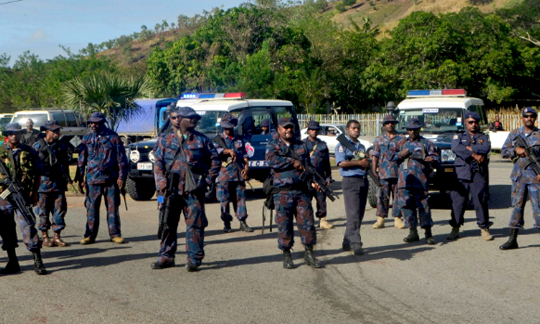
17 shot dead in Papua New Guinea prison breakout: reports

May 15, 2017

Sydney, May 15: Seventeen prisoners have been shot dead after a mass breakout at a jail in Papua New Guinea, reports said on Monday, with 57 still on the run.

prison

Inmates from the Buimo jail in the Pacific nation's second largest city Lae made a dash for freedom after breaking out of their compound on Friday, with prison warders opening fire.

Papua New Guinea Post-Courier and The National newspapers both cited local police as confirming 17 were killed, three were caught and 57 were still at large.

‘Threat to the community'

“These are undesirable people and will be a threat to the community,” Lae police metropolitan commander Chief Superintendent Anthony Wagambie Jr said of the escapees, warning the public to be vigilant.

“The majority of those who escaped were arrested for serious crimes and were in custody awaiting trial. A good number were arrested by police last year for mainly armed robberies, car thefts, break and enter and stealing,” he said.

Such an incident not new

It is the same prison where police shot dead 12 inmates during a jailbreak last year.

Crime and lawlessness in Papua New Guniea, a sprawling nation where many still live traditional and subsistence lives in remote areas, is rampant.

Mr. Wagambie urged family members and associates of the escapees not to harbour them.

“I am warning them that they will be caught. They must do what is good for them and surrender,” he said.

Comments

Add new comment

  • Coastaldigest.com reserves the right to delete or block any comments.
  • Coastaldigset.com is not responsible for its readers’ comments.
  • Comments that are abusive, incendiary or irrelevant are strictly prohibited.
  • Please use a genuine email ID and provide your name to avoid reject.
News Network
March 3,2020

Mar 3: Just hours after the ending of a week-long “reduction” in violence that was crucial for Donald Trump’s peace deal in Afghanistan, the Taliban struck again: On Monday, they killed three people and injured about a dozen at a football match in Khost province. This resumption of violence will not surprise anyone actually invested in peace for that troubled country. The point of the U.S.-Taliban deal was never peace. It was to try and cover up an ignominious exit for the U.S., driven by an election-bound president who feels no responsibility toward that country or to the broader region.

Seen from South Asia, every point we know about in the agreement is a concession by Trump to the Taliban. Most importantly, it completes a long-term effort by the U.S. to delegitimize the elected government in Kabul — and, by extension, Afghanistan’s constitution. Afghanistan’s president is already balking at releasing 5,000 Taliban prisoners before intra-Afghan talks can begin — a provision that his government did not approve.

One particularly cringe-worthy aspect: The agreement refers to the Taliban throughout  as “the Islamic Emirate of Afghanistan that is not recognized by the United States as a state and is known as the Taliban.” This unwieldy nomenclature validates the Taliban’s claim to be a government equivalent to the one in Kabul, just not the one recognised at the moment by the U.S. When read together with the second part of the agreement, which binds the U.S. to not “intervene in [Afghanistan’s] domestic affairs,” the point is obvious: The Taliban is not interested in peace, but in ensuring that support for its rivals is forbidden, and its path to Kabul is cleared.

All that the U.S. has effectively gotten in return is the Taliban’s assurance that it will not allow the soil of Afghanistan to be used against the “U.S. and its allies.” True, the U.S. under Trump has shown a disturbing willingness to trust solemn assurances from autocrats; but its apparent belief in promises made by a murderous theocratic movement is even more ridiculous. Especially as the Taliban made much the same promise to an Assistant Secretary of State about Osama bin Laden while he was in the country plotting 9/11.

Nobody in the region is pleased with this agreement except for the Taliban and their backers in the Pakistani military. India has consistently held that the legitimate government in Kabul must be the basic anchor of any peace plan. Ordinary Afghans, unsurprisingly, long for peace — but they are, by all accounts, deeply skeptical about how this deal will get them there. The brave activists of the Afghan Women’s Network are worried that intra-Afghan talks will take place without adequate representation of the country’s women — who have, after all, the most to lose from a return to Taliban rule.

But the Pakistani military establishment is not hiding its glee. One retired general tweeted: “Big victory for Afghan Taliban as historic accord signed… Forced Americans to negotiate an accord from the position of parity. Setback for India.” Pakistan’s army, the Taliban’s biggest backer, longs to re-install a friendly Islamist regime in Kabul — and it has correctly estimated that, after being abandoned by Trump, the Afghan government will have sharply reduced bargaining power in any intra-Afghan peace talks. A deal with the Taliban that fails also to include its backers in the Pakistani military is meaningless.

India, meanwhile, will not see this deal as a positive for regional peace or its relationship with the U.S. It comes barely a week after Trump’s India visit, which made it painfully clear that shared strategic concerns are the only thing keeping the countries together. New Delhi remembers that India is not, on paper, a U.S. “ally.” In that respect, an intensification of terrorism targeting India, as happened the last time the U.S. withdrew from the region, would not even be a violation of Trump’s agreement. One possible outcome: Over time the government in New Delhi, which has resolutely sought to keep its ties with Kabul primarily political, may have to step up security cooperation. Nobody knows where that would lead.

The irresponsible concessions made by the U.S. in this agreement will likely disrupt South Asia for years to come, and endanger its own relationship with India going forward. But worst of all, this deal abandons those in Afghanistan who, under the shadow of war, tried to develop, for the first time, institutions that work for all Afghans. No amount of sanctimony about “ending America’s longest war” should obscure the danger and immorality of this sort of exit.


Comments

Add new comment

  • Coastaldigest.com reserves the right to delete or block any comments.
  • Coastaldigset.com is not responsible for its readers’ comments.
  • Comments that are abusive, incendiary or irrelevant are strictly prohibited.
  • Please use a genuine email ID and provide your name to avoid reject.
Agencies
June 2,2020

Washington, Jun 2: There is no place for hate and racism in the society, Microsoft CEO Satya Nadella has said, asserting that empathy and shared understanding are a start, but more needs to be done. Nadella’s remarks come in the wake of the custodial death of George Floyd, a 46-year-old African-American man who was pinned to the ground in Minneapolis on May 25 by a white police officer who kneeled on his neck as he gasped for breath.

“There is no place for hate and racism in our society. Empathy and shared understanding are a start, but we must do more,” Nadella said in a tweet on Monday.

“I stand with the Black and African American community and we are committed to building on this work in our company and in our communities,” Nadella said.

A day earlier, Google CEO Sunder Pichai expressed solidarity with the African-American community.

“Today on US Google & YouTube homepages we share our support for racial equality in solidarity with the Black community and in memory of George Floyd, Breonna Taylor, Ahmaud Arbery & others who don’t have a voice,” Pichai wrote on Twitter on Sunday.

“For those feeling grief, anger, sadness & fear, you are not alone,” Pichai said, sharing a screenshot of the Google search home page which said, “We stand in support of racial equality, and all those who search for it.”

Nadella’s Microsoft also said they will be using the platform to amplify voices from the Black and African American community at the company.

Nadella had also spoken out a few months ago about the discriminatory Citizenship Amendment Act passed in his native country. Talking to BuzzFeed’s editor-in-chief, Ben Smith, in Manhattan, Nadella said what’s happening in the country is “sad.”

“I think what is happening is sad. I feel, and in fact quite frankly, now being informed (and) shaped by the two amazing American things that I’ve observed which is both, it’s technology reaching me where I was growing up and its immigration policy and even a story like mine being possible in a country like this.

“I think, it’s just bad, if anything, I would love to see a Bangladeshi immigrant who comes to India and creates the next unicorn in India or becomes the CEO of Infosys. That should be the aspiration. If I had to sort of mirror what happened to me in the US, I hope that’s what happens in India,” Microsoft’s India-born CEO was quoted as saying by BuzzFeed.

Comments

Add new comment

  • Coastaldigest.com reserves the right to delete or block any comments.
  • Coastaldigset.com is not responsible for its readers’ comments.
  • Comments that are abusive, incendiary or irrelevant are strictly prohibited.
  • Please use a genuine email ID and provide your name to avoid reject.
News Network
June 22,2020

Geneva, Jun 22: The global count of coronavirus cases has surpassed 8.7 million, with 183,020 new cases recorded on Sunday, the World Health Organisation said in its daily situation report.

Over the last 24 hours, 4,743 people died from COVID-19 worldwide, taking the death toll to 461,715 fatalities, according to the report.

The cumulative global toll of confirmed cases has now reached 8,708,008, as stated in the report.

The WHO Regional Director for Europe, Dr Hans Henri P. Kluge, shared that Europe accounts for 31 per cent of COVID-19 cases and 43 per cent of COVID-19 deaths globally.

Dr Kluge highlighted that several countries continue to face increasing disease incidence and that "preparing for the autumn is a priority now at the WHO Regional Office for Europe"

The United States continues to be worst affected by the contagion with the highest count of cases and fatalities -- 2.2 million and 118,895, respectively.

The novel coronavirus was declared a pandemic by WHO on March 11.

Comments

Add new comment

  • Coastaldigest.com reserves the right to delete or block any comments.
  • Coastaldigset.com is not responsible for its readers’ comments.
  • Comments that are abusive, incendiary or irrelevant are strictly prohibited.
  • Please use a genuine email ID and provide your name to avoid reject.