17 shot dead in Papua New Guinea prison breakout: reports

May 15, 2017

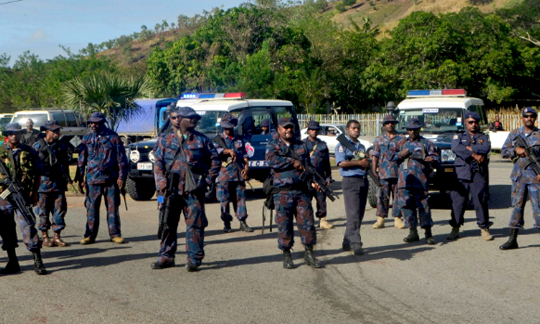
Sydney, May 15: Seventeen prisoners have been shot dead after a mass breakout at a jail in Papua New Guinea, reports said on Monday, with 57 still on the run.

prison

Inmates from the Buimo jail in the Pacific nation's second largest city Lae made a dash for freedom after breaking out of their compound on Friday, with prison warders opening fire.

Papua New Guinea Post-Courier and The National newspapers both cited local police as confirming 17 were killed, three were caught and 57 were still at large.

‘Threat to the community'

“These are undesirable people and will be a threat to the community,” Lae police metropolitan commander Chief Superintendent Anthony Wagambie Jr said of the escapees, warning the public to be vigilant.

“The majority of those who escaped were arrested for serious crimes and were in custody awaiting trial. A good number were arrested by police last year for mainly armed robberies, car thefts, break and enter and stealing,” he said.

Such an incident not new

It is the same prison where police shot dead 12 inmates during a jailbreak last year.

Crime and lawlessness in Papua New Guniea, a sprawling nation where many still live traditional and subsistence lives in remote areas, is rampant.

Mr. Wagambie urged family members and associates of the escapees not to harbour them.

“I am warning them that they will be caught. They must do what is good for them and surrender,” he said.

Comments

Add new comment

  • Coastaldigest.com reserves the right to delete or block any comments.
  • Coastaldigset.com is not responsible for its readers’ comments.
  • Comments that are abusive, incendiary or irrelevant are strictly prohibited.
  • Please use a genuine email ID and provide your name to avoid reject.
Agencies
July 28,2020

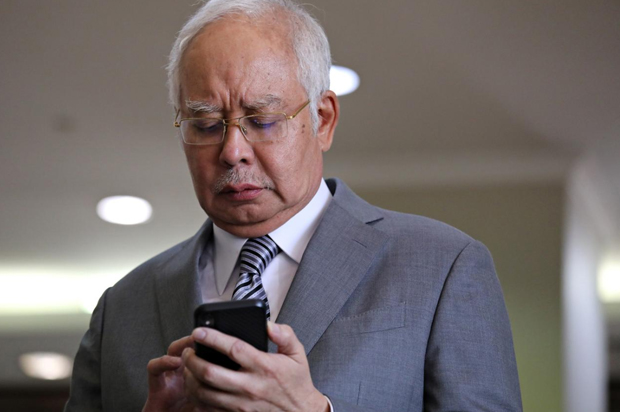
Kuala Lumpur, Jul 28: Malaysia's ex-leader Najib Razak was found guilty Tuesday in his first trial over the multi-billion-dollar 1MDB scandal, two years after the fraud contributed to the downfall of his long-ruling government.

The former prime minister could now face decades in jail after being convicted on all charges in the case related to the looting of sovereign wealth fund 1Malaysia Development Berhad.

Billions of dollars were stolen from the investment vehicle and spent on everything from high-end real estate to pricey art, while investment bank Goldman Sachs also became embroiled in the scandal.

Anger at the looting played a large part in the shock loss of Najib's long-ruling coalition in elections in 2018, and he was arrested and hit with dozens of charges following his defeat.

The verdict was a test of Malaysia's rule of law. It comes about five months after Najib's scandal-plagued party returned to power as part of a coalition, development observers had feared could affect the outcome of the case.

About 16 months after it began, the Kuala Lumpur High Court delivered the verdict in Najib's first trial, which centred on the transfer of 42 million ringgit ($9.9 million) from a former 1MDB unit, SRC International, into his accounts.

Najib had vehemently denied wrongdoing.

But Judge Mohamad Nazlan Mohamad Ghazali took apart all the arguments put forward by his defence, and found him guilty on the seven charges he faced.

"In conclusion, after considering all the evidence in this trial, I find the prosecution has successfully proven the case," the judge told the court.

The charges were one of abuse of power, three of criminal breach of trust and three of money-laundering.

The counts of abuse of power and criminal breach of trust are punishable by up to 20 years in jail each, while the money-laundering charges are punishable by up to 15 years each.

Sentencing was not handed down straight away. The 67-year-old will likely appeal and he may not be sent to jail immediately. If his conviction is upheld, he will also be barred from political office for several years.

Najib had insisted he was ignorant of the transactions.

The defence team portrayed Najib as a victim and instead sought to paint financier Low Taek Jho, a key figure in the scandal who has been charged in the US and Malaysia, as the mastermind.

Low, whose whereabouts are unknown, maintains his innocence.

Prosecutors insisted Najib was in control of the 1MDB unit, SRC International.

The return of Najib's party to power as part of a coalition in March followed the collapse of Mahathir Mohamad's reformist administration.

Since then, 1MDB-linked charges were unexpectedly dropped against the ex-leader's stepson Riza Aziz, a producer of Hollywood movie "The Wolf of Wall Street", in exchange for him agreeing to return assets to Malaysia.

Prosecutors also dropped dozens of charges against Najib ally Musa Aman, the former leader of Sabah state.

The amounts involved in Najib's first case are small compared to those in his second and most significant trial, which centres on allegations he illicitly obtained more than $500 million.

Malaysia had charged Goldman Sachs and some current and former staff, claiming large amounts were stolen when the bank arranged bond issues for 1MDB.

But the two sides agreed to a $3.9 billion settlement last week in exchange for charges being dropped.

Comments

Add new comment

  • Coastaldigest.com reserves the right to delete or block any comments.
  • Coastaldigset.com is not responsible for its readers’ comments.
  • Comments that are abusive, incendiary or irrelevant are strictly prohibited.
  • Please use a genuine email ID and provide your name to avoid reject.
Agencies
May 4,2020

Washington, May 4: Anxious for an economic recovery, President Donald Trump fielded Americans' questions about decisions by some states to allow nonessential businesses to reopen while other states are on virtual lockdown due to the coronavirus.

After more than a month of being cooped up at the White House, Trump returned from a weekend at the Camp David presidential retreat in Maryland and participated in a “virtual” town hall, hosted Sunday night by Fox News Channel, from inside the Lincoln Memorial.

He pushed for an economic reopening, one his advisers believe will be essential for his reelection chances this November.

“We have to get it back open safely but as quickly as possible," Trump said.

The president acknowledged fear on both sides of the issue, some Americans worried about getting sick while others are concerned about losing jobs.

Though the administration's handling of the pandemic, particularly its ability to conduct widespread testing, has come under fierce scrutiny, the president defended the response and said the nation was ready to begin reopening.

“I'll tell you one thing. We did the right thing and I really believe we saved a million and a half lives,” the president said.

But he also broke with the assessment of his senior adviser and son-in-law, Jared Kushner, saying it was “too soon to say" if the federal government was overseeing a “success story."

Trump's impatience also flashed. While noting that states would go at their own pace in returning to normal, with ones harder hit by the coronavirus going slower, he said that “some states frankly I think aren't going fast enough" and singled out Virginia, which has a Democratic governor and legislature.

And he urged the nation's schools and universities to return to classes this fall.

But many public health experts believe that cannot be done safely until a vaccine is developed.

Trump declared Sunday that he believed one could be available by year's end although his own pandemic task force has predicated it could be another 18 months.

Federal guidelines that encouraged people to stay at home and practice social distancing expired late last week.

Debate continued over moves by governors to start reopening state economies that tanked after shopping malls, salons and other nonessential businesses were ordered closed in attempt to slow a virus that has killed more than 66,000 Americans, according to a tally of reported deaths by Johns Hopkins University.

The U.S. economy has suffered, shrinking at a 4.8 per cent annual rate from January through March, the government estimated last week. It was the sharpest quarterly drop since the 2008 financial crisis.

Roughly 30.3 million people have filed for unemployment aid in the six weeks since the outbreak forced employers to shut down and slash their workforces. It was the worst string of layoffs on record.

Larry Kudlow, Trump's top economic adviser, on Sunday predicted a “spectacular 2021” — with “the right set of policies” — on top of a rebound from July through December of this year.

He said on CNN's "State of the Union" that the administration would "pause” to review the effectiveness of trillions in economic relief spending before making any decision on whether additional aid is needed.

House Speaker Nancy Pelosi, D-Calif., said Thursday that state and local governments are seeking up to USD 1 trillion for coronavirus costs, The Senate planned to reopen Monday, despite the Washington area's continued status as a virus hot spot and with the region still under stay-at-home orders.

The House remains shuttered. The pandemic is forcing big changes at the tradition-bound Supreme Court: The justices will hear arguments, beginning Monday, by telephone for the first time since Alexander Graham Bell patented his invention in 1876.

Congressional Republicans are resisting calls by Democrats for emergency spending for states and local governments whose revenue streams all but dried up in recent weeks.

The GOP is counting on the country's reopening and the rebound promised by Trump as their best hope to forestall another big round of virus aid.

The leaders of California and Michigan are among governors under public pressure over lockdowns still in effect while states such as Florida, Georgia and Ohio are reopening.

Michigan Governor Gretchen Whitmer, a Democrat, said Sunday that the armed protesters who demonstrated inside her state's Capitol “depicted some of the worst racism” and “awful parts” of US history by showing up with Confederate flags, nooses and swastikas.

Trump had tweeted “LIBERATE” and named Michigan and other states in mid-April. In a new tweet Friday, he urged Whitmer to “make a deal” with the protesters. “These are very good people, but they are angry.

They want their lives back again, safely!” Trump said.

Despite the opposition of Michigan's Republican-controlled Legislature, Whitmer has extended a state of emergency declaration and directed most businesses statewide to remain closed.

Some people participating in other public protests across the US have not kept their distance from one another and have rallied without masks, not heeding public health recommendations.

Deborah Birx, coordinator of the White House coronavirus task force, called that behavior “devastatingly worrisome.”

She said people will feel guilty for the rest of their lives if they end up infected and unwittingly spread the virus to vulnerable family members.

“We need to protect each other at the same time we're voice our discontent,” she told CNN's “State of the Union.”

An overwhelming majority of Americans support stay-at-home orders and other efforts to slow the virus' spread, according to a recent survey from The Associated Press-NORC Center for Public Affairs Research.

Asked about states that are reopening before they meet benchmarks laid out in federal guidelines she helped write, Birx said the guidelines “are a pretty firm policy of what we think is important from a public health standpoint.”

She added that she and others have made it clear that people must continue practising social distancing, “scrupulous” hand washing and other measures to protect themselves and others.

Fox News Channel said it asked viewers to submit questions about reopening the country on the network's Twitter, Facebook and Instagram accounts for a chance to appear on the rare broadcast from the Lincoln Memorial. Trump spoke from the memorial's steps last July Fourth.


Comments

Add new comment

  • Coastaldigest.com reserves the right to delete or block any comments.
  • Coastaldigset.com is not responsible for its readers’ comments.
  • Comments that are abusive, incendiary or irrelevant are strictly prohibited.
  • Please use a genuine email ID and provide your name to avoid reject.
News Network
May 6,2020

Washington, May 6: At a time when the coronavirus pandemic has squeezed them, multi-national companies in America are laying off workers while paying cash dividends to their shareholders. Thus making the workers bear the brunt of the sacrifices while the shareholders continue to collect.

The Washington Post said in one of its reports that five big American companies have paid a combined USD 700 million to shareholders while cutting jobs, closing plants and leaving thousands of their workers filing for unemployment benefits.

Since the pandemic was declared an emergency, Caterpillar has suspended operations at two plants and a foundry, Levi Strauss has closed stores, and toolmaker Stanley Black & Decker has been planning layoffs and furloughs.

Steelcase, an office furniture manufacturer, and World Wrestling Entertainment have also shed employees.

Executives of those companies told the Post that the layoffs support the long-term health of their companies, and often the executives are giving up a piece of their salaries. Furloughed workers can apply for unemployment benefits.

But distributing millions of dollars to shareholders while leaving many workers without a paycheck is unfair, critics argue, and belies the repeated statements from executives about their concern for employees' welfare during the coronavirus crisis.

Caterpillar, for example, announced a USD 500 million distribution to shareholders April 8, about two weeks after indicating that operations at some plants would stop. The company however declined to divulge how many workers are affected.

"We are taking a variety of actions globally, but we aren't going to discuss the number of impacted people," spokeswoman of the company, Kate Kenny, said in a reply to an email by the Post.

This spate of dividends is also likely to revive long-standing debates about economic rewards.

"There are no hard-and-fast rules about this," said Amy Borrus, deputy director of the Council of Institutional Investors, a group that argues for shareholder rights and represents pension funds and other long-term investors.

Many large US companies choose to issue a regular, quarterly dividend to shareholders, often increasing it, and they boast about these payments because they help keep the share price higher than it might otherwise be. Those companies might be reluctant to announce that they are cutting or suspending their dividend during a crisis, Borrus was further quoted as saying.

But "companies have to be mindful of the optics of paying dividends if they're laying off thousands of workers," she added.

On March 26, Caterpillar had announced that because of the pandemic, it was "temporarily suspending operations at certain facilities." Two plants, in East Peoria, Ill., and Lafayette, Ind., were coming to a halt, as well as a foundry in Mapleton, Ill., according to news reports.

"We are taking a variety of actions at our global facilities to reduce production due to weaker customer demand, potential supply constraints and the spread of the covid-19 pandemic and related government actions," Kenny said via email.

"These actions include temporary facility shutdowns, indefinite or temporary layoffs," she added.

Similarly, Levi Strauss announced April 7 that the company would stop paying store workers, and about 4,000 are now on furlough. On the same day, the company announced that it was returning USD 32 million to shareholders.

"As this human and economic tragedy unfolds globally over the coming months, we are taking swift and decisive action that will ensure we remain a winner in our industry," Chip Bergh, president and chief executive of the company, also told the Post.

Stanley Black & Decker announced on April 2 that it was planning furloughs and layoffs because of the pandemic. Two weeks later, it issued a dividend to shareholders of about USD 106 million.

The notion that a company's primary purpose is to serve shareholders gained prominence in the 1980s but has come under attack in recent years, even from business executives, the newspaper reported.

Corporate decisions to suspend dividends and buybacks are complex, however, and it is difficult to know whether these suspensions of dividend and buyback programs were motivated by a desire to conserve cash in anticipation of bad times, and how much they are prompted by a sense of obligation to employees.

Over recent decades, the mandate to "maximize shareholder value" has become orthodoxy, for many, and it is often unclear what motivates companies to pare dividends or buybacks for shareholders, said William Lazonick, an emeritus economics professor at the University of Massachusetts at Lowell, who has been one of the leading critics of companies that distribute cash to shareholders through stock buybacks and dividends rather than reinvesting the profits into employees, innovation and production.

Comments

Add new comment

  • Coastaldigest.com reserves the right to delete or block any comments.
  • Coastaldigset.com is not responsible for its readers’ comments.
  • Comments that are abusive, incendiary or irrelevant are strictly prohibited.
  • Please use a genuine email ID and provide your name to avoid reject.