17 shot dead in Papua New Guinea prison breakout: reports

May 15, 2017

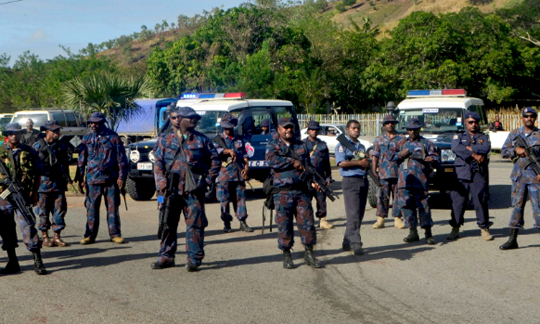
Sydney, May 15: Seventeen prisoners have been shot dead after a mass breakout at a jail in Papua New Guinea, reports said on Monday, with 57 still on the run.

prison

Inmates from the Buimo jail in the Pacific nation's second largest city Lae made a dash for freedom after breaking out of their compound on Friday, with prison warders opening fire.

Papua New Guinea Post-Courier and The National newspapers both cited local police as confirming 17 were killed, three were caught and 57 were still at large.

‘Threat to the community'

“These are undesirable people and will be a threat to the community,” Lae police metropolitan commander Chief Superintendent Anthony Wagambie Jr said of the escapees, warning the public to be vigilant.

“The majority of those who escaped were arrested for serious crimes and were in custody awaiting trial. A good number were arrested by police last year for mainly armed robberies, car thefts, break and enter and stealing,” he said.

Such an incident not new

It is the same prison where police shot dead 12 inmates during a jailbreak last year.

Crime and lawlessness in Papua New Guniea, a sprawling nation where many still live traditional and subsistence lives in remote areas, is rampant.

Mr. Wagambie urged family members and associates of the escapees not to harbour them.

“I am warning them that they will be caught. They must do what is good for them and surrender,” he said.

Comments

Add new comment

  • Coastaldigest.com reserves the right to delete or block any comments.
  • Coastaldigset.com is not responsible for its readers’ comments.
  • Comments that are abusive, incendiary or irrelevant are strictly prohibited.
  • Please use a genuine email ID and provide your name to avoid reject.
Agencies
February 23,2020

Wuhan, Feb 23: Ninety-seven more people died in China due to coronavirus, taking the death toll to 2,442, officials said on Sunday, as a team of WHO experts visited the worst-affected Wuhan city in Hubei province.

By the end of Saturday, a total of 2,442 people had died of the disease and 76,936 confirmed cases of novel coronavirus infection had been reported in 31 provincial-level regions, China's National Health Commission (NHC) said in its daily update on Sunday.

Ninety-six deaths were reported from Hubei province and one from Guangdong province on Saturday besides 648 new confirmed cases of coronavirus infections, it said.

Hubei province, where the virus first emerged in December last, reported 630 new confirmed cases, taking the total confirmed cases in the hard-hit province to 64,084, state-run Xinhua news agency reported.

The NHC also said China's daily number of newly cured and discharged novel coronavirus patients has surpassed that of new confirmed infections for the fifth consecutive day, indicating that cases of infections are coming down.

Saturday saw 2,230 people walk out of hospital after recovery, much higher than the number of the same day's new confirmed infections, which was 648, Xinhua reported.

A total of 22,888 patients infected with the novel coronavirus had been discharged from hospital after recovery by the end of Saturday, NHC said.

Meanwhile, a team of public health experts from the World Health Organisation (WHO) visited Wuhan on Saturday to conduct a detailed probe about the virus which reportedly originated from a seafood market in the city in December last year.

The NHC said WHO experts along with their Chinese counterparts who formed a joint investigation team have held talks with the local health authority in Wuhan and visited relevant healthcare institutions.

The UN team comprises specialists from the United States, Germany, Japan, Nigeria, Russia, Singapore and South Korea, Hong-Kong based South China Morning Post reported.

The 12-member team, which arrived in China on Monday, was initially designated to visit only Beijing, Guangdong and Sichuan provinces, while the worst-affected Hubei province and its capital Wuhan were missing from the list.

However, the team was finally given permission to visit Wuhan by the Chinese government.

Besides controlling the spread of the virus, a major task for the WHO team along with their Chinese counterparts was to come up with standard medicine to cure the disease.

The NHC said on Saturday that the team had met top Chinese respiratory disease expert Zhong Nanshan in Guangdong, and visited the centre for disease control and prevention in Guangdong and the city of Shenzhen, and Sichuan.

The specialists also discussed quarantine measures, the wild animal trade and community prevention measures with their Chinese counterparts, it said.

Comments

Add new comment

  • Coastaldigest.com reserves the right to delete or block any comments.
  • Coastaldigset.com is not responsible for its readers’ comments.
  • Comments that are abusive, incendiary or irrelevant are strictly prohibited.
  • Please use a genuine email ID and provide your name to avoid reject.
Agencies
July 15,2020

Huawei will be completely removed from the UK's 5G networks by the end of 2027, the UK government announced on Tuesday after a review by the country's National Cyber Security Centre (NCSC) on the impact of US sanctions against the Chinese telecommunications giant.

In the lead up to this complete removal of all Huawei kit from UK networks, there will be a total ban on the purchase of any new 5G kit after December 31, 2020.

The decision was taken at a meeting of the UK's National Security Council (NSC) chaired by Prime Minister Boris Johnson, in response to new US sanctions against the telecom major imposed in May which removed the firm's access to products which have been built based on US semiconductor technology.

5G will be transformative for our country, but only if we have confidence in the security and resilience of the infrastructure it is built upon, said Oliver Dowden, UK Secretary of State for Digital, Culture, Media and Sport (DCMS).

Following US sanctions against Huawei and updated technical advice from our cyber experts, the government has decided it necessary to ban Huawei from our 5G networks. No new kit is to be added from January 2021, and UK 5G networks will be Huawei free by the end of 2027. This decisive move provides the industry with the clarity and certainty it needs to get on with delivering 5G across the UK, he said.

The minister, who laid out the details of the UK's ban on Huawei in the House of Commons, said the government will now seek to legislate with a new Telecoms Security Bill to put in place the powers necessary to implement the tough new telecoms security framework.

By the time of the next election (2024) we will have implemented in law an irreversible path for the complete removal of Huawei equipment from our 5G networks, said Dowden.

The new law will give the government the national security powers to impose these new controls on high risk vendors and create extensive security duties on network operators to drive up standards, DCMS said.

Technical experts at the NCSC reviewed the consequences of the US sanctions and concluded that Huawei will need to do a major reconfiguration of its supply chain as it will no longer have access to the technology on which it currently relies and there are no alternatives which we have sufficient confidence in.

They found the new restrictions make it impossible to continue to guarantee the security of Huawei equipment in the future.

After a ban on the purchase of new Huawei kit for 5G from next year, the aim is to completely remove the Chinese vendor's influence on 5G networks across the UK by the end of 2027.

The DCMS said Tuesday's decision takes into account the UK's specific national circumstances and how the risks from these sanctions are manifested in the country.

The existing restrictions on Huawei in sensitive and critical parts of the network remain in place, it highlighted.

The DCMS said the US action also affects Huawei products used in the UK's full fibre broadband networks. However, the UK has managed Huawei's presence in the UK's fixed access networks since 2005 and we also need to avoid a situation where broadband operators are reliant on a single supplier for their equipment.

As a result, following security advice from experts, DCMS is advising full fibre operators to transition away from purchasing new Huawei equipment. A technical consultation will determine the transition timetable, but it is expect this period to last no longer than two years.

The government said its new approach strikes the right balance by recognising full fibre's established presence and supporting the connections that the public relies on, while fully addressing the security concerns.

It stressed that its new policy in relation to high risk vendors has not been designed around one company, one country or one threat but as an enduring and flexible policy that will enable the UK to manage the risks to the network, now and in the future.

Comments

Add new comment

  • Coastaldigest.com reserves the right to delete or block any comments.
  • Coastaldigset.com is not responsible for its readers’ comments.
  • Comments that are abusive, incendiary or irrelevant are strictly prohibited.
  • Please use a genuine email ID and provide your name to avoid reject.
Agencies
July 28,2020

Kuala Lumpur, Jul 28: Malaysia's ex-leader Najib Razak was found guilty Tuesday in his first trial over the multi-billion-dollar 1MDB scandal, two years after the fraud contributed to the downfall of his long-ruling government.

The former prime minister could now face decades in jail after being convicted on all charges in the case related to the looting of sovereign wealth fund 1Malaysia Development Berhad.

Billions of dollars were stolen from the investment vehicle and spent on everything from high-end real estate to pricey art, while investment bank Goldman Sachs also became embroiled in the scandal.

Anger at the looting played a large part in the shock loss of Najib's long-ruling coalition in elections in 2018, and he was arrested and hit with dozens of charges following his defeat.

The verdict was a test of Malaysia's rule of law. It comes about five months after Najib's scandal-plagued party returned to power as part of a coalition, development observers had feared could affect the outcome of the case.

About 16 months after it began, the Kuala Lumpur High Court delivered the verdict in Najib's first trial, which centred on the transfer of 42 million ringgit ($9.9 million) from a former 1MDB unit, SRC International, into his accounts.

Najib had vehemently denied wrongdoing.

But Judge Mohamad Nazlan Mohamad Ghazali took apart all the arguments put forward by his defence, and found him guilty on the seven charges he faced.

"In conclusion, after considering all the evidence in this trial, I find the prosecution has successfully proven the case," the judge told the court.

The charges were one of abuse of power, three of criminal breach of trust and three of money-laundering.

The counts of abuse of power and criminal breach of trust are punishable by up to 20 years in jail each, while the money-laundering charges are punishable by up to 15 years each.

Sentencing was not handed down straight away. The 67-year-old will likely appeal and he may not be sent to jail immediately. If his conviction is upheld, he will also be barred from political office for several years.

Najib had insisted he was ignorant of the transactions.

The defence team portrayed Najib as a victim and instead sought to paint financier Low Taek Jho, a key figure in the scandal who has been charged in the US and Malaysia, as the mastermind.

Low, whose whereabouts are unknown, maintains his innocence.

Prosecutors insisted Najib was in control of the 1MDB unit, SRC International.

The return of Najib's party to power as part of a coalition in March followed the collapse of Mahathir Mohamad's reformist administration.

Since then, 1MDB-linked charges were unexpectedly dropped against the ex-leader's stepson Riza Aziz, a producer of Hollywood movie "The Wolf of Wall Street", in exchange for him agreeing to return assets to Malaysia.

Prosecutors also dropped dozens of charges against Najib ally Musa Aman, the former leader of Sabah state.

The amounts involved in Najib's first case are small compared to those in his second and most significant trial, which centres on allegations he illicitly obtained more than $500 million.

Malaysia had charged Goldman Sachs and some current and former staff, claiming large amounts were stolen when the bank arranged bond issues for 1MDB.

But the two sides agreed to a $3.9 billion settlement last week in exchange for charges being dropped.


Comments

Add new comment

  • Coastaldigest.com reserves the right to delete or block any comments.
  • Coastaldigset.com is not responsible for its readers’ comments.
  • Comments that are abusive, incendiary or irrelevant are strictly prohibited.
  • Please use a genuine email ID and provide your name to avoid reject.