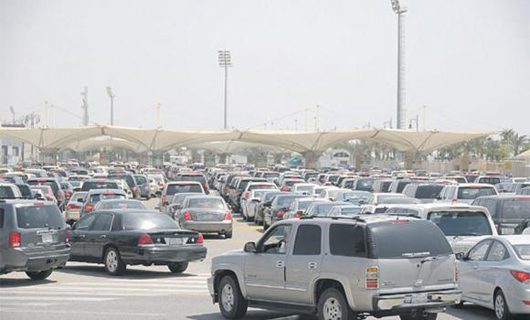
18m vehicles likely on Saudi roads by year-end

October 23, 2014

Riyadh, Oct 23: Eighteen million licensed vehicles are likely to be on Saudi roads by the end of this year, from 17 million last year, according to a study published by Al-Eqtisadiah daily.

The number of licensed cars rose by 7 percent from 2011 to 2012, to 15.9 million vehicles, it said. This was a rise of 975,000 cars from the 14.9 million in 2011.

saudivehicle

About 81 percent of the registered vehicles in 2012 were in the three major provinces of Makkah, Riyadh and the Eastern Province.

Makkah province registered 5.1 million vehicles accounting for 32 percent of the total of 12.8 million vehicles registered in the three provinces in that year.

Riyadh province followed with 4.8 million registered vehicles accounting for 30 percent of the total vehicles registered followed by the Eastern Province with more than 3 million vehicles accounting for 19 percent of all registered vehicles, the report said.

The country’s traders paid SR356 billion to import cars over the past six years. The cost of imports rose 3 percent from SR77 billion in 2012 to SR79 billion last year, according to the study.

The study stated that SR53.8 million worth of cars were imported in 2008, falling 22 percent to SR41.9 billion in 2009, attributed largely to the global financial crisis. However, it increased 22 percent in 2010 to SR51 billion, then SR53.7 billion in 2011 and R76.6 billion in 2012.

Makkah has the dubious credit of recording the most accidents at 1,993 in 2013, followed by the Eastern Province with 1,018, and Riyadh with 554.

Comments

Add new comment

  • Coastaldigest.com reserves the right to delete or block any comments.
  • Coastaldigset.com is not responsible for its readers’ comments.
  • Comments that are abusive, incendiary or irrelevant are strictly prohibited.
  • Please use a genuine email ID and provide your name to avoid reject.
News Network
July 10,2020

Dubai, Jul 10: Saudi Minister of Culture Prince Badr bin Abdullah bin Farhan has appointed Dina Amin as CEO of the Visual Arts Commission.

She will take the lead in implementing the ministry’s vision and directions in promoting and developing visual arts in the Kingdom and empowering practitioners in the field.

Amin is a leading Saudi specialist in visual arts and the international contemporary art field. She gained a bachelor’s degree in art history and architecture from Wellesley College, in the US, and also attended a collaborative program in architecture at Massachusetts Institute of Technology.

During her career, spanning more than two decades, she has held senior positions in prominent international arts companies, including most recently Phillips, a global auction house for art, design, watches, jewels, and more.

She has also worked at Christie’s, one of the world’s most famous auction houses, employed in senior roles at the company’s international offices including New York, Dubai, and London.

The Visual Arts Commission is one of 11 new cultural bodies recently launched by the Ministry of Culture in line with the Saudi Vision 2030 reform plan to manage the empowerment and development of the Kingdom’s cultural sector. The commission will be responsible for managing and developing the visual arts sector to help achieve the ministry’s goals.

Comments

Add new comment

  • Coastaldigest.com reserves the right to delete or block any comments.
  • Coastaldigset.com is not responsible for its readers’ comments.
  • Comments that are abusive, incendiary or irrelevant are strictly prohibited.
  • Please use a genuine email ID and provide your name to avoid reject.
News Network
May 11,2020

May 11: Saudi Arabia will triple its value-added tax rate and suspend a cost of living allowance for state workers, it said on Monday, seeking to shield finances hit by low oil prices and a slump in demand for its lifeline export worsened by the new coronavirus.

Historic oil output cuts agreed by Riyadh and other major producers have given only limited support to prices after they sank on oversupply caused by a war for petroleum market share between the kingdom and its fellow oil titan Russia.

Saudi Arabia, the world's largest oil exporter, is also being hit hard by measures to fight the new coronavirus, which are likely to curb the pace and scale of economic reforms launched by Crown Prince Mohammed bin Salman.

"The cost of living allowance will be suspended as of June 1, and the value added tax will be increased to 15% from 5% as of July 1," Finance Minister Mohammed al-Jadaan said in a statement reported by the state news agency. "These measures are painful but necessary to maintain financial and economic stability over the medium to long term...and to overcome the unprecedented coronavirus crisis with the least damage possible."

The austerity measures come after the kingdom posted a $9 billion budget deficit in the first quarter.

The minister said non-oil revenues were affected by the suspension and decline in economic activity, while spending had risen due to unplanned strains on the healthcare sector and the initiatives taken to support the economy.

"All these challenges have cut state revenues, pressured public finances to a level that is hard to deal with going forward without affecting the overall economy in the medium to long term, which requires more spending cuts and measures to support non-oil revenues stability," he added.

The government has cancelled and put on hold some operating and capital expenditures for some government agencies, and cut allocations for some reform initiatives and projects worth a total 100 billion riyals ($26.6 billion), the statement said.

Central bank foreign reserves fell in March at their fastest rate in at least 20 years and to their lowest since 2011, while oil revenues in the first three months of the year fell 24% from a year earlier to $34 billion, pulling total revenues down 22%.

"The reforms are positive from a fiscal side as greater adjustment is essential. However, the tripling of VAT is unlikely to help that much in 2020 revenue wise with the expected fall in consumption," said Monica Malik, chief economist at Abu Dhabi Commercial Bank.

She said she kept unchanged her deficit forecast of 16.3% of GDP for this year, which already factors in a greater than previously announced spending cut.

About 1.5 million Saudis are employed in the government sector, according to official figures released in December.

In 2018, Saudi Arabia's King Salman ordered a monthly payment of 1,000 riyals ($267) to every state employee to compensate them for the rising living costs after the government hiked domestic gas prices and introduced value-added tax.

DIFFICULT TIMES

A committee has been formed to study all financial benefits paid to public sector employees and contractors, and will submit recommendations within 30 days, the statement said.

In late 2015, when oil prices fell from record highs, the kingdom slashed lavish bonuses, overtime payments and other benefits once considered routine perks in the public sector.

In a country without elections and with political legitimacy resting partly on distribution of oil revenue, the ability of citizens to adapt to such reforms is crucial for stability.

"Tripling the VAT will test the limits of the balance between revenues and consumption as the economy dives into a deep recession. The move will impact consumption and could also lower the expected revenues," said John Sfakianakis, a Gulf expert at the University of Cambridge.

"These are pro-austerity and pro-revenue moves rather than pro-growth ones," he said.

Hasnain Malik, head of equity strategy at Tellimer, said the VAT rise could bring about $24-$26.5 billion in additional non-oil fiscal revenue. The rise would hit consumer spending further but was a needed step towards fiscal sustainability, he said.


Comments

Add new comment

  • Coastaldigest.com reserves the right to delete or block any comments.
  • Coastaldigset.com is not responsible for its readers’ comments.
  • Comments that are abusive, incendiary or irrelevant are strictly prohibited.
  • Please use a genuine email ID and provide your name to avoid reject.
News Network
January 8,2020

Dubai, Jan 8: A Ukrainian airliner crashed soon after taking off from Tehran's Imam Khomeini airport on Wednesday, killing all 176 people aboard, Iran's state television and Ukraine's leaders said.

The Boeing 737 belonging to Ukraine International Airlines crashed near the airport and burst into flames. Ukraine's embassy in Iran, citing preliminary information, said the plane had suffered engine failure and the crash was not caused by "terrorism".

Ukraine President Volodymyr Zelenskiy said there were no survivors.

"My sincere condolences to the relatives and friends of all passengers and crew," Zelenskiy said in a statement, adding that Ukraine was seeking to establish the circumstances of the crash and the death toll.

Iranian TV said the crash was due to technical problems but did not elaborate. State broadcaster IRIB said on its website that one of the plane's two black boxes - the flight data recorder and the cockpit voice recorder - had been found.

Iranian media quoted an Iranian aviation official as saying the pilot of the airliner did not declare an emergency.

There was no official word from Ukraine International Airlines. It was the Kiev-based airline's first fatal crash.

"The fire is so heavy that we cannot (do) any rescue... we have 22 ambulances, four bus ambulances and a helicopter at the site," Pirhossein Koulivand, head of Iran's emergency services, told Iranian state television.

Ukraine's prime minister and Iranian state TV said 167 passengers and 9 crew were on board. Iranian TV said 32 of those on board were foreigners.

Television footage showed debris and smouldering engine parts strewn across a field, and rescue workers with face masks retrieving bodies of the victims.

According to air tracking service FlightRadar24, the plane that crashed was Flight PS 752 and was flying to Kiev. The plane was three years old and was a Boeing 737-800NG, it said.

The model's twin engines are made by CFM International, a U.S.-French venture co-owned by General Electric and France's Safran.

Modern aircraft are designed and certified to cope with an engine failure shortly after take-off and to fly for extended periods on one engine. However, an uncontained engine failure releasing shrapnel can cause damage to other aircraft systems.

A spokesman for Boeing said the company was aware of media reports of a plane crash in Iran and was gathering more information. The plane manufacturer grounded its 737 MAX fleet in March after two crashes that killed 346 people.

The 737-800 is one of the world's most-flown models with a good safety record and which does not have the software feature implicated in crashes of the 737 MAX.

Under international rules overseen by the United Nations, Iran is responsible for leading the crash investigation.

Ukraine would be involved and the United States would usually be accredited as the country where the Boeing jet was designed and built. France, where the engine maker CFM has half its activities, may also be involved.

There was no immediate word on whether the U.S. National Transportation Safety Board would be involved in the probe amid escalating tensions between the U.S. and Iran. The NTSB usually invites Boeing to give technical advice in such investigations.

Comments

Add new comment

  • Coastaldigest.com reserves the right to delete or block any comments.
  • Coastaldigset.com is not responsible for its readers’ comments.
  • Comments that are abusive, incendiary or irrelevant are strictly prohibited.
  • Please use a genuine email ID and provide your name to avoid reject.