



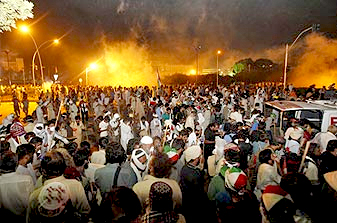
2 killed, 450 injured in police crackdown on protesters in Pak

August 31, 2014

Anti-govt protestersIslamabad, Aug 31: At least two persons were killed and about 450 others injured overnight when police baton- charged hundreds of anti-government protesters led by Imran Khan and Tahir-ul-Qadri who marched towards Prime Minister Nawaz Sharif's residence here demanding his resignation.

The clashes started after Tehrik-e-Insaf chairman Khan and Awami Tehrik chief Qadri yesterday ordered their hundreds of supporters to shift the protest venue in the front of the residence of Prime Minister Sharif to force him to quit.

Police fired tear gas shells and rubber bullets to disperse the protesters outside the prime minister's official residence and the adjacent parliament building.

Hundreds of protesters entered the lawn of parliament but they were pushed back at the main entrance of the building where army was deployed.

About 450 injured were brought to Polyclinic and Pakistan Institute of Medical Sciences, the two premier state-run hospitals, a government official said.

A police official said over 70 policemen and five Frontier Constabulary personnel were injured in clashes with protesters armed with sticks, catapults and stones.

Dr Ayesha Isani of the Pakistan Institute of Medical Sciences hospital told reporters that a man brought to the hospital late last night had passed away.

She confirmed that earlier a man was brought dead to the hospital who had drowned by falling into a trench.

So far the protesters failed to break into the security cordon and reach the PM House.

Khan was present in his container mounted on a truck and frequently addressed his supporters. He said he will register cases against the Sharif brothers and interior minister Nisar Ali Khan for ordering crackdown on protesters.

His party leader Pervaiz Khattak said that they will not stop until Sharif resigns, as the protest entered 18th day.

Qadri today emerged from his container and addressed the supporters in husky voice which he said was due to effect tear gas. "I salute my sons and daughters who won today," he said without explaining.

He promised to make another speech later on and vowed to continue to struggle till final victory of "revolution".

Fearing backlash from protesters, roads leading to Prime Minister Sharif's Lahore residence, where he is currently residing, have been blocked and heavy contingent of police deployed. His brother and Punjab Chief Minister Shahbaz Sharif is also living there.

Sharif had left the prime minister house in Islamabad for his Lahore residence, which is sprawling on acres of land, on Friday along with his personal staff.

"Sharif had vacated the prime minister house fearing it might come under siege from the protesters," a source in the ruling PML-N said.

"Sharif will not move to the prime minister house in Islamabad till the police manage to clear the area from Khan's Pakistan Tahreek-i-Insaf and Qadri's Pakistan Awami Tahreek," the source said, adding Sharif and his family members would not travel by road in the present circumstances.

Information Minister Pervaiz Rashid said that protesters had committed a crime by attacking parliament which is a "symbol of democracy".

Intermittent clashes are continuing and fresh contingents of police were sent this morning as reinforcement.

The situation was very tense in the capital as a number of demonstrators refused to budge from the protest site.

Both the leaders are agitating since August 14 against alleged rigging during the last year general elections.

A late night government announcement categorically ruled out Sharif's resignation and there is no threat to his life.

Meanwhile, the protesters clashed with police at famous Liberty Chowk and the Mall Road in Lahore. Half a dozen protesters suffered injuries and were shifted to hospital where their condition is stated to be out of danger.

A group of Khan's supporters gathered outside the residence of Defense Minister Khawaja Asif in Sialkot, some 150 km from Lahore, and pelted stones at it.

Police, however, managed to disperse them.

In Multan, some 350 km from Lahore, the Tehrik-e-Insaf activists blocked the motorway road for several hours. Police used baton to disperse them.

Tehrik-e-Insaf Punjab president Ejaz Chaudhry said: "Today we will block all entry and exit points of Punjab province. We will bring the life to standstill to pressure Nawaz Sharif to resign."

Opposition leaders have criticised both Khan and Qadri for inciting violence.

Jan Achakzai of Jamiat Ulema-e-Islam said that both Qadri and Khan talked about western democracy but what they did was in clear violation of international democratic norms.

Pakistan People's Party Aitizaz Ahsan said that demand for resignation was illegal and the Prime Minister should not accept it. He blamed the protesters for the violence.

Comments

Add new comment

  • Coastaldigest.com reserves the right to delete or block any comments.
  • Coastaldigset.com is not responsible for its readers’ comments.
  • Comments that are abusive, incendiary or irrelevant are strictly prohibited.
  • Please use a genuine email ID and provide your name to avoid reject.
News Network
January 3,2020

New Delhi, Jan 3: US aviation regulator Federal Aviation Administration on Thursday warned America's airlines and their pilots that there is risk involved in operating flights in Pakistan airspace due to "extremist or militant activity", according to an official document.

"Exercise caution during flight operations. There is a risk to US civil aviation operating in the territory and airspace of Pakistan due to extremist/militant activity," said the US Federal Aviation Administration (FAA) in a notice to airmen (NOTAM) dated December 30, 2019.

The NOTAM is applicable to all US-based airlines and US-based pilots.

The US regulator said in its NOTAM that there continues to be a risk to US civil aviation sector from attacks against airports and aircraft in Pakistan, particularly for aircraft on the ground and aircraft operating at low altitudes, including during the arrival and departure phases of flights.

"The ongoing presence of extremist/militant elements operating in Pakistan poses a continued risk to US civil aviation from small-arms fire, complex attacks against airports, indirect weapons fire, and anti-aircraft fire, any of which could occur with little or no warning," it said.

The FAA said that while, to date, there have been no reports of man-portable air defense systems or Manpads being used against the civil aviation sector in Pakistan, some extremist or terrorist groups operating there are suspected of having access to these Manpads.

"As a result, there is potential risk for extremists/militants to target civil aviation in Pakistan with Manpads," it said.

The regulator added that pilots or airlines must report safety or security incidents - which may happen in Pakistan - to the FAA.

Pakistan on July 16 last year opened its airspace for India after about five months of restrictions imposed in the wake of a standoff with New Delhi.

Following the Balakot airstrikes by the Indian Air Force, Pakistan had closed its airspace on February 26 last year.

Pakistan in October last year had denied India's request to allow Prime Minister Narendra Modi's VVIP flight to use its airspace for his visit to Saudi Arabia over the Jammu and Kashmir issue.

Comments

Add new comment

  • Coastaldigest.com reserves the right to delete or block any comments.
  • Coastaldigset.com is not responsible for its readers’ comments.
  • Comments that are abusive, incendiary or irrelevant are strictly prohibited.
  • Please use a genuine email ID and provide your name to avoid reject.
News Network
March 24,2020

New Delhi, Mar 24: Reports of a person in China dying due to a virus called hantavirus have spread panic at a time when the world is battling the pandemic of novel coronavirus, which began in China.

The novel coronavirus has killed over 16,000 people around the world and the outbreak is yet to be brought under control.

This morning, hantavirus became one of the top trends on Twitter after the Chinese state media tweeted about one person in the country dying due the virus. However, it turns out, hantavirus is not a new virus and has been infecting humans for decades.

Global Times, a state-run English-language newspaper, wrote on Twitter on Tuesday, "A person from Yunnan Province died while on his way back to Shandong Province for work on a chartered bus on Monday. He was tested positive for hantavirus. Other 32 people on bus were tested."

Global Times's hantavirus report on Twitter has been shared over 6,000 times.

On Tuesday, hantavirus was one of the top trends on Twitter.

WHAT IS HANTAVIRUS?

Some people are calling it a new virus but so is not the case. United States's National Center for Biotechnology Information (NCBI) in a journal writes that currently, the hantavirus genus includes more than 21 species.

"Hantaviruses in the Americas are known as 'New World' hantaviruses and may cause hantavirus pulmonary syndrome [HPS]," CDC says. "Other hantaviruses, known as 'Old World' hantaviruses, are found mostly in Europe and Asia and may cause hemorrhagic fever with renal syndrome [HFRS]."

Any man, woman, or child who is around mice or rats that carry harmful hantaviruses can get HPS.

People get HPS when they breath in hantaviruses. This can happen when rodent urine and droppings that contain a hantavirus are stirred up into the air. People can also become infected when they touch mouse or rat urine, droppings, or nesting materials that contain the virus and then touch their eyes, nose, or mouth. They can also get HPS from a mouse or rat bite.

In the US, 10 confirmed cases of hantavirus infection in people who visited Yosemite National Park in California, US, in November 2012, were reported. Similarly, in 2017, CDC assisted health officials in investigating an outbreak of Seoul virus infection that infected 17 people in seven states.

WHAT ARE THE SYMPTOMS OF HANTAVIRUS?

If people get HPS, they will feel sick one to five weeks after they were around mice or rats that carried a hantavirus.

At first people with HPS will have:

Fever
Severe muscle aches
Fatigue

After a few days, they will have a hard time breathing. Sometimes people will have headaches, dizziness, chills, nausea, vomiting, diarrhoea, and stomach pain.

Usually, people do not have a runny nose, sore throat, or a rash.

Comments

Add new comment

  • Coastaldigest.com reserves the right to delete or block any comments.
  • Coastaldigset.com is not responsible for its readers’ comments.
  • Comments that are abusive, incendiary or irrelevant are strictly prohibited.
  • Please use a genuine email ID and provide your name to avoid reject.
Agencies
July 1,2020

The ILO has warned that if another Covid-19 wave hits in the second half of 2020, there would be global working-hour loss of 11.9 percent - equivalent to the loss of 340 million full-time jobs.

According to the 5th edition of International Labour Organisation (ILO) Monitor: Covid-19 and the world of work, the recovery in the global labour market for the rest of the year will be uncertain and incomplete.

The report said that there was a 14 percent drop in global working hours during the second quarter of 2020, equivalent to the loss of 400 million full-time jobs.

The number of working hours lost across the world in the first half of 2020 was significantly worse than previously estimated. The highly uncertain recovery in the second half of the year will not be enough to go back to pre-pandemic levels even in the best scenario, the agency warned.

The baseline model – which assumes a rebound in economic activity in line with existing forecasts, the lifting of workplace restrictions and a recovery in consumption and investment – projects a decrease in working hours of 4.9 percent (equivalent to 140 million full-time jobs) compared to last quarter of 2019.

It says that in the pessimistic scenario, the situation in the second half of 2020 would remain almost as challenging as in the second quarter.

“Even if one assumes better-tailored policy responses – thanks to the lessons learned throughout the first half of the year – there would still be a global working-hour loss of 11.9 per cent at the end of 2020, or 340 million full-time jobs, relative to the fourth quarter of 2019,” it said.

The pessimistic scenario assumes a second pandemic wave and the return of restrictions that would significantly slow recovery. The optimistic scenario assumes that workers’ activities resume quickly, significantly boosting aggregate demand and job creation. With this exceptionally fast recovery, the global loss of working hours would fall to 1.2 per cent (34 million full-time jobs).

The agency said that under the three possible scenarios for recovery in the next six months, “none” sees the global job situation in better shape than it was before lockdown measures began.

“This is why we talk of an uncertain but incomplete recovery even in the best of scenarios for the second half of this year. So there is not going to be a simple or quick recovery,” ILO Director-General Guy Ryder said.

The new figures reflect the worsening situation in many regions over the past weeks, especially in developing economies. Regionally, working time losses for the second quarter were: Americas (18.3 percent), Europe and Central Asia (13.9 percent), Asia and the Pacific (13.5 percent), Arab States (13.2 percent), and Africa (12.1 percent).

The vast majority of the world’s workers (93 per cent) continue to live in countries with some sort of workplace closures, with the Americas experiencing the greatest restrictions.

During the first quarter of the year, an estimated 5.4 percent of global working hours (equivalent to 155 million full-time jobs) were lost relative to the fourth quarter of 2019. Working- hour losses for the second quarter of 2020 relative to the last quarter of 2019 are estimated to reach 14 per cent worldwide (equivalent to 400 million full-time jobs), with the largest reduction (18.3 per cent) occurring in the Americas.

The ILO Monitor also found that women workers have been disproportionately affected by the pandemic, creating a risk that some of the modest progress on gender equality made in recent decades will be lost, and that work-related gender inequality will be exacerbated.

The severe impact of Covid-19 on women workers relates to their over-representation in some of the economic sectors worst affected by the crisis, such as accommodation, food, sales and manufacturing.

Globally, almost 510 million or 40 percent of all employed women work in the four most affected sectors, compared to 36.6 percent of men, it said.

The report said that women also dominate in the domestic work and health and social care work sectors, where they are at greater risk of losing their income and of infection and transmission and are also less likely to have social protection.

The pre-pandemic unequal distribution of unpaid care work has also worsened during the crisis, exacerbated by the closure of schools and care services.

Even as countries have adopted policy measures with unprecedented speed and scope, the ILO Monitor highlights some key challenges ahead, including finding the right balance and sequencing of health, economic and social and policy interventions to produce optimal sustainable labour market outcomes; implementing and sustaining policy interventions at the necessary scale when resources are likely to be increasingly constrained and protecting and promoting the conditions of vulnerable, disadvantaged and hard-hit groups to make labour markets fairer and more equitable.

“The decisions we adopt now will echo in the years to come and beyond 2030. Although countries are at different stages of the pandemic and a lot has been done, we need to redouble our efforts if we want to come out of this crisis in a better shape than when it started,” Ryder said. 

Comments

Add new comment

  • Coastaldigest.com reserves the right to delete or block any comments.
  • Coastaldigset.com is not responsible for its readers’ comments.
  • Comments that are abusive, incendiary or irrelevant are strictly prohibited.
  • Please use a genuine email ID and provide your name to avoid reject.