



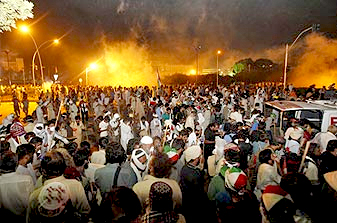
2 killed, 450 injured in police crackdown on protesters in Pak

August 31, 2014

Anti-govt protestersIslamabad, Aug 31: At least two persons were killed and about 450 others injured overnight when police baton- charged hundreds of anti-government protesters led by Imran Khan and Tahir-ul-Qadri who marched towards Prime Minister Nawaz Sharif's residence here demanding his resignation.

The clashes started after Tehrik-e-Insaf chairman Khan and Awami Tehrik chief Qadri yesterday ordered their hundreds of supporters to shift the protest venue in the front of the residence of Prime Minister Sharif to force him to quit.

Police fired tear gas shells and rubber bullets to disperse the protesters outside the prime minister's official residence and the adjacent parliament building.

Hundreds of protesters entered the lawn of parliament but they were pushed back at the main entrance of the building where army was deployed.

About 450 injured were brought to Polyclinic and Pakistan Institute of Medical Sciences, the two premier state-run hospitals, a government official said.

A police official said over 70 policemen and five Frontier Constabulary personnel were injured in clashes with protesters armed with sticks, catapults and stones.

Dr Ayesha Isani of the Pakistan Institute of Medical Sciences hospital told reporters that a man brought to the hospital late last night had passed away.

She confirmed that earlier a man was brought dead to the hospital who had drowned by falling into a trench.

So far the protesters failed to break into the security cordon and reach the PM House.

Khan was present in his container mounted on a truck and frequently addressed his supporters. He said he will register cases against the Sharif brothers and interior minister Nisar Ali Khan for ordering crackdown on protesters.

His party leader Pervaiz Khattak said that they will not stop until Sharif resigns, as the protest entered 18th day.

Qadri today emerged from his container and addressed the supporters in husky voice which he said was due to effect tear gas. "I salute my sons and daughters who won today," he said without explaining.

He promised to make another speech later on and vowed to continue to struggle till final victory of "revolution".

Fearing backlash from protesters, roads leading to Prime Minister Sharif's Lahore residence, where he is currently residing, have been blocked and heavy contingent of police deployed. His brother and Punjab Chief Minister Shahbaz Sharif is also living there.

Sharif had left the prime minister house in Islamabad for his Lahore residence, which is sprawling on acres of land, on Friday along with his personal staff.

"Sharif had vacated the prime minister house fearing it might come under siege from the protesters," a source in the ruling PML-N said.

"Sharif will not move to the prime minister house in Islamabad till the police manage to clear the area from Khan's Pakistan Tahreek-i-Insaf and Qadri's Pakistan Awami Tahreek," the source said, adding Sharif and his family members would not travel by road in the present circumstances.

Information Minister Pervaiz Rashid said that protesters had committed a crime by attacking parliament which is a "symbol of democracy".

Intermittent clashes are continuing and fresh contingents of police were sent this morning as reinforcement.

The situation was very tense in the capital as a number of demonstrators refused to budge from the protest site.

Both the leaders are agitating since August 14 against alleged rigging during the last year general elections.

A late night government announcement categorically ruled out Sharif's resignation and there is no threat to his life.

Meanwhile, the protesters clashed with police at famous Liberty Chowk and the Mall Road in Lahore. Half a dozen protesters suffered injuries and were shifted to hospital where their condition is stated to be out of danger.

A group of Khan's supporters gathered outside the residence of Defense Minister Khawaja Asif in Sialkot, some 150 km from Lahore, and pelted stones at it.

Police, however, managed to disperse them.

In Multan, some 350 km from Lahore, the Tehrik-e-Insaf activists blocked the motorway road for several hours. Police used baton to disperse them.

Tehrik-e-Insaf Punjab president Ejaz Chaudhry said: "Today we will block all entry and exit points of Punjab province. We will bring the life to standstill to pressure Nawaz Sharif to resign."

Opposition leaders have criticised both Khan and Qadri for inciting violence.

Jan Achakzai of Jamiat Ulema-e-Islam said that both Qadri and Khan talked about western democracy but what they did was in clear violation of international democratic norms.

Pakistan People's Party Aitizaz Ahsan said that demand for resignation was illegal and the Prime Minister should not accept it. He blamed the protesters for the violence.

Comments

Add new comment

  • Coastaldigest.com reserves the right to delete or block any comments.
  • Coastaldigset.com is not responsible for its readers’ comments.
  • Comments that are abusive, incendiary or irrelevant are strictly prohibited.
  • Please use a genuine email ID and provide your name to avoid reject.
News Network
March 28,2020

Washington, Mar 28: The world is in the face of a devastating impact due to the coronavirus pandemic and has clearly entered a recession, the International Monetary Fund said on Friday, but projected a recovery next year.

"We have reassessed the prospects for growth for 2020 and 2021. It is now clear that we have entered a recession as bad or worse than in 2009. We do project recovery in 2021," IMF Managing Director Kristalina Georgieva told reporters at a news conference.

Georgieva was addressing the press after a meeting of governing body of the IMF, the International Monetary and Financial Committee. Representing 189 members, the body met virtually to discuss the unprecedented challenge posed to the world by COVID-19.

The key to recovery in 2021, she said, is only if the international community succeeds in containing the virus everywhere and prevent liquidity problems from becoming a solvency issue.

"The US is in recession, as is the rest of the advanced economies of the world. And in a big chunk of developed and emerging markets in developing economies. How severe? We are working now on our projections for 2020, Georgieva said in response to a question.

The new projections are expected in the next few weeks.

Stressing that while containment is the main reason for the economy to stand still and get into a recession, she said containment is very necessary to come out of this period and step in to recovery. "Until the virus is not contained, it would be very difficult to go to the lives we love."

"A key concern about a long-lasting impact of the sudden stop of the world economy is the risk of a wave of bankruptcies and layoffs that not only can undermine the recovery. But can erode the fabric of our societies," the IMF chief said.

To avoid this from happening, many countries have taken far-reaching measures to address the health crisis and to cushion its impact on the economy, both on the monetary and on the fiscal side, she said.

The IMF chief said 81 emergency financing requests, including 50 from lower-income countries, have been received. She said current estimate for the overall financial needs of emerging markets is 2.5 trillion dollars.

"We believe this is on the lower end. We do know that their own reserves and domestic resources will not be sufficient," she added.

The G-20, a day earlier, reported fiscal measures totalling some 5 trillion dollars or over 6 per cent of the global GDP.

Responding to another question, Georgieva said the IMF is projecting recession for 2020.

"We do expect it to be quite deep and we are very much urging countries to step up containment measures aggressively so we can shorten the duration of this period of time when the economy is in standstill," she said.

"And also to apply well-targeted measures, primarily focusing on the health system to absorb that enormous stress that comes from coronavirus. And on people, businesses and the financial system, I am very pleased to say that when we went through countries' responses, that sense of targeted fiscal measures is there and are also very impressive to see the size of these measures," she added.

"Countries are doing all they can on the fiscal and on the monetary front. We have heard from our members' very impressive decisions taken over the last days," the IMF chief said.

"We also want to caution that as we are responding now, we want to make the recession as possibly short and not too deep. We also want to think about what is going to follow the recovery and make sure that we are putting forward measures that can be supportive in this regard," she said.

Comments

Add new comment

  • Coastaldigest.com reserves the right to delete or block any comments.
  • Coastaldigset.com is not responsible for its readers’ comments.
  • Comments that are abusive, incendiary or irrelevant are strictly prohibited.
  • Please use a genuine email ID and provide your name to avoid reject.
News Network
May 19,2020

May 18: Risk managers expect a prolonged global recession as a result of the coronavirus pandemic, a report by the World Economic Forum showed on Tuesday.

Two-thirds of the 347 respondents to the survey - carried out in response to the outbreak - put a lengthy contraction in the global economy top of their list of concerns for the next 18 months.

Half of risk managers expected bankruptcies and industry consolidation, the failure of industries to recover and high levels of unemployment, particularly among the young.

“The crisis has devastated lives and livelihoods. It has triggered an economic crisis with far-reaching implications and revealed the inadequacies of the past," said Saadia Zahidi, managing director of the World Economic Forum.

Environmental goals risk being discarded as a result of the pandemic, the report said, but governments should try to carve out a "green recovery".

"We now have a unique opportunity to use this crisis to do things differently and build back better economies that are more sustainable, resilient and inclusive," Zahidi said.

The report was compiled by the World Economic Forum’s Global Risks Advisory Board together with Marsh & McLennan Companies Inc and Zurich Insurance Group.

Risk managers were surveyed between April 1 and 13.

Comments

Add new comment

  • Coastaldigest.com reserves the right to delete or block any comments.
  • Coastaldigset.com is not responsible for its readers’ comments.
  • Comments that are abusive, incendiary or irrelevant are strictly prohibited.
  • Please use a genuine email ID and provide your name to avoid reject.
News Network
February 19,2020

Washington, Feb 19: US President Donald Trump has said he is "saving the big deal" with India for later and he "does not know" if it will be done before the presidential election in November, clearly indicating that a major bilateral trade deal during his visit to Delhi next week might not be on the cards.

"We can have a trade deal with India. But I'm really saving the big deal for later," he told reporters at Joint Base Andrews Tuesday afternoon (local time).

The US and India could sign a "trade package" during the visit, according to media reports.

Asked whether he expects a trade deal with India before the visit, Trump said, "We're doing a very big trade deal with India. We'll have it. I don't know if it'll be done before the election, but we'll have a very big deal with India."

US Trade Representative Robert Lighthizer, the point-person for trade negotiations with India, is likely to not accompany Trump to India, sources said. However, officials have not ruled it out altogether.

In an apparent dissatisfaction over US-India trade ties, Trump said, "We're not treated very well by India." But he praised Prime Minister Narendra Modi and said he is looking forward to his visit to India.

"I happen to like Prime Minister Modi a lot," Trump said.

"He told me we'll have seven million people between the airport and the event. And the stadium, I understand, is sort of semi under construction, but it's going to be the largest stadium in the world. So it's going to be very exciting... I hope you all enjoy it," he told reporters.

Meanwhile, the US-India Strategic and Partnership Forum (USISPF) in a report said the latest quarterly data depict continuation of overall positive bilateral trade trends. The third quarter data reflects some downslide in growth rates.

"It may be due to several reasons, including the unexpected economic slowdown in India's economic growth, impact of US-China trade war, GSP withdrawal from the US side and retaliatory tariffs on specific US goods from the Indian side," USISPF said.

According to the report, the data available for the first three quarters of 2019 (January-September) pulled the overall growth rate in cumulative bilateral trade down to 4.5 percent from 8.4 percent registered for the first two quarters.

Goods and services trade performance in third quarter was dismal at -2.3 percent, in contrast with the impressive 9.6 percent growth witnessed for the first two quarters of the year; while trade in services was up two percent goods trade dropped five percent, the report said.

The cumulative US-India trade in goods and services (USD 110.9 billion) for the first three quarters of 2019 increased 4.5 percent with US exports and imports growing at four percent and five percent respectively.

The US exported USD 45.3 billion worth of goods and services to India in the first three quarters 2019, up 4 percent from the corresponding period in the previous year; and the US imported USD 65.6 billion worth of goods and services from India, up five percent from the previous year's USD 62.5 billion level for the same period, it said.

The USISPF has projected that the total bilateral trade can touch USD 238 billion by 2025 if the current 7.5 percent average annual rate of growth sustains; however, higher growth rates can result in bilateral trade in the range of USD 283 billion and USD 327 billion.

The US remains the top trading partner for India in terms of trade in goods and services, followed by China. While the bilateral trade between US and India is approximately 62 percent in goods and 38 percent in services, the bilateral trade between India and China is dominated by goods.

China had a huge trade surplus of USD 58 billion with India, indicating Beijing's strength in the Indian market, especially in sectors, such as electronics, machinery, organic chemicals, plastics and medical devices.

The US goods exports to India, in comparison, were mainly concentrated in mineral fuels, precious stones, and aircraft. The US faces tough competition with China in the Indian market in areas such as electronics, machinery, organic chemicals and medical devices.

Comments

Add new comment

  • Coastaldigest.com reserves the right to delete or block any comments.
  • Coastaldigset.com is not responsible for its readers’ comments.
  • Comments that are abusive, incendiary or irrelevant are strictly prohibited.
  • Please use a genuine email ID and provide your name to avoid reject.