



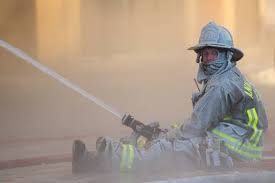
 New York/Milwaukee, Jan 9: A DEEP freeze has spread from the US midwest to the east and south, setting record low temperatures from Boston to Birmingham, and leaving 21 people dead.
The midwest and the east experienced temperatures colder than much of Antarctica. All 50 states have seen freezing temperatures, including Hawaii, where it was -8ÚC (18ÚF) on top of Mauna Kea, a dormant volcano.
The big chill started in the midwest over the weekend and has spread to cover about half of the country.
In New York City, the high was expected to be -12ÚC (10ÚF), and in Boston, around -8ÚC (18ÚF).
Across the south, records were shattered like icicles. Birmingham, Alabama, dipped to a low of -14ÚC ( 7ÚF), breaking the record of -11.7ÚC (11ÚF) set in 1970.
The deep freeze dragged on in the midwest as well, with the thermometer reaching -24ÚC (-12ÚF) overnight in the Chicago area.
More than 500 passengers were stranded overnight on three Chicago-bound trains that were stopped by blowing and drifting snow in Illinois. Food ran low, but the heat stayed on.
The authorities reported at least 21 cold-related deaths since Sunday including five people who collapsed while shovelling snow.
Earlier:
'Polar freeze' extends to eastern United States, at least 9 dead
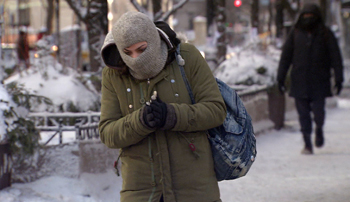 New York/Milwaukee, Jan 8: A deadly blast of arctic air shattered decades-old temperature records as it enveloped the eastern United States on Tuesday, snarling air, road and rail travel, driving energy prices higher and overwhelming shelters for homeless people.
At least nine deaths have been reported across the country connected with the polar air mass that swept over North America during the past few days. Authorities have put about half of the United States under a wind chill warning or cold weather advisory.
Temperatures were expected to be 25 degrees to 35 degrees Fahrenheit (14 to 19 degrees celcius) below normal from the Midwest to the Southeast, the National Weather Service said.
PJM Interconnection, the agency that oversees the electric grid supplying the mid-Atlantic and parts of the Midwest, said electricity suppliers were struggling to keep up with surging demand as the cold forced some power plants to shut.
"This particular cold is far-reaching, and most of our neighbors are experiencing the extreme conditions we are," said Michael Kormos, executive vice-president for operations at PJM Interconnection.
Oil refiners were also hit, with Marathon Petroleum Corp and Exxon Mobil Corp both experiencing cold-related outages.
In Oklahoma, a depleted supply of propane due to extreme weather led governor Mary Fallin to declare a state of emergency, waiving licensing requirements for out-of-state transportation companies to allow them to bring in propane.
Homeless shelters and public buildings took in people who were freezing outside.
Daniel Dashner, a 33-year-old homeless man who typically sleeps under a bridge on Milwaukee's south side, said he opted to seek a spot at a shelter on Monday night.
"Usually if I have four or five blankets, I can stay pretty warm, but when that wind is blowing, I don't care how many blankets I have, the wind blows right through me," he said, as temperatures dropped to minus 6 degrees Fahrenheit (minus 21 degrees celcius).
The extreme cold won't last much longer, according to AccuWeather.com. The frigid air and " polar vortex" that affected about 240 million people in the United States and southern Canada will depart during the second half of this week, and a far-reaching January thaw will begin, according to AccuWeather.com.
Cold's broad reach
Major US cities were in the grip of temperatures well below freezing, with Chicago seeing 2 degrees Fahrenheit (minus 17 C), Detroit 0 F (minus 18 C), Pittsburgh 5 F (minus 15 C), Washington 19 (minus 7 C) and Boston 15 F (minus 9 C).
New York's Central Park recorded the lowest temperature for the date, 4 Fahrenheit (minus 16 C), rising to 9 F (minus 13 C) on Tuesday afternoon with wind chills making it feel much colder, meteorologists said.
At New York's Bowery Mission homeless shelter, the 80-bed dormitory was full on Monday night and 179 other people slept in the chapel and cafeteria, officials said.
Schools in Minneapolis and Chicago were closed for a second day on Tuesday, although Chicago plans to reopen schools on Wednesday. Cleveland remained below freezing after temperatures fell to minus 11 F (minus 24 C) on Monday, breaking a 130-year-old record.
Impassable snow and ice halted three Chicago-bound Amtrak trains on Monday, stranding more than 500 passengers overnight in northwestern Illinois.
In the normally mild south, Atlanta recorded its coldest weather on this date in 44 years, as the temperature dropped to 6 degrees Fahrenheit (minus 14 degrees celcius), while temperatures in northern Florida also briefly dropped below freezing, though the state's citrus crop was unharmed, according to a major growers' group.
Among the deaths reported was a 51-year-old homeless man in Columbus, Georgia, whose body was found in an empty lot after spending the night outdoors.
Two men died in Westerport, Massachusetts, while duck hunting on Tuesday when their boat capsized, dropping them into a frigid river, officials said. A third man was rescued.
A large avalanche in backcountry outside the Colorado ski resort area of Vail killed one person on Tuesday and caught up three others who survived and were being rescued, officials said. Avalanche danger in the area was rated as "considerable" due to high winds and recent heavy snows, said Spencer Logan, forecaster with the Colorado Avalanche Information Center.
Four cold and storm-related deaths were reported around Chicago and an elderly woman was found dead outside her Indianapolis home early Monday.
Airlines struggle
The cold snap could cost the US economy up to $5 billion, when lost productivity and lost retail sales are accounted for, estimated Evan Gold, senior vice-president at Planalytics, which tracks weather for businesses. He said about 200 million people in major cities might face "bill shock" for heating.
The deep freeze disrupted commutes on Tuesday, with icy or closed roads and flight delays. Some 2,380 US flights were canceled and 2,912 delayed, according to FlightAware.com, which tracks airline activity. Airlines scrambled to catch up a day after the cold froze fuel supplies, leading to flight cancellations, many at Chicago O'Hare International Airport.
Hardest hit were travelers who had booked trips on JetBlue Airways Corp, which on Monday halted its flights at New York's three major airports and Boston Logan International Airport overnight. Flights had resumed by midday on Tuesday.
Tuesday proved too cold even for some polar bears. At Lincoln Park Zoo in Chicago, a 14-year-old female polar bear named Anana mostly remained in her indoor enclosure, where temperatures are 40 F (4 C), said zoo spokeswoman Sharon Dewar.
She said that in their native environment, polar bears build up a layer of fat to help them through the Arctic winter of long periods of sub-zero temperatures. In Chicago, however, she said "we don't create that fat layer in zoo animals because that would normally not be something they would be comfortable with."
Earlier:
'Polar freeze' grips United States, disrupts travel, business
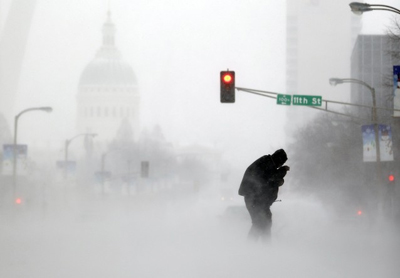 Chicago/Cleveland, Jan 7: A blast of Arctic air gripped the vast middle of the United States on Monday, bringing the coldest temperatures felt in two decades, causing at least four deaths, forcing businesses and schools to close and canceling thousands of flights.
Shelters for the homeless were overflowing and the weather threatened to briefly curtail some oil production in the severe cold described by some meteorologists as the " polar vortex" and dubbed by media as the "polar pig".
Temperatures were 20 to 40 degrees F (11-22 degrees C) below average in parts of Montana, North and South Dakota, Minnesota, Iowa, Wisconsin, Michigan and Nebraska, according to the National Weather Service.
More than half the flights at Chicago's O'Hare International Airport were closed as fuel supplies froze, leaving crews unable to fill aircraft tanks. The afternoon temperature in Chicago was minus 12 degrees Fahrenheit (minus 24 degrees C), making it colder than in areas of Antarctica, parts of which hovered around 32 F (0 C) during the southern hemisphere summer.
The Arctic air was moving toward the east coast where temperatures were expected to fall throughout Monday as low as 0 degrees Fahrenheit (minus 18 degrees celsius) in some areas on Tuesday. The coldest temperatures in years and gusty winds were expected as far south as Brownsville, Texas and central Florida, the National Weather Service said.
The northeast saw unseasonably mild weather and rain, but authorities warned travelers to expect icy roads and sidewalks on Tuesday.
At least four weather-related deaths were reported. In northwest Missouri, a one-year-old boy died Monday when the vehicle he was riding in crashed into a snow plow on an icy highway, according to the Missouri State Highway Patrol.
In Indianapolis, firefighters found the body of an elderly woman outside her home early on Monday.
"It appeared she had been there for a while," said Captain Michael Pruitt of the Wayne Township fire department.
A 58-year-old man died on Sunday in northeastern Oklahoma after he lost control of his car on icy roads, the Oklahoma Highway Patrol said. In Chicago, a 48-year-old man died of a heart attack while shoveling snow on Sunday night.
In oil fields from Texas to North Dakota and Canada, the severe cold threatened to disrupt traffic, strand wells and interrupt drilling and fracking operations.
It also disrupted grain and livestock shipments throughout the farm belt, curbed meat production at several packing plants and threatened to damage the dormant wheat crop.
Life-threatening wind chills
In Cleveland, Ohio, where the temperature was minus 3 degrees F (minus 19 degrees C) and was forecast to drop to minus 6 degrees F (minus 21 degrees C) overnight, homeless shelters were operating at full capacity. Shelter operators had begun to open overflow facilities to accommodate more than 2,000 people who had come seeking warmth.
"There are also going to be people that won't go into the shelters," said Brian Davis, an organizer with Northeast Ohio Coalition for the Homeless. Frostbite can set in within minutes in such low temperatures, according to experts.
The National Weather Service issued warnings for life-threatening wind chills in western and central North Dakota, with temperatures as low as minus 60 F (minus 51 C).
The US cold snap mirrored or outdid freezing weather in parts of the world as Almaty, Kazakhstan where it was minus 8 degrees F (minus 22 C), Mongolia, where temperatures reached minus 10 degrees F (minus 23 C) and Irkutsk, in Siberia, where it was minus 27 degrees F (minus 33 C).
Travel snarled
Some 4,392 flights were canceled and 3,577 delayed, according to FlightAware.com, which tracks airline activity.
Many airlines could not allow their ground crews to remain outdoors for more than 15 minutes at a time. There were hundreds of cancellations by airlines including United, Southwest , and American.
"The fuel and glycol supplies are frozen at (Chicago O'Hare) and other airports in the midwest and northeast," said Andrea Huguely, a spokeswoman for American Airlines Group. "We are unable to pump fuel and or de-ice."
After five days of scrambling to catch up from storm delays, JetBlue said it would halt operations at three airports in the New York area and Boston Logan International Airport from 5pm EST (2200 GMT) Monday until 10am EST (1500 GMT) on Tuesday to give crews time to rest.
The bitter cold combined with blowing snow was complicating rail traffic as well. Union Pacific, one of the largest railroads and a chief mover of grains, chemicals, coal and automotive parts, warned customers on Monday that the weather was causing delays up to 48 hours across Illinois, Iowa, Minnesota, Missouri and Wisconsin.
Following last week's storm that dumped up to two feet (60cm) of snow on parts of New England, some shoppers opted for the comforts of home rather than venturing out to shop.
Many people did not have the luxury of staying home.
In the western Chicago suburb of Geneva, Beth Anderson, 38, was shoveling the remains of Sunday's snow from her driveway before sunrise on Monday while warming up her pickup truck for the short drive to her job at a mall.
"I just wish I could get the day off too but it would take more than a bit of weather to close down the mall where I work," she said.


Comments
Add new comment