



217 dead in Pakistan earthquake

September 24, 2013

Pakistan_earthquake

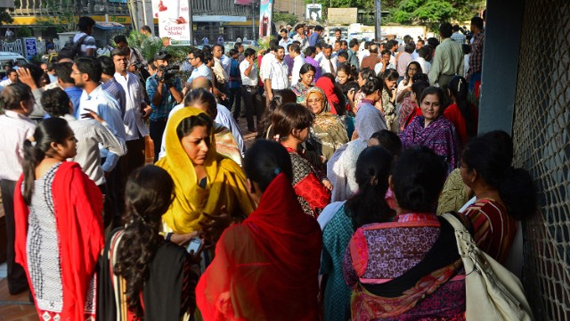
Islamabad, Sep 25: The death toll in the devastating earthquake that struck havoc in Pakistan's southwestern Balochistan province rose to 217 today, amid fears that it is likely to go up.

Many of the far-flung areas in Balochistan are yet to be reached by rescue teams because of the terrain and lack of proper roads.

Home Secretary Asad Gilani said yesterday's 7.7-magnitude earthquake had claimed the lives of 208 people and injured 350 others in Awaran district, Dawn daily quoted him as saying.

Deaths of seven more people were reported from Turbat city in Kech district of Balochistan.

Gilani that the long distance and disrupted road routes were causing obstacles to the relief efforts.

Chief Minister Balochistan Abdul Malik Baloch yesterday declared an emergency in Awaran and five other districts.

Over 300 Army and Frontier Corps troops are already involved in rescue operations and military sources said further troops have been mobilised to the affected areas.

A large number of people were rescued from the debris of houses and the injured were given emergency medical aid by army and FC doctors and paramedics. Locals in Awaran district said no building in the town, including those of hospitals, schools and government buildings, remained intact.

The government of Balochistan has dispatched 1000 tents, 500 food bags, medicines, 15 ambulances towards Awaran, said Jan Buledi, the spokesman for Balochistan government.

Addressing a press conference, Buledi said the earthquake affected six districts in the province and that Awaran was the worst affected district where hundreds of mud-walled houses were demolished as result of the powerful earthquake.

The quake was so strong that it prompted a new 'island' to rise from the sea just off Pakistan's southern coast.

The earthquake caused the seabed to rise and create a small, mountain-like island about 600 meters off Gwadar coastline in the Arabian Sea.

A large number of people had gathered near the coast to witness the emergence of the island.

"The island popped up soon after the earthquake. Our staff stationed in Gwadar has reported that the island is about one and a half kilometres away from the coastline," said Dr Asif Inam, the Principal Scientific Officer of the National Institute of Oceanography.

It's the third time in 15 years that such a phenomenon has occurred along the Balochistan coast.

Earlier:

At least 33 killed as powerful 7.7-magnitude quake hits Pakistan

Quetta, Pakistan, Sep 24: A huge earthquake hit southwest Pakistan on Tuesday, killing at least 33 people, toppling scores of homes and sending people around the region rushing into the streets in panic.pak_copy
The 7.7-magnitude quake centred in Baluchistan province's Awaran district was felt as far afield as New Delhi and Dubai, residents said.

It also injured at least 24 people, said Brigadier Kamran Zia of Pakistan's National Disaster Management Authority which gave the death toll.

Officials said the tremor at 4:29pm (1129 GMT) had demolished dozens of houses in Awaran, 350 kilometres (219 miles) southwest of the Baluchistan provincial capital Quetta. Its epicentre was 15 kilometres below ground.

The area is sparsely populated and most buildings are mud-built. But the US Geological Survey issued a red alert, warning that heavy casualties were likely based on past data.

"A large number of houses have collapsed in the area and we fear the death toll may rise," said Rafiq Lassi, police chief for Awaran district.

The provincial government declared an emergency in Awaran and the military mobilised 200 soldiers and paramilitary troops to help with the immediate relief effort.

"We have received reports that many homes in Awaran district have collapsed. We fear many deaths," Jan Muhammad Baledi, a spokesman for the Baluchistan government, said on the ARY news channel.

"There are not many doctors in the area but we are trying to provide maximum facilities in the affected areas."

Television footage showed collapsed houses, caved-in roofs and people sitting in the open air outside their homes, the rubble of mud and bricks scattered around them.

Abdul Qudoos Bizinjo, deputy speaker of Baluchistan's parliament, told Dunya TV there were reports of "heavy losses" in Awaran. Damage to the mobile phone network was hampering communications in the area, he said.

Awaran district has an estimated population of around 300,000.

Tremors were felt as far away as the Indian capital and even Dubai in the Gulf, while office workers in the Indian city of Ahmedabad near the border with Pakistan ran out of buildings and into the street in panic.

In April a 7.8-magnitude quake centred in southeast Iran, close to the border with Baluchistan, killed 41 people and affected more than 12,000 on the Pakistan side of the border.

The Red Crescent in Tehran reported no damage from the latest quake but office workers in Pakistan's largest city Karachi rushed out of their buildings, and squatted or stood on the footpaths well away from the structures.

"My work table jerked a bit and again and I impulsively rushed outside," said Noor Jabeen, a 28-year woman working for an insurance company, breathing heavily.

"It was not so intense but it was terrible," said Owais Khan, who works for a provincial government office.

"Whenever I feel jolts it reminds me of the 2005 earthquake in Kashmir," said Amjad Ali, 45, an IT official standing in the street.

The 7.6 magnitude quake in 2005 centred in Kashmir killed at least 73,000 people and left several million homeless in one of the worst natural disasters to hit Pakistan.

Comments

Add new comment

  • Coastaldigest.com reserves the right to delete or block any comments.
  • Coastaldigset.com is not responsible for its readers’ comments.
  • Comments that are abusive, incendiary or irrelevant are strictly prohibited.
  • Please use a genuine email ID and provide your name to avoid reject.
News Network
July 1,2020

Melbourne, July 1: Authorities will lock down around 300,000 people in suburbs north of Melbourne for a month from late on Wednesday to contain the risk of infection after two weeks of double-digit rises in new coronavirus cases in Australia's second-most populous state.

Australia has fared better than many countries in the pandemic, with around 7,830 cases and 104 deaths, but the recent surge has stoked fears of a second wave of COVID-19, echoing concerns expressed in other countries.

Globally, coronavirus cases exceeded 10 million on Sunday, a major milestone in the spread of a disease that has killed more than half a million people in seven months.

From midnight, more than 30 suburbs in Australia's second-biggest city will return to stage three restrictions, the third-strictest level in curbs to control the pandemic. That means residents will be confined to home except for grocery shopping, health appointments, work or caregiving, and exercise.

The restrictions will be accompanied by a testing blitz that authorities hope will extend to half the population of the area affected, and for which borders will be patrolled, authorities said. The measures come as curbs ease across the rest of the state of Victoria, with restaurants, gyms and cinemas reopening in recent weeks.

Victoria recorded 73 fresh cases on Tuesday from 20,682 tests, following an increase of 75 cases on Monday. State premier Daniel Andrews warned on Wednesday that the return of broader restrictions across city remained a possibility.

"If we all stick together these next four weeks, we can regain control of that community transmission ... across metropolitan Melbourne," Andrews said at a briefing. "Ultimately if I didn't shut down those postcodes I'd be shutting down all postcodes. We want to avoid that."

Victoria's spike in cases has been linked to staff members at hotels housing returned travellers for which quarantine protocols were not strictly followed. Victorian state authorities have announced an investigation into the matter.

Some other Australian states and territories are preparing to open borders, but applying limits and quarantine measures to citizens of Victoria as the school holiday season gets under way.

South Australia, the country's fifth most populous state, has had just three new cases in the past month. But citing the spike in coronavirus infections, on Tuesday it cancelled its scheduled reopening to other parts of the nation.

New South Wales (NSW), Australia's most populous state, has stopped short of closing its borders to all Victorians, but those holidaying from hotspot areas - not permitted under NSW rules - can be handed a fine of A$11,000 ($7,596) or jailed if they are detected, state authorities said.

The delays reopening internal borders cast doubts over a federal plan to set up "travel bubble" with neighbouring New Zealand that would allow movement between the two countries.

Comments

Add new comment

  • Coastaldigest.com reserves the right to delete or block any comments.
  • Coastaldigset.com is not responsible for its readers’ comments.
  • Comments that are abusive, incendiary or irrelevant are strictly prohibited.
  • Please use a genuine email ID and provide your name to avoid reject.
Agencies
February 23,2020

Washington, Feb 23: U.S. president Donald Trump on Saturday said he was looking forward to being with his "great friends" in India next week as he retweeted a short video in which his face was superimposed on the hit movie-character Bahubali, showing the president as a great saviour bringing peace to his kingdom.

Trump will pay a state visit to India on February 24 and 25, accompanied by a high-level delegation including first lady Melania Trump, his daughter Ivanka, son-in-law Jared Kushner and a galaxy of top American officials.

"Look so forward to being with my great friends India!" Trump said in the tweet.

Along with the tweet, Trump retweeted an 81-second video by a Twitter account identified as "Sol" with the handle Solmemes1.

"To celebrate Trump's visit to India I wanted to make a video to show how in my warped mind it will go... USA and India united!" the handle Solmemes1 tweeted in the original post with the video.

Trump appears as a great saviour, in the short animated clip, riding on a chariot with Melania. A few stills later, Trump is seen riding a horse carrying on his shoulders his son Donald Jr and daughter Ivanka.

Later, he is welcomed by Narendra Modi in a village setting. Hundreds and thousands of people are seen welcoming Trump in the video.

"This week Trump will visit India and in celebration I have created a new meme for the occasion... You few, who are my patrons, get to see it first!" Sol told viewers on subscription content service Patreon on Saturday. A few hours later, Trump retweeted the video.

In the Twitter description, Sol describes herself as "award winning master memetician, professor of memology at University of GFY, my views are my own and not associated with real life."

The Trump-Bahubali video, which ends with "USA and India United", went viral after Trump retweeted it. In a few hours, it was seen by nearly 6 lakh people.

Sol in one of her previous posts, dated January 23, writes she was inspired by a video of Bahubali sent to her by a friend, which is the story of 'good defeating evil.'

This inspired Sol to create her first Bahubali-theme meme. The video, lasting 93 seconds, is titled "Jiyo Re Baahu Trump", in which the first lady is seen wearing a saree. "Jiyo Re Bahubali," is the theme song of the video.

"I just loved this video when I saw it! A friend sent it to me and he told me that it is the story of good defeating evil... it was so fitting I had to make it (meme)..." Sol wrote in her post.

Sol's posts show that she is an admirer of Trump. Sol's January 23 video was released at the peak of Trump's impeachment proceedings.

Trump is seen being greeted by an elephant, which bears the logo of the Republican Party.

Towards the end of the video, Trump is seen riding the elephant, and putting on fire the effigy of "Raavan" marked as "D" in a big circle representing the opposition Democratic Party.

An arrow is given by warrior Narendra Modi to the First Lady, who then passes it on to Trump, before he lights the effigy.

Comments

Add new comment

  • Coastaldigest.com reserves the right to delete or block any comments.
  • Coastaldigset.com is not responsible for its readers’ comments.
  • Comments that are abusive, incendiary or irrelevant are strictly prohibited.
  • Please use a genuine email ID and provide your name to avoid reject.
Agencies
January 20,2020

For the first time in the 15 years of the Global Risks Report, the climate change and environment risk has occupied all the top five slots.

According to the 15th edition of the World Economic Forum's (WEF) Global Risks Report, the top five risks in terms of likelihood are extreme weather, climate action failure, natural disasters, biodiversity loss and human-made environmental disasters. They all fall in the one category of climate change and related environmental disasters.

WEF President Borge Brende said the world was feeling long-mounting and interconnected risks.

The report also points to how citizens are protesting across the world as discontent rises with failed systems that are creating inequality. The citizens' discontent had hardened with systems that had failed to promote advancement, it said.

"Disapproval of how governments are addressing profound economic and social issues has sparked protests throughout the world, potentially weakening the ability of governments to take decisive action should a downturn occur. Without economic and social stability, countries could lack the financial resources, fiscal margin, political capital or social support needed to confront key global risks," it said.

Listing the grim scenario, Borge said the global economy was faced with "synchronised slowdown", the past five years had been the warmest on record and cyber attacks were expected to increase this year.

The report warns that while the myriad risks were rising, time was running out on how to prevent them.

Borge said the growing palpability of shared economic, environmental and societal risks indicated that the horizon had shortened for preventing "or even mitigating" some of the direst consequences of global risks.

"It's sobering that in the face of this development, when the challenges before us demand immediate collective action, fractures within the global community appear to only be widening," he said.

The report points to grave concern about the consequences of continued environmental degradation, including the record pace of species decline.

Pointing to an unsettled geopolitical environment, the report said today's risk landscape was one in which new centres of power and influence were forming and old alliance structures and global institutions were being tested.

"While these changes can create openings for new partnership structures in the immediate term, they are putting stress on systems of coordination and challenging norms around shared responsibility. Unless stakeholders adapt multilateral mechanisms for this turbulent period, the risks that were once on the horizon will continue to arrive," it said.

Calling it a "an unsettled world", the WEF report notes that powerful economic, demographic and technological forces were shaping a new balance of power. "The result is an unsettled geopolitical landscape in which states are increasingly viewing opportunities and challenges through unilateral lenses," it said.

"What were once givens regarding alliance structures and multilateral systems no longer hold as states question the value of long-standing frameworks, adopt more nationalist postures in pursuit of individual agendas and weigh the potential geopolitical consequences of economic decoupling. Beyond the risk of conflict, if stakeholders concentrate on immediate geo-strategic advantage and fail to re-imagine or adapt mechanisms for coordination during this unsettled period, opportunities for action on key priorities may slip away," the WEF said.

In a chapter on risks to economic stability and social cohesion, it said a challenging economic climate might persist this year and members of the multi-stakeholder community saw "economic confrontations" and "domestic political polarisation" as the top risks in 2020.

The report also warned of downward pressure on the global economy from macroeconomic fragilities and financial inequality. These pressures continued to intensify in 2019, increasing the risk of economic stagnation.

Low trade barriers, fiscal prudence and strong global investment, once seen as fundamentals for economic growth, are fraying as leaders advance nationalist policies. The margins for monetary and fiscal stimuli are also narrower than before the 2008-2009 financial crisis, creating uncertainty about how well countercyclical policies will work.

The strategic partners for the WEF report included Marsh & McLennan and Zurich Insurance Group. The academic advisers were National University of Singapore, Oxford Martin School, University of Oxford and Wharton Risk Management and Decision Processes Center, University of Pennsylvania.

Comments

Add new comment

  • Coastaldigest.com reserves the right to delete or block any comments.
  • Coastaldigset.com is not responsible for its readers’ comments.
  • Comments that are abusive, incendiary or irrelevant are strictly prohibited.
  • Please use a genuine email ID and provide your name to avoid reject.