



25 killed, deputy chairman Senate injured in blast in Pak

May 12, 2017

Karachi, May 12: Pakistan's Senate deputy chairman today escaped an assassination attempt with injuries when a suicide bomber targeted his convoy, killing 25 people and wounding 35 others in the volatile south-western Balochistan province.pak
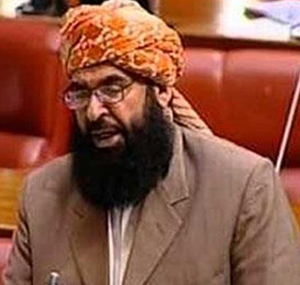
The bomber targeted Maulana Abdul Ghafoor Haideri when he came out of a mosque after addressing a gathering shortly after the Friday prayers in Mastung area of the province.

The area where the explosion took place is approximately 70 kilometres from provincial capital Quetta.
District Health Officer in Mastung Sher Zaman said that 25 bodies have been shifted to two hospitals in Quetta. "More than 35 were also injured," he added.

Earlier, Mastung Hospital Public Relation Officer Malik Jibran said over 35 injured were brought to the hospital. He said more than 15 injured were in critical condition.

Senior police officer Abdul Razzaq Cheema said Haideri was slightly injured and he has been shifted to the Combined Military Hospital in Quetta. "I am alive, Allah has saved my life, it was a sudden blast, broken pieces of the windscreen hit me, I am injured but safe. The driver and other people sitting next to me were badly injured," Haideri later told SAMAA TV.

"I am sorry for the death of innocent of people," said Haideri, who belongs to Jamiat Ulema-e-Islam Fazal (JUI-F) of Maulana Fazlur Rehman. Most of the people killed were workers of his party.

No group has claimed responsibility for the attack.

Maulana Fazulr Rehman condemned the attack on Haideri and said today's attack was not the first on the party. "Many of our dear companions have been martyred [in this attack]," he said further, adding that, "We have to continue to work for this country and the stability of Islam."

District Police Officer Muhammad Ghazanfar said that initial evidence suggests it was a suicide attack.
Prime Minister Nawaz Sharif strongly condemned the attack directed the relevant authorities to ensure the best medical treatment for the injured.

Chairman Senate Raza Rabbani and Interior Minister Chaudhary Nisar Ali Khan also condemned the attack. Rabbani said that it was suicide attack which targeted Haideri. "I have talked to chief secretary of Balochistan and asked him to airlift Haideri to Quetta," he said.

TV footage showed Haideri's vehicle was badly damaged. His driver was killed in the attack. The District Police Officer Mastung, Ghazanfar Ali, said Haideri escaped as he was not sitting in the car when the blast took place.

"It could be a suicide bomb attack but it is too early to say for sure," he said.

Balochistan government spokesman Anwarul Haq Kakar said it was too early to say anything about the nature of the attack. "Probe has been launched to determine the nature of the bombing," he added.

Balochistan has been hit hard by attacks from terrorists and separatists in recent years and Mastung has seen a lot of unrest despite constant security operations in the area.

Comments

Add new comment

  • Coastaldigest.com reserves the right to delete or block any comments.
  • Coastaldigset.com is not responsible for its readers’ comments.
  • Comments that are abusive, incendiary or irrelevant are strictly prohibited.
  • Please use a genuine email ID and provide your name to avoid reject.
News Network
January 8,2020

Sydney, Jan 8:  Authorities in Australia will begin five-day campaign to kill thousands of camels in the country as they drink too much water amid the wildfires.  The government will send helicopters to kill up to 10,000 camels in a five-day campaign starting Wednesday, The Hill reported citing The Australian.

Marita Baker, an Anangu Pitjantjatjara Yankunytjatjara (APY) (large, sparsely-populated local government area for Aboriginal Australians) executive board member, said that the camels were causing problems in her community of Kanypi.

"We have been stuck in stinking hot and uncomfortable conditions, feeling unwell, because the camels are coming in and knocking down fences, getting in around the houses and trying to get to water through air conditioners,'' she said.

The planned killing of the camels comes at a time the country is ravaged by wildfires since November. The disaster has killed more than a dozen people and caused the displacement or deaths of 480 million animals, according to University of Sydney researchers.

Comments

Add new comment

  • Coastaldigest.com reserves the right to delete or block any comments.
  • Coastaldigset.com is not responsible for its readers’ comments.
  • Comments that are abusive, incendiary or irrelevant are strictly prohibited.
  • Please use a genuine email ID and provide your name to avoid reject.
News Network
April 12,2020

Apr 12: India and other South Asian countries are likely to record their worst growth performance in four decades this year due to the coronavirus outbreak, the World Bank said on Sunday.

The South Asian region, comprising eight countries, is likely to show economic growth of 1.8 per cent to 2.8 per cent this year, the World Bank said in its South Asia Economic Focus report, well down from the 6.3 per cent it projected six months ago.

India's economy, the region's biggest, is expected to grow 1.5 per cent to 2.8 per cent in the fiscal year that started on April 1. The World Bank has estimated it will grow 4.8 per cent to 5 per cent in the fiscal year that ended on March 31.

"The green shoots of a rebound that were observable at the end of 2019 have been overtaken by the negative impacts of the global crisis," the World Bank report said.

Other than India, the World Bank forecast that Sri Lanka, Nepal, Bhutan and Bangladesh will also see sharp falls in economic growth.

Three other countries - Pakistan, Afghanistan and the Maldives - are expected to fall into recession, the World Bank said in the report, which was based on country-level data available as of April 7.

Measures taken to counter the coronavirus have disrupted supply chains across South Asia, which has recorded more than 13,000 cases so far - still lower than many parts of the world.

India's lockdown of 1.3 billion people has also left millions out of work, disrupted big and small businesses and forced an exodus of migrant workers from the cities to their homes in villages.

In the event of prolonged and broad national lockdowns, the report warned of a worst-case scenario in which the entire region would experience an economic contraction this year.

To minimize short-term economic pain, the Bank called for countries in the region to announce more fiscal and monetary steps to support unemployed migrant workers, as well as debt relief for businesses and individuals.

India has so far unveiled a $23 billion economic plan to offer direct cash transfers to millions of poor people hit by its lockdown. In neighbouring Pakistan, the government has announced a $6 billion plan to support the economy.

"The priority for all South Asian governments is to contain the virus spread and protect their people, especially the poorest who face considerable worse health and economic outcomes," said senior World Bank official Hartwig Schafer.

Comments

Add new comment

  • Coastaldigest.com reserves the right to delete or block any comments.
  • Coastaldigset.com is not responsible for its readers’ comments.
  • Comments that are abusive, incendiary or irrelevant are strictly prohibited.
  • Please use a genuine email ID and provide your name to avoid reject.
Agencies
June 16,2020

India continues to remain ranked 43rd on an annual World Competitiveness Index compiled by Institute for Management Development (IMD) with some traditional weaknesses like poor infrastructure and insufficient education investment keeping its ranking low, the international business school said on Tuesday.

Singapore has retained its top position on the 63-nation list.

Denmark has moved up to the second position (from 8th last year), Switzerland has gained one place to rank 3rd, the Netherlands has retained its 4th place and Hong Kong has slipped to the fifth place (from 2nd in 2019).

The US has moved down to 10th place (from 3rd last year), while China has also slipped from 14th to 20th place. Among the BRICS nations, India is ranked second after China, followed by Russia (50th), Brazil (56th) and South Africa (59th).

India was ranked 41st on the IMD World Competitiveness Ranking, being produced by the business school based in Switzerland and Singapore every year since 1989, but had slipped to 45th in 2017 before improving to 44th in 2018 and then to 43rd in 2019.

While its overall position has remained unchanged in the 2020 list, it has recorded improvements in areas like long-term employment growth, current account balance, high-tech exports, foreign currency reserves, public expenditure on education, political stability and overall productivity, the IMD said.

However, it has moved down in areas like exchange rate stability, real GDP growth, competition legislation and taxes.

Arturo Bris, Head of Competitiveness Center at IMD Business School, said India continues to struggle on the list and the recent country rating downgrade by Moody’s reflects the uncertainties regarding the economy’s future.

"In our ranking this year, we again emphasize the traditional weaknesses of India -- poor infrastructure, an important deficit in education investment, and a health system that does not reach everybody. For India to follow the path of China, it must stress its intangible infrastructure," Bris said.

"In a less global world, with China, USA, and Europe looking inwards, currencies like the rupee (and the Brazilian real for instance) are going to suffer and display high volatilities.

"Moody’s has threatened the country with a downgrade to junk and that would put India in a terrible position to attract foreign capital. So the urgency for the government should be to fix the short-term problems—and this requires to improve the credibility of the government itself," Bris added.

With the exception of Singapore, the Philippines, Taiwan and the Korean Republic, most Asian economies dropped in rankings this year, the IMD said.

The reason for the Asian economies’ less stellar performance as a region, this year is partly the result of the trade frictions between China and the US, particularly because these economies are highly dependent on trade with China.

About Singapore, which moved to the top rank last year, the IMD said its position is largely driven by the relative ease of setting up business, availability of skilled labour and its cutting-edge technological infrastructure.

The IMD said the impact of COVID-19 on the competitiveness ranking has partially been captured by executives’ opinions about the effectiveness of the different health systems.

In the ASEAN countries included in the survey, only Singapore and Thailand have a positive performance in the effectiveness of the health infrastructure.

Comments

Add new comment

  • Coastaldigest.com reserves the right to delete or block any comments.
  • Coastaldigset.com is not responsible for its readers’ comments.
  • Comments that are abusive, incendiary or irrelevant are strictly prohibited.
  • Please use a genuine email ID and provide your name to avoid reject.