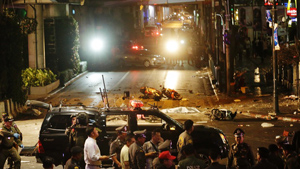
27 killed in bomb blasts outside Brahma temple in Thailand

August 17, 2015

Bangkok, Aug 17: Two powerful bomb blasts outside a hugely popular Brahma temple in a crowded business district here today killed at least 27 people, including four foreigners.

The twin blasts, which the government believed was aimed at damaging economy and tourism, occurred in a space of minutes around 7 pm (5:30 IST) outside Erawan Shrine dedicated to Lord Brahma in the downtown Chidlom district, creating panic as people fled the place that was spilled with blood.

bombThe temple is located on a main road through Bangkok's commercial hub and is surrounded by three major shopping malls. However, there were no reports of any Indian casualties in the explosions that caused a huge amount of chaos, with body parts scattered everywhere. It is among Bangkok's most popular tourist attractions.

Police said first an improvised explosive device fastened to a utility pole in front of the temple at the Ratchaprasong intersection detonated which was immediately followed by a motorbike bomb blast, causing two nearby taxis to explode.

However, some sources said a bomb was hidden under a roadside bench in front of the Phra Prom (Brahma temple). No group has claimed responsibility for the blast.

The Rajprasong intersection has been the centre of political demonstrations in recent years.

Thai TV said at least 27 people were killed and 80 others injured during the evening rush hour. The nationality of four foreigners killed in the blast is not known yet.

The iron fence surrounding the shrine was bent outward by the force of the blast.

Defence Minister Prawit Wongsuwong said: "It was a TNT bomb... the people who did it targeted foreigners and to damage tourism and the economy."

Police said the bomb was made of 5 kg of TNT explosive. The explosion had a radius of 40 metres.

The Bangkok Post quoted police as saying that at least one more bomb was defused by officers in the same area.

"We are in close touch with the authorities concerned. So far there have been no reports of any Indians being injured," Indian Ambassador to Thailand Harsh Vardhan Shringla told PTI.

Police, emergency vans and bomb detonation squads rushed to the area where several motorcycles lay mangled. Bomb attacks in Bangkok are extremely rare.

In 2012, a series of explosions hit Bangkok, injuring five people. Thai authorities said that the bombings were a botched attempt by Iranian nationals to assassinate Israeli diplomats. Several Iranians were arrested and charged for the attacks, one of whom was badly injured.

Comments

Add new comment

  • Coastaldigest.com reserves the right to delete or block any comments.
  • Coastaldigset.com is not responsible for its readers’ comments.
  • Comments that are abusive, incendiary or irrelevant are strictly prohibited.
  • Please use a genuine email ID and provide your name to avoid reject.
News Network
February 2,2020

Feb 2: The Philippines on Sunday reported the first death from a new virus outside of China, where authorities delayed the opening of schools in the worst-hit province and tightened quarantine measures in a city that allow only one family member to venture out to buy supplies.

The Philippine Department of Health said a 44-year-old Chinese man from Wuhan was admitted on Jan. 25 after experiencing a fever, cough, and sore throat. He developed severe pneumonia, and in his last few days, “the patient was stable and showed signs of improvement, however, the condition of the patient deteriorated within his last 24 hours resulting in his demise.”

The man’s 38-year-old female companion, also from Wuhan, also tested positive for the virus and remains in hospital isolation in Manila.

President Rodrigo Duterte approved a temporary ban on all travelers, except Filipinos, from China and its autonomous regions. The U.S., Japan, Singapore and Australia have imposed similar restrictions despite criticism from China and an assessment from the World Health Organization that they were unnecessarily hurting trade and travel.

The death toll in China climbed by 45 to 304 and the number of cases by 2,590 to 14,380, according to the National Health Commission, well above the number of those infected in in the 2002-03 outbreak of SARS, or severe acute respiratory syndrome, which broke out in southern China and spread worldwide.

Meanwhile, six officials in the city of Huanggang, neighboring the epicenter of Wuhan in Hubei province, have been fired over “poor performance” in handling the outbreak, the official Xinhua News Agency reported.

It cited the mayor as saying the city’s “capabilities to treat the patients remained inadequate and there is a severe shortage in medical supplies such as protective suits and medical masks.”

After Huanggang, the trading center of Wenzhou in coastal Zhejiang province also confined people to homes, allowing only one family member to venture out every other day to buy necessary supplies.

With the outbreak showing little sign of abating, authorities in Hubei and elsewhere have extended the Lunar New Year holiday, due to end this week, well into February. The annual travel crunch of millions of people returning from their hometowns to the cities is thought to pose a major threat of secondary infection at a time when authorities are encouraging people to avoid public gatherings.

All Hubei schools will postpone the opening of the new semester until further notice and students from elsewhere who visited over the holiday will also be excused from classes.

Far away on China’s southeast coast, the manufacturing hub of Wenzhou put off the opening of government offices until Feb. 9, private businesses until Feb. 17 and schools until March 1.

With nearly 10 million people, Wenzhou has reported 241 confirmed cases of the virus, one of the highest levels outside Hubei. Similar measures have been announced in the provinces and cities of Heilongjiang, Shandong, Guizhou, Hebei and Hunan, while the major cities of Shanghai and Beijing were on indefinite leave pending developments.

Despite imposing drastic travel restrictions at home, China has chafed at those imposed by foreign governments, criticizing Washington’s order barring entry to most non-citizens who visited China in the past two weeks. Apart from dinging China’s international reputation, such steps could worsen a domestic economy already growing at its lowest rate in decades.

The crisis is the latest to confront Chinese leader Xi Jinping, who has been beset by months of anti-government protests in the semi-autonomous Chinese city of Hong Kong, the reelection of Taiwan’s pro-independence president and criticism over human rights violations in the traditionally Muslim northwestern territory of Xinjiang. Economically, Xi faces lagging demand and dramatically slower growth at home while the tariff war with the U.S. remains largely unresolved.

Among a growing number of airlines suspending flights to mainland China was Qatar Airways. The Doha-based carrier said on its website that its flights would stop Monday. It blamed “significant operational challenges caused by entry restrictions imposed by a number of countries” for the suspension of flights.

Oman also halted flights to China, as did Saudi Arabia’s flagship national carrier, Saudia.

Saudi Arabia’s state-run TV reported that 10 Saudi students were evacuated from Wuhan on a special flight. It said the students would be screened upon arrival, but did not say whether they would be quarantined for 14 days.

This weekend, South Korea and India flew hundreds of their citizens out of Wuhan. They went into a two-week quarantine.

On Sunday, South Korea reported three more cases for a total of 15. They include an evacuee, a Chinese relative of a man who tested positive and a man who returned from Wuhan. India reported a second case, also in southern Kerala state.

South Korea also barred foreigners who have stayed or traveled to Hubei province within the last 14 days from entering the country.

Indonesia flew back 241 nationals from Wuhan on Sunday and quarantined them on the remote Natuna Islands for two weeks. Several hundred residents protested the move, with one saying, “This is not because we do not have a sense of solidarity with fellow nationals. But because we fear they could infect us with the deadly virus from China.”

A Turkish military transport plane carrying 42 people arrived in Ankara from Wutan Saturday night. The 32 Turkish, six Azerbaijani, three Georgian nationals and an Albanian will remain under observation for 14 days, together with 20 personnel who participated in the evacuation, Health Minister Fahrettin Koca said.

Vietnam counted its seventh case, a Vietnamese-American man who had a two-hour layover in Wuhan on his way from the U.S. to Ho Chi Minh City.

The virus’ rapid spread in two months prompted the WHO on Thursday to declare it a global emergency.

That declaration “flipped the switch” from a cautious attitude to recommending governments prepare for the possibility the virus might spread, said the WHO representative in Beijing, Gauden Galea. Most cases reported so far have been people who visited China or their family members.

WHO said it was especially concerned that some cases abroad involved human-to-human transmission.

“Countries need to get ready for possible importation in order to identify cases as early as possible and in order to be ready for a domestic outbreak control, if that happens,” Galea told The Associated Press.

Both the new virus and SARS are from the coronavirus family, which also includes those that cause the common cold.

The death rate in China is falling, but the number of confirmed cases will keep growing because thousands of specimens from suspected cases have yet to be tested, Galea said.

“The case fatality ratio is settling out at a much lower level than we were reporting three, now four, weeks ago,” he said.

Although scientists expect to see limited transmission of the virus between people with family or other close contact, they are concerned about cases of infection spreading to people who might have less exposure.


Comments

Add new comment

  • Coastaldigest.com reserves the right to delete or block any comments.
  • Coastaldigset.com is not responsible for its readers’ comments.
  • Comments that are abusive, incendiary or irrelevant are strictly prohibited.
  • Please use a genuine email ID and provide your name to avoid reject.
Agencies
May 26,2020

Sheikhupura, May 26: Younus, the brother-in-law of Asia Bibi, a Christian woman convicted of blasphemy by a Pakistani court, was killed in Sheikhupura city of Punjab province in Pakistan on Monday.

According to the FIR, Younus had gone to his farms on May 24 and did not return home at night. His body with throat slit was traced in the farm the following morning.

It is believed that, hailing from minority Christian community, Younus was killed in a rivalry.

This is not the first time that somebody associated with Asia Bibi has been murdered in cold blood.

In 2011, Salman Taseer, the influential governor of Punjab was assassinated after he made headlines by appealing for the pardon of Asia Bibi, who had been sentenced to death for allegedly insulting Prophet Muhammad.

A month after Taseer was killed, Religious Minorities Minister Shahbaz Bhatti, a Christian who spoke out against the laws, was shot dead in Islamabad, underlining the threat faced by critics of the law.

Asia Bibi is now living in exile after the Supreme Court of Pakistan acquitted her based on insufficient evidence in October 2018.

Recounting the hellish conditions of eight years spent on death row on blasphemy charges but also the pain of exile, Asia Bibi recently broke her silence to give her first personal insight into an ordeal that caused international outrage.

French journalist Anne-Isabelle Tollet, who has co-written a book about her, was once based in the country where she led a support campaign for her."You already know my story through the media," she said in the book.

"But you are far from understanding my daily life in prison or my new life," she said. "I became a prisoner of fanaticism," she said. In prison, "tears were the only companions in the cell".

She described the horrendous conditions in squalid jails in Pakistan where she was kept chained and jeered at by other detainees.

Pakistan's blasphemy laws carry a potential death sentence for anyone who insults Islam. Critics say they have been used to persecute minority faiths and unfairly target minorities.

Pakistan's Prime Minister Imran Khan defended the country's strict blasphemy laws during his election campaigns. The status quo is still in place.

No government in Pakistan was ready to make changed to the blasphemy law due to fears of a backlash.

Comments

Add new comment

  • Coastaldigest.com reserves the right to delete or block any comments.
  • Coastaldigset.com is not responsible for its readers’ comments.
  • Comments that are abusive, incendiary or irrelevant are strictly prohibited.
  • Please use a genuine email ID and provide your name to avoid reject.
News Network
June 18,2020

Washington, Jun 18: US Defence officials are concerned over China's use of COVID-19 situation to gain stakes in strategically important companies of United States as the impact of novel coronavirus has left several companies in dire need of capital.

Amid the pandemic, it getting hard for the defence department to keep an eye on national security and help protect smaller companies down the chain, CNN reported.

"We are paying close attention to any indicators that China is leveraging Covid-19 to take advantage of a situation where defence companies need capital more than ever," a defence official told CNN.

In April, Ellen Lord, undersecretary of defence for acquisition and sustainment said it is paying close attention to 'adversaries' against the 'economic warfare' with the United States.

"We have to be very, very careful about the focused efforts some of our adversaries have to really undergo sort of economic warfare with us, which has been going on for some time," Ellen Lord, undersecretary of defence for acquisition and sustainment was quoted as saying by CNN.

US Committee on Foreign Investment protects its interest against hostile countries gaining ownership in strategically important companies. But the pandemic is changing the definition of national security concerns to include drugs, protective gear and medical supplies.

"These are now national security needs and we probably should have been thinking about it a long time ago in terms of biowarfare that we should have a trusted industrial base or a set of trusted allies -- the UK, or NATO allies or Japan or Korea -- who are trusted in that regard," Bill Greenwalt, a former Pentagon official.

Give the threat posed by foreign acquisition, Pentagon has been offering tools to help small US businesses defend themselves against adversarial investment and conducting background checks with other government agencies to ensure transparency.

US President Donald Trump's trade adviser Peter Navarro recently told CNN if Trump wins reelection, Washington DC will likely take offshore supply chains as national security priorities.

"If we fail to do that in the face of this crisis, we will have failed this country and all future generations of Americans," Navarro said.

The US State Department has also warned US allies to "avoid economic overreliance on China" and "guard their critical infrastructure" from China's influence.

Chad P Bown, a senior fellow at the Peterson Institute for International Economics, pointed to recent China's economic coercion of Australia on the political matter saying, "this is how China operates and everybody knows it."

Comments

Add new comment

  • Coastaldigest.com reserves the right to delete or block any comments.
  • Coastaldigset.com is not responsible for its readers’ comments.
  • Comments that are abusive, incendiary or irrelevant are strictly prohibited.
  • Please use a genuine email ID and provide your name to avoid reject.