



27 killed in bomb blasts outside Brahma temple in Thailand

August 17, 2015

Bangkok, Aug 17: Two powerful bomb blasts outside a hugely popular Brahma temple in a crowded business district here today killed at least 27 people, including four foreigners.

The twin blasts, which the government believed was aimed at damaging economy and tourism, occurred in a space of minutes around 7 pm (5:30 IST) outside Erawan Shrine dedicated to Lord Brahma in the downtown Chidlom district, creating panic as people fled the place that was spilled with blood.
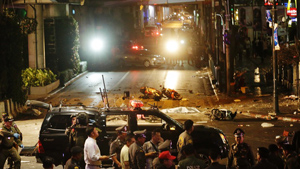
bombThe temple is located on a main road through Bangkok's commercial hub and is surrounded by three major shopping malls. However, there were no reports of any Indian casualties in the explosions that caused a huge amount of chaos, with body parts scattered everywhere. It is among Bangkok's most popular tourist attractions.

Police said first an improvised explosive device fastened to a utility pole in front of the temple at the Ratchaprasong intersection detonated which was immediately followed by a motorbike bomb blast, causing two nearby taxis to explode.

However, some sources said a bomb was hidden under a roadside bench in front of the Phra Prom (Brahma temple). No group has claimed responsibility for the blast.

The Rajprasong intersection has been the centre of political demonstrations in recent years.

Thai TV said at least 27 people were killed and 80 others injured during the evening rush hour. The nationality of four foreigners killed in the blast is not known yet.

The iron fence surrounding the shrine was bent outward by the force of the blast.

Defence Minister Prawit Wongsuwong said: "It was a TNT bomb... the people who did it targeted foreigners and to damage tourism and the economy."

Police said the bomb was made of 5 kg of TNT explosive. The explosion had a radius of 40 metres.

The Bangkok Post quoted police as saying that at least one more bomb was defused by officers in the same area.

"We are in close touch with the authorities concerned. So far there have been no reports of any Indians being injured," Indian Ambassador to Thailand Harsh Vardhan Shringla told PTI.

Police, emergency vans and bomb detonation squads rushed to the area where several motorcycles lay mangled. Bomb attacks in Bangkok are extremely rare.

In 2012, a series of explosions hit Bangkok, injuring five people. Thai authorities said that the bombings were a botched attempt by Iranian nationals to assassinate Israeli diplomats. Several Iranians were arrested and charged for the attacks, one of whom was badly injured.

Comments

Add new comment

  • Coastaldigest.com reserves the right to delete or block any comments.
  • Coastaldigset.com is not responsible for its readers’ comments.
  • Comments that are abusive, incendiary or irrelevant are strictly prohibited.
  • Please use a genuine email ID and provide your name to avoid reject.
News Network
February 5,2020

Feb 5: Pakistan will buy more palm oil from Malaysia, Prime Minister Imran Khan said on Tuesday, aiming to help offset lost sales after top buyer India put curbs on Malaysian imports last month amid a diplomatic row.

India imposed restrictions on refined palm oil imports and informally asked traders to stop buying from Malaysia, the world's biggest producer of the edible oil. Sources said the move was in retaliation for Malaysia's criticism of India's policy on Kashmir.

Malaysian Prime Minister Mahathir Mohamad said on Tuesday that he discussed palm oil with Khan who was on a visit to Malaysia and that Pakistan had indicated it would import more from Malaysia.

"That's right, especially since we noticed India threatened Malaysia for supporting the Kashmir cause, threatened to cut palm oil imports," Khan told a joint news conference, referring to India's Muslim-majority region of Kashmir.

"Pakistan will do its best to compensate for that."

India is a Hindu-majority country while Malaysia and Pakistan are mainly Muslim. India and Pakistan have been mostly hostile to each other since the partition of British India in 1947, and have fought two of their three wars over competing territorial claims in Kashmir.

Pakistan may have bought around 135,000 tonnes of Malaysian palm oil last month, a record high, India-based dealers who track such shipments told Reuters on condition of anonymity.

The figure is close to estimates of 141,500 tonnes from Refinitiv, which show sales to India in January may have plunged 80% from a year earlier to 40,400 tonnes.

Malaysia will release official export data on Monday.

Pakistan bought 1.1 million tonnes of palm oil from Malaysia last year, while India bought 4.4 million tonnes, according to the Malaysian Palm Oil Council.

Malaysian palm oil futures rose on Tuesday after Khan's comments and on expectations of a steep drop in production in January.

STRONG TIES

India has repeatedly objected to Mahathir speaking out against its move last year to strip Kashmir's autonomy and make it easier for non-Muslims from neighbouring Muslim-majority Bangladesh, Pakistan and Afghanistan to gain citizenship.

At the news conference, Mahathir did not refer to Kashmir but Khan did.

"The way you, PM, have stood with us and spoken about this injustice going on, on behalf of Pakistan I really want to thank you," Khan said.

He also said he was sad he had been unable to attend a summit of Muslim leaders in Malaysia in December. Saudi Arabia did not attend the summit, saying it was the wrong forum to discuss matters affecting the world's Muslims and Khan belatedly pulled out.

Some Pakistani officials, unnamed because they were not authorised to speak to the media, said at the time that Khan pulled out under pressure from Saudi Arabia, a close ally, although local media reported his officials denied that was the reason for his absence.

"Unfortunately our friends, who are very close to Pakistan as well, felt that somehow the conference was going to divide the ummah," Khan said, using the Arabic word for the Muslim community but not mentioning Saudi Arabia by name.

"It is clearly a misconception, as that was not the purpose of the conference."

Comments

Add new comment

  • Coastaldigest.com reserves the right to delete or block any comments.
  • Coastaldigset.com is not responsible for its readers’ comments.
  • Comments that are abusive, incendiary or irrelevant are strictly prohibited.
  • Please use a genuine email ID and provide your name to avoid reject.
News Network
May 21,2020

Canberra, May 21: Australian Prime Minister Scott Morrison and his Indian counterpart, Narendra Modi, are looking forward to deepening the countries' strategic relationship, with both sides expected to sign a range of pacts from defence to trade in strategic sectors amid heightened tensions with China over Beijing's response to coronavirus pandemic.

During a virtual summit, scheduled to take place on June 4, both leaders are expected to ramp up efforts to diversify Australia's export markets and find trusted suppliers of vital products and components, a local newspaper, The Australian reported on Tuesday.

The new agreements will focus on reliable supply chains in key strategic sectors, including medical goods, technology and critical minerals, amid heightened tensions with China over Beijing's response to coronavirus pandemic.

The leaders will seal a new defence agreement allowing reciprocal access to bases and co-operation on military technology projects, while a new education partnership will be on the table to help overcome Australian university reliance on Chinese students.

The talks in terms of strategic convergence, now have greater significance as COVID-19 exacerbates the strategic contest between the US and China, and forces like-minded countries to seek out reliable partners.

Australian farmers could also benefit, with talks underway on expanding agricultural exports to India, including barley, as China throws up new trade barriers, media reports stated.

The virtual summit follows the cancellation of Morrison's planned state visit to India in January due to the bushfires.

Morrison said last year, ahead of his planned visit, that India was "a natural partner for Australia", referring to the countries' "shared values" -- a point of differentiation with China.

Former Department of Foreign Affairs and Trade secretary Peter Varghese, who wrote a landmark report on the bilateral relationship in 2018, was quoted by the newspaper as saying that India would be even more important to Australia in the post-COVID world. "If one of the lessons from COVID is that countries need to spread their risk, then finding new markets or building up existing markets is a crucial part of that," he added.

Varghese noted that India, a member of the Quadrilateral Security Dialogue along with Australia, Japan and the US, was a vital strategic partner to Australia in helping "constrain China's ambitions to be the predominant power".

"That shared objective between Australia and India of not wanting to see the region dominated by China is a key component of building up our geopolitical relationship," he told The Australian.

The summit also follows recent talks between Australian Foreign Minister Marise Payne and Indian counterpart Subrahmanyam Jaishankar on the pandemic response and Australia's call for an independent inquiry, which was overwhelmingly backed at the World Health Assembly on Tuesday.

Australia wants to support India to develop a domestic critical minerals processing industry, which would provide Western nations with an alternative to sourcing the materials from China.

Meanwhile, India has strong expertise as a manufacturer of drugs and medical equipment, while Australia is a centre of biomedical research, opening the possibility for closer co-operation in the key sector, the media reported further.

Comments

Add new comment

  • Coastaldigest.com reserves the right to delete or block any comments.
  • Coastaldigset.com is not responsible for its readers’ comments.
  • Comments that are abusive, incendiary or irrelevant are strictly prohibited.
  • Please use a genuine email ID and provide your name to avoid reject.
News Network
March 11,2020

Rome, Mar 11: Italy has recorded its deadliest day of the coronavirus crisis despite locking down the entire country, as New York deployed the National Guard to contain a disease that has sown worldwide panic.

The hardest-hit country in Europe said its death toll from the COVID-19 virus had risen Tuesday by a third to 631, with the surging epidemic taking its toll on global sporting, cultural and political events.

While authorities in China, where the outbreak began, have declared it "basically curbed", cases are multiplying around the world, sparking panic buying in shops, and wild swings on financial markets.

China remains the hardest-hit overall with more than 80,000 cases and over 3,000 deaths, out of a global total of 117,339 cases and 4,251 deaths across 107 countries and territories, according to an AFP tally.

The virus is infecting all walks of life, including politics, with US Democratic presidential hopefuls Bernie Sanders and Joe Biden both cancelling campaign rallies and British health minister Nadine Dorries saying she had tested positive.

And amid criticism of the US authorities' response, New York deployed the National Guard for the first time during the crisis to help contain the spread of the disease from an infection-hit suburb.

There have been 173 confirmed cases in New York state, including 108 in Westchester County, home to New Rochelle where the majority of infections have been detected.

"It is a dramatic action, but it is the largest cluster in the country. This is literally a matter of life and death," said state governor Andrew Cuomo.

"People are scared, it's an unusual situation to be in," Miles Goldberg, who runs a New Rochelle bar, told AFP.

"It makes people nervous to be around others, it makes people nervous to get inside into businesses and such," he said.

In an unprecedented move, Italian Prime Minister Giuseppe Conte has told the 60 million residents of his country they should travel only for the most urgent work or health reasons.

And while squares in Milan and Rome were emptied of their usual bustle and traffic, some residents appeared uncertain if they were even allowed to leave their homes for everyday tasks like shopping.

The virus has battered tourism around the world, as people scrap travel plans, and a restaurant owner in Florence in northern Italy said that the impact on business had been catastrophic.

"We hope that we will see the end of it, because from around 140 covers a day, this afternoon, we've gone down to 20-25," Agostino Ferrara told AFP.

Pope Francis also seemed to muddy the waters, holding a mass in which he urged priests to go out and visit the sick -- something Conte has specifically discouraged.

Sporting events continued to fall victim to the virus as authorities urge people to avoid large gatherings.

Arsenal's game at Manchester City was postponed after players from the London club were put into quarantine, making it the first Premier League fixture to be called off because of the virus.

The virus has sparked doubts about the Olympics due to open in Tokyo on July 24 and the traditional flame lighting ceremony in Greece is set to be held without spectators.

In the United States, organisers rescheduled the two-week Coachella music festival for October.

The virus and the response to the crisis has prompted pandemonium on global markets with volatility not seen since the world financial crisis in 2008.

After suffering its worst session in more than 11 years at the beginning of the week, the Dow Jones Index in New York bounced back significantly, rising five percent on Tuesday.

Politicians around the world have scrambled to put together emergency packages to ease the significant financial hardships the virus is expected to cause for households and businesses.

US President Donald Trump, who is relying on a strong economy to boost his re-election hopes, promised to announce "major" economic measures on Tuesday.

The biggest item on his wish list is a cut in payroll taxes. But even allies in Congress and reportedly some aides in the White House are sceptical, questioning the cost.

Italy prepared Tuesday to let families skip mortgage and some tax payments while Japan unveiled a second emergency package to tackle economic woes stemming from the outbreak, including $15 billion in loan programmes to support small businesses.

Analysts warned of further volatility ahead however.

"It's like winding up a rubber band. The more you wind it, when you let go, the more it pops," said LBBW's Karl Haeling.

"A lot of the uncertainty goes to the root of the virus itself."

Comments

Add new comment

  • Coastaldigest.com reserves the right to delete or block any comments.
  • Coastaldigset.com is not responsible for its readers’ comments.
  • Comments that are abusive, incendiary or irrelevant are strictly prohibited.
  • Please use a genuine email ID and provide your name to avoid reject.