



3D metal sign at Almatti dam featured in limca book of records

[email protected] (CD Network)
August 6, 2016

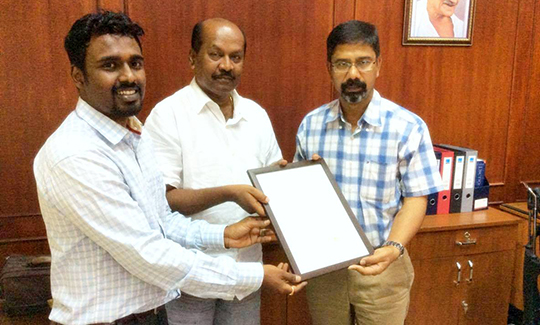
Bucket Design, is an industrial design studio from Pune has designed and installed India's biggest 3D metal sign at Almatti dam for Karnataka Government.
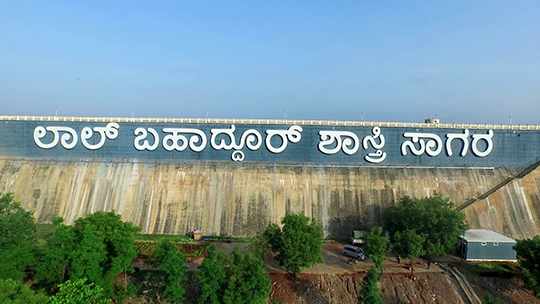
sign 1

Almatti dam is a biggest dam under Krishna Bhagya Jal Nigham Limited (KBJNL) and was named after Lal Bahadur Shastri as he laid the foundation stone of this irrigation project for the benefit of farmers in north Karnataka region.

The sign reads “LAL BAHADUR SHASTRI SAGAR” in Kannada language. This project has become a landmark in north Karnataka region and got featured in the Limca Book of Records recently.

The sign is designed in such a way that no support structure is visible from front and all the letters are installed at a height of 70 feet from ground. Complete sign is finished in aluminium to prevent it from damages in different weather conditions. The total project got completed in six months.

The detail technical specification of the sign is as follows:
Maximum height of letters: 8 meters.
Total length of the sign: 112.7 meters. (Longer than Hollywood sign, length of Hollywood sign: 106.6 meters)
Total number of steel frames used : 45
Aluminium used : 5500 sq ft.

sign 2

Comments

Add new comment

  • Coastaldigest.com reserves the right to delete or block any comments.
  • Coastaldigset.com is not responsible for its readers’ comments.
  • Comments that are abusive, incendiary or irrelevant are strictly prohibited.
  • Please use a genuine email ID and provide your name to avoid reject.
Agencies
June 27,2020

Mumbai, Jun 27: The Bombay High Court observed that COVID-19 patients from poor and indigent sections cannot be expected to produce documentary proof to avail subsidised or free treatment while getting admitted to hospitals.

The court on Friday was hearing a plea filed by seven residents of a slum rehabilitation building in Bandra, who had been charged ₹ 12.5 lakh by K J Somaiya Hospital for COVID-19 treatment between April 11 and April 28.

The bench of Justices Ramesh Dhanuka and Madhav Jamdar directed the hospital to deposit ₹10 lakh in the court.

The petitioners had borrowed money and managed to pay ₹10 lakh out of ₹12.5 lakh that the hospital had demanded, after threatening to halt their discharge if they failed to clear the bill, counsel Vivek Shukla informed the court.

According to the plea, the petitioners were also overcharged for PPE kits and unused services.

On June 13, the court had directed the state charity commissioner to probe if the hospital had reserved 20% beds for poor and indigent patients and provided free or subsidised treatment to them.

Last week, the joint charity commissioner had informed the court that although the hospital had reserved such beds, it had treated only three poor or indigent persons since the lockdown.

It was unfathomable that the hospital that claimed to have reserved 90 beds for poor and indigent patients had treated only three such persons during the pandemic, advocate Shukla said.

He further argued that COVID-19 patients, who are in distress, cannot be expected to produce income certificate and such documents as proof.

However, senior advocate Janak Dwarkadas, who represented the hospital, said the petitioners did not belong to economically weak or indigent categories and had not produced documents to prove the same.

A person who is suffering from a disease like COVID-19 cannot be expected to produce certificates from a tehsildar or social welfare officer before seeking admission in the hospital, the bench noted and asked the hospital to deposit ₹10 lakh in court within two weeks.

Comments

Add new comment

  • Coastaldigest.com reserves the right to delete or block any comments.
  • Coastaldigset.com is not responsible for its readers’ comments.
  • Comments that are abusive, incendiary or irrelevant are strictly prohibited.
  • Please use a genuine email ID and provide your name to avoid reject.
Agencies
January 7,2020

Washington, Jan 7: Facebook will ban deepfake videos ahead of the US elections but the new policy will still allow heavily edited clips so long as they are parody or satire, the social media giant said Tuesday.

Deepfake videos are hyper-realistic doctored clips made using artificial intelligence or programs that have been designed to accurately fake real human movements.

In a blog published following a Washington Post report, Facebook said it would begin removing clips that were edited--beyond for clarity and quality--in ways that "aren't apparent to an average person" and could mislead people.

Clips would be removed if they were "the product of artificial intelligence or machine learning that merges, replaces or superimposes content onto a video, making it appear to be authentic," the statement from Facebook vice-president Monika Bickert said.

However, the statement added: "This policy does not extend to content that is parody or satire, or video that has been edited solely to omit or change the order of words."

US media noted the new guidelines would not cover videos such as the 2019 viral clip -- which was not a deepfake -- of House Speaker Nancy Pelosi that appeared to show her slurring her words.

Facebook also gave no indication on the number of people assigned to identify and take down the offending videos, but said videos failing to meet its usual guidelines would be removed, and those flagged clips would be reviewed by teams of third-party fact-checkers -- among them AFP.

The news agency has been paid by the social media giant to fact-check posts across 30 countries and 10 languages as part of a program starting in December 2016, and including more than 60 organisations.

Content labeled "false" is not always removed from newsfeeds but is downgraded so fewer people see it -- alongside a warning explaining why the post is misleading.

Comments

Add new comment

  • Coastaldigest.com reserves the right to delete or block any comments.
  • Coastaldigset.com is not responsible for its readers’ comments.
  • Comments that are abusive, incendiary or irrelevant are strictly prohibited.
  • Please use a genuine email ID and provide your name to avoid reject.
Agencies
June 28,2020

The US space agency has thrown open a challenge to win over Rs 26 lakh, calling the global community to send novel design concepts for compact toilets that can operate in both microgravity and lunar gravity.

NASA is preparing for return to the Moon and innumerable activities to equip, shelter, and otherwise support future astronauts are underway.

The astronauts will be eating and drinking, and subsequently urinating and defecating in microgravity and lunar gravity.

NASA said that while astronauts are in the cabin and out of their spacesuits, they will need a toilet that has all the same capabilities as ones here on Earth.

The public designs for space toilet may be adapted for use in the Artemis lunar landers that take humans back to the Moon.

"Although space toilets already exist and are in use (at the International Space Station, for example), they are designed for microgravity only," the US space agency said in a statement.

NASA's Human Landing System Programme is looking for a next-generation device that is smaller, more efficient, and capable of working in both microgravity and lunar gravity.

The new NASA challenge includes a Technical category and Junior category and the last date to send designs is August 17.

NASA's Artemis Moon mission will land the first woman and next man on the lunar surface by 2024.

The Artemis programme is part of America's broader Moon to Mars exploration approach, in which astronauts will explore the Moon and experience gained there to enable humanity's next giant leap, sending humans to Mars.

Comments

Add new comment

  • Coastaldigest.com reserves the right to delete or block any comments.
  • Coastaldigset.com is not responsible for its readers’ comments.
  • Comments that are abusive, incendiary or irrelevant are strictly prohibited.
  • Please use a genuine email ID and provide your name to avoid reject.