40-year-old temple manager gored to death by mighty bull in Sullia

[email protected] (CD Network)
June 7, 2016

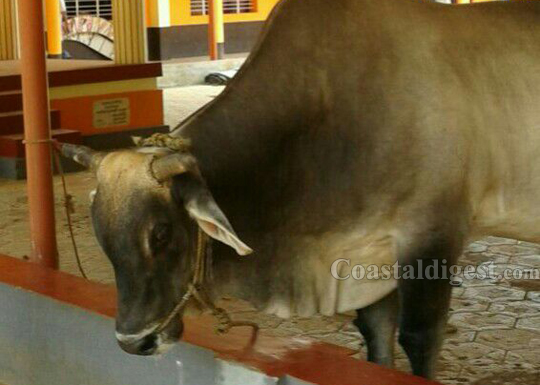
Mangaluru, Jun 7: In a horrific incident, a 40-year-old man died after being gored by a strong and mighty bull at Ajapila Bellare village in Sullia taluk of Dakshina Kannada district.

bull

The victim has been identified as Narayana, manager of Sri Mahalingeshwara temple, Ajapila Bellare. A native of Kalanjeri, Pailar, Narayana was residing at Bellare and had held the post of manager in the temple for more than a decade.

The killer bull is also part of the same temple and is being looked after the temple management. According to sources, Narayana was fond of this bull and he used to feed it from his hands.

The tragedy occurred on Monday morning, when Narayana tried to bring the bull, which was tied at a little distance away, back to the temple premises as usually.

As soon as the clueless man approached the beast, it turned violence, attacked him pierced him with its horns. Horrified onlookers watched as he suffered fatal injuries and breathed his last on the spot.

The police have registered a case. The body was handed over to the police after post-mortem. Investigations are on.

Comments

ali
 - 
Tuesday, 7 Jun 2016

Bull is animal not god. Its proved to the foolish group of worshipper by killing narayana.

Rikaz
 - 
Tuesday, 7 Jun 2016

He must be member of go rakshaka brigade...

Karan
 - 
Tuesday, 7 Jun 2016

what? is it bull or elephant?

Malabar
 - 
Tuesday, 7 Jun 2016

really sad, what this animal make to kill this person.

Priyanka
 - 
Tuesday, 7 Jun 2016

reason behind this accident was brutality to the animal.

Karukara
 - 
Tuesday, 7 Jun 2016

Act of god, he would be corrupt that bull killed him for his sin.

Zafar
 - 
Tuesday, 7 Jun 2016

why bull was being used in the temple, its not a mother of hindus may be father

Shamala
 - 
Tuesday, 7 Jun 2016

he is a lucky person, being killed by god's bull.

Mohan Pandith
 - 
Tuesday, 7 Jun 2016

bull must be given to make flush out.

Add new comment

  • Coastaldigest.com reserves the right to delete or block any comments.
  • Coastaldigset.com is not responsible for its readers’ comments.
  • Comments that are abusive, incendiary or irrelevant are strictly prohibited.
  • Please use a genuine email ID and provide your name to avoid reject.
News Network
January 31,2020

Bengaluru, Jan 31: Senior IPS officer Praveen Sood is the new Head of Police Force in Karnataka as the current DG and IG Neelamani Raju today retired.

Praveen Sood, the DIG of CID’s Economic Offences Wing, introduced several reforms that sped up investigation processes. He introduced the Crime and Criminal Tracking Network System all over the state by networking all police stations in the country and ensuring data entry and retrieval of all information in police stations and higher police officers online.

Born in 1964, Sood graduated from IIT Delhi and joined the Indian Police Service in 1986. He kicked off his career as the Assistant Superintendent of Police in Mysuru in 1989. He has served as the SP of Ballari and Raichur before being posted as the Deputy Police Commissioner (Law and Order) of Bengaluru.

In 1999, he served as the police officer on foreign deputation as the police advisor to the Government of Mauritius for 3 years.  He was posted as Police Commissioner of Mysuru City between 2004 and 2007.

He took over as the Additional Commissioner of Police (Traffic) in Bengaluru in 2008 and continued in the post till 2011. He has won the Chief Minister’s Gold Medal for excellence in service in 1996, the Police Medal for Meritorious Service in 2002  and the President’s Police Medal in 2011.

During 2013-14 he took over as Managing Director of Karnataka State Police Housing Corporation. He later worked as the Principal Secretary to the Home  Department as the Additional Director General of Police (Karnataka State Reserve Police) and the ADGP of Administration.

In 2017, he was appointed the Bengaluru Police Commissioner. He was also instrumental in launching “Suraksha” App and “Pink Hoyasalas” managed by all-women police officers.

As the DIG of the CID, Economic offences and Special Units, he is credited for opening the Centre for Cyber-crime Investigation, Training and Research for training police officers, prosecutors and the judiciary in handling cyber crime cases.

Comments

Add new comment

  • Coastaldigest.com reserves the right to delete or block any comments.
  • Coastaldigset.com is not responsible for its readers’ comments.
  • Comments that are abusive, incendiary or irrelevant are strictly prohibited.
  • Please use a genuine email ID and provide your name to avoid reject.
News Network
February 23,2020

The euphoria over the claim that around 3,000 tonnes of gold reserves, worth Rs 12 trillion, have been discovered in Uttar Pradesh’s Sonbhadra district could not last even 24 hours, with the Geological Survey of India (GSI) clarifying on Saturday there had been no such discovery.

The GSI, headquartered in Kolkata, rebutted the claims of the Uttar Pradesh Directorate of Geology and Mining (UPDGM), and said “miscommunication” must have led to the wrong reporting of facts.

M Sridhar, director general of the GSI, said nobody in the agency gave any such data. He said 52,806 tonnes of gold ore was found in Sonbhadra district during the exploration work in 1998-2000. From this reserve, only 160 kg of gold can be extracted.

“There must have been some miscommunication of facts because of which the gold ore deposits have been overestimated. We have written a letter to Uttar Pradesh (UPDGM), stating the facts. The GSI has not estimated such kind of vast resource of gold deposits in Sonbhadra,” Sridhar said.

ALSO READ: 2,900-tonne gold mine found in Sonbhadra, 4 times that of India's reserves

The UPDGM had said on Friday that gold deposits were found in Son Pahadi and Hardi areas of the district. Sridhar said while gold ore was found in the area during the GSI’s exploration work in 1998-2000, it had told the state government about the discovery in November last year.

Under the new regulation, which came into effect from 2015, the GSI has to inform the state government when ore deposits are discovered. Earlier, no such action was mandatory. In its report, the GSI estimated that only 3.03 gm of gold can be extracted from a tonne of ore. It also clarified that even the extraction amount was tentative and could not be established for certain.

Moreover, Sridhar said the deposits were spread across only 0.5 sq km in forest land, which made the mining of ore economically unviable. “When there are several mines nearby, we can club it into a block and then it makes sense to mine the ore. But in this case, the deposits are too small to make it viable for any company to mine it,” he said. The GSI usually prioritises its exploration work based on the needs of the Centre. While strategic minerals like tin, cobalt, lithium, beryllium, germanium, gallium, indium, tantalum, niobium, selenium, and bismuth are atop the list in GSI exploration, gold is another commodity on its priority list.

According to the World Gold Council, India has reserves of 630 tonnes of gold.

Comments

Add new comment

  • Coastaldigest.com reserves the right to delete or block any comments.
  • Coastaldigset.com is not responsible for its readers’ comments.
  • Comments that are abusive, incendiary or irrelevant are strictly prohibited.
  • Please use a genuine email ID and provide your name to avoid reject.
News Network
January 25,2020

New Delhi, Jan 25: The latest edition of the Oxford Advanced Learner's Dictionary features 26 new Indian English words, including Aadhaar, chawl, dabba, hartal and shaadi.

The 10th edition of the dictionary, which was launched on Friday, has 384 Indian English words and incorporates over 1,000 new words such as chatbot, fake news and microplastic.

The dictionary focuses on language change and its evolution through the years, and has ensured that the language and examples used in the new edition are relevant and up to date with the times, Oxford University Press (OUP) said.

The new edition comes with interactive online support through the Oxford Learner's Dictionaries website and an app. The website includes advanced features such as audio-video tutorials, video walkthroughs, self-study activities and enhanced iWriter and iSpeaker tools.

"This edition has 26 new Indian English words of which 22 figure in the printed dictionary. The other four are in the digital version," said Fathima Dada, Managing Director (Education Division) at OUP.

Some of other new Indian words in the dictionary are auntie (while aunty already figures in the English dictionary, auntie is an Indianism), bus stand, deemed university, FIR, non-veg, redressal, tempo, tube light, veg and videograph.

The four new Indian English words in the online version of the dictionary are current (for electricity), looter, looting and upazila (one of the areas that a district is divided into for administration purposes).

According to OUP, the new edition provides better, more accurate and understandable definitions with examples, usage notes and additional resources to help the learner use the right word in the right context.

"Prevalence and common usage are the main criteria for enlisting new words. We scan the globe for words which are often used by people while speaking English. Then these words go through a rigorous testing process," Dada said.

"As OUP is the custodian of English language globally, these words have to go through its processes," she told PTI.

The Oxford Advanced Learner's Dictionary, she said, has been reinventing itself for nearly eight decades, anticipating the growing learning requirements of learners.

"The 10th edition also is equipped with a strong digital support system, including an app," she said.

It is equipped with several digital tools. With iSpeaker, learners can get help preparing for speaking exams and presentations. With iWriter, learners can plan, write and review their written work. Text Checker allows the teacher to check any text against the Oxford 3000, 5000, and OPAL (Oxford Phrasal Academic Lexicon) written word list.

Resources accessible through online premium access include lesson plans, worksheets, video walkthroughs, and classroom and self-study activities. With the OALD app one can find 86,000 words, 95,000 phrases, 112,000 meanings and 237,000 examples.

The dictionary, which spans 77 years, was originally published in Japan in 1942 and was first brought out by OUP in 1948. The learner's dictionary is based on the original values of its creator, Albert Sydney Hornby, whose aim was to help language learners worldwide understand the meaning of English words.


Comments

Add new comment

  • Coastaldigest.com reserves the right to delete or block any comments.
  • Coastaldigset.com is not responsible for its readers’ comments.
  • Comments that are abusive, incendiary or irrelevant are strictly prohibited.
  • Please use a genuine email ID and provide your name to avoid reject.