40-year-old temple manager gored to death by mighty bull in Sullia

[email protected] (CD Network)
June 7, 2016

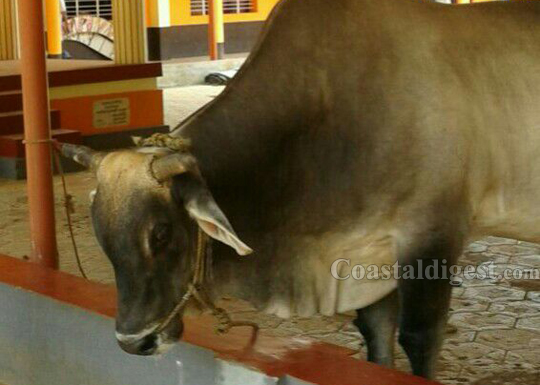
Mangaluru, Jun 7: In a horrific incident, a 40-year-old man died after being gored by a strong and mighty bull at Ajapila Bellare village in Sullia taluk of Dakshina Kannada district.

bull

The victim has been identified as Narayana, manager of Sri Mahalingeshwara temple, Ajapila Bellare. A native of Kalanjeri, Pailar, Narayana was residing at Bellare and had held the post of manager in the temple for more than a decade.

The killer bull is also part of the same temple and is being looked after the temple management. According to sources, Narayana was fond of this bull and he used to feed it from his hands.

The tragedy occurred on Monday morning, when Narayana tried to bring the bull, which was tied at a little distance away, back to the temple premises as usually.

As soon as the clueless man approached the beast, it turned violence, attacked him pierced him with its horns. Horrified onlookers watched as he suffered fatal injuries and breathed his last on the spot.

The police have registered a case. The body was handed over to the police after post-mortem. Investigations are on.

Comments

ali
 - 
Tuesday, 7 Jun 2016

Bull is animal not god. Its proved to the foolish group of worshipper by killing narayana.

Rikaz
 - 
Tuesday, 7 Jun 2016

He must be member of go rakshaka brigade...

Karan
 - 
Tuesday, 7 Jun 2016

what? is it bull or elephant?

Malabar
 - 
Tuesday, 7 Jun 2016

really sad, what this animal make to kill this person.

Priyanka
 - 
Tuesday, 7 Jun 2016

reason behind this accident was brutality to the animal.

Karukara
 - 
Tuesday, 7 Jun 2016

Act of god, he would be corrupt that bull killed him for his sin.

Zafar
 - 
Tuesday, 7 Jun 2016

why bull was being used in the temple, its not a mother of hindus may be father

Shamala
 - 
Tuesday, 7 Jun 2016

he is a lucky person, being killed by god's bull.

Mohan Pandith
 - 
Tuesday, 7 Jun 2016

bull must be given to make flush out.

Add new comment

  • Coastaldigest.com reserves the right to delete or block any comments.
  • Coastaldigset.com is not responsible for its readers’ comments.
  • Comments that are abusive, incendiary or irrelevant are strictly prohibited.
  • Please use a genuine email ID and provide your name to avoid reject.
News Network
January 21,2020

Bengaluru, Jan 21: A private hospital in Bengaluru, the capital of Karnataka, on Tuesday claimed that it has successfully performed a live liver transplant on a Jehovah's Witness from Nigeria, by not using blood or blood products, in order to protect the patient's religious beliefs.

It is said that Jehovah's Witnesses are followers of a Christian faith that prohibits the use of blood or blood products during their treatment. Gehojadak (37), a Jehovah's Witness follower, had developed decompensated liver disease and visited more than three countries seeking treatment over the last four years but was turned away by most doctors due to the highly risky nature of surgery, Aster CMI Hospital said.

The surgery was challenging compared to a normal liver transplant because in order to protect the patient's religious beliefs, the medical team could not use blood or blood products (Fresh frozen plasma, Cryoprecipitate, Platelets etc), it said in a release, adding that very few such surgeries have been successfully conducted worldwide.

The patient's brother was the donor, the hospital said, adding, without a liver transplant, Gehojadak's chances of survival were less than 10 per cent over the next two years. A team of liver specialists from the Hospital thoroughly reviewed the patient's medical history before recommending a bloodless liver transplant and charted out a feasible pathway to make the surgery a success.

"This transplant was especially challenging as we did not have the safety net (of using blood) even if the patient's life was at risk due to their advance directive. We have performed other non-transplant liver surgeries in Jehovah's Witnesses and this gave us the confidence to take on Gehojadak's transplant," Dr Rajiv Lochan, Consultant Liver Transplant Surgeon, said.

The critical surgery took a 12-hour period to complete where two teams of specialists with close to 25 doctors including anaesthetists, intensivists worked in absolute sync with each other and Gehojadak finally received a life-saving liver transplant, the Hospital said. In a period of two weeks, the patient and his brother were fit enough to go home and were discharged from the hospital.

"Even if their haemoglobin levels dropped to life-threatening levels, the patients were clear that they would not accept a blood transfusion. Keeping the limitations in mind, the most effective treatment path was planned, and we spent close to two months preparing the patients for surgery," Arun V, Consultant Anesthesiologist said. The hospital arranged customised artificial products like synthetic drug molecules, to conduct a bloodless liver transplant, he added.

Comments

Add new comment

  • Coastaldigest.com reserves the right to delete or block any comments.
  • Coastaldigset.com is not responsible for its readers’ comments.
  • Comments that are abusive, incendiary or irrelevant are strictly prohibited.
  • Please use a genuine email ID and provide your name to avoid reject.
News Network
April 2,2020

The current physical distancing guidelines provided by the World Health Organisation (WHO) and by the US Centers for Disease Control and Prevention (CDC) may not be adequate to curb the coronavirus spread, according to a research which says the gas cloud from a cough or sneeze may help virus particles travel up to 8 metres. The research, published in the Journal of the American Medical Association, noted that the the current guidelines issued by the WHO and CDC are based on outdated models from the 1930s of how gas clouds from a cough, sneeze, or exhalation spread.

Study author, MIT associate professor Lydia Bourouiba, warned that droplets of all sizes can travel 23 to 27 feet, or 7-8 metres, carrying the pathogen.

According to Bourouiba, the current guidelines are based on "arbitrary" assumptions of droplet size, "overly simplified", and "may limit the effectiveness of the proposed interventions" against the deadly pandemic.

 She explained that the old guidelines assume droplets to be one of two categories, small or large, taking short-range semi-ballistic trajectories when a person exhales, coughs, or sneezes.

However based on more recent discoveries, the MIT scientist said, sneezes and coughs are made of a puff cloud that carries ambient air, transporting within it clusters of droplets of a wide range of sizes.

Bourouiba warned that this puff cloud, with ambient air entrapped in it, can offer the droplets moisture and warmth that can prevent it from evaporation in the outer environment.

"The locally moist and warm atmosphere within the turbulent gas cloud allows the contained droplets to evade evaporation for much longer than occurs with isolated droplets," she said.

"Under these conditions, the lifetime of a droplet could be considerably extended by a factor of up to 1000, from a fraction of a second to minutes," the researcher explained in the study.

The MIT scientist, who has researched the dynamics of coughs and sneezes for years, added that these droplets settle along the trajectory of a cough or sneeze contaminating surfaces, with their residues staying suspended in the air for hours.

"Even when maximum containment policies were enforced, the rapid international spread of COVID-19 suggests that using arbitrary droplet size cutoffs may not accurately reflect what actually occurs with respiratory emissions, possibly contributing to the ineffectiveness of some procedures used to limit the spread of respiratory disease," Bourouiba wrote in the study


Comments

Add new comment

  • Coastaldigest.com reserves the right to delete or block any comments.
  • Coastaldigset.com is not responsible for its readers’ comments.
  • Comments that are abusive, incendiary or irrelevant are strictly prohibited.
  • Please use a genuine email ID and provide your name to avoid reject.
News Network
February 12,2020

Mangaluru, Feb 12: More than 7,000 people at Mangalore International Airport (MIA) and over 1,000 at the New Mangalore Port (NMP) have undergone thermal screening for the novel coronavirus in the past few days, a taluk health official said on Wednesday.

A few more ships are scheduled to arrive at the port and all precautionary measures to check the ship’s passengers and crew are ready, he said.

Soon after a positive case of deadly pathogen surfaced in Kerala, the district health officials here actively started monitoring all entry points in the bordering district. 

Apart from Mangaluru, there is bus connectivity to Puttur, Sullia, Bantwal, Dharmasthala and Subrahmanya from Kerala. More than eight to 10 trains arrive at Mangaluru daily from Kerala.

Hence, it is impossible to take up screening of all the vehicles arriving from Kerala, sources in District Health and Family Welfare said.

Comments

Add new comment

  • Coastaldigest.com reserves the right to delete or block any comments.
  • Coastaldigset.com is not responsible for its readers’ comments.
  • Comments that are abusive, incendiary or irrelevant are strictly prohibited.
  • Please use a genuine email ID and provide your name to avoid reject.