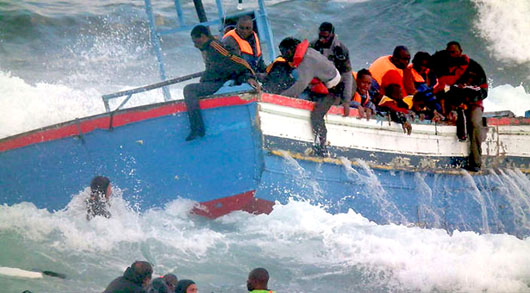
Up to 400 migrants died in boat capsize off Libya: survivors

April 15, 2015

Rome, Apr 15: Up to 400 illegal migrants trying to reach Europe died after their boat capsized off the Libyan coast on Sunday, said survivors who were saved and brought to Italy.

The Italian coastguard had previously said that they managed to rescue 144 of the people on the capsized vessel, while nine bodies were also recovered.

boat capsize

Quoting survivors, the International Organization for Migration and the charity Save the Children said between 144 and 150 survivors arrived on Tuesday morning at Reggio Calabria, located on Italy's southern tip.

"There were 400 victims in this shipwreck, which occurred 24 hours after (their vessel) left the Libyan coast," Save the Children said in a statement, citing survivors.

"There were several young males, probably minors, among the victims," the international NGO said, adding that there were also children among the survivors.

IOM spokesman in Italy Flavio Di Giacomo told AFP his organisation has also interviewed several survivors, who said there were between 500 and 550 people on board when the ship sank.

"We are continuing to investigate in order to understand how the shipwreck happened," Di Giacomo said.

According to initial findings, the boat may have capsized after passengers started moving when they saw the Italian rescue team.

On Tuesday, the coastguard said its teams had rescued nearly 8,000 people at sea since Friday.

Recent good weather in the Mediterranean has prompted a surge in the number of migrants attempting to reach Italy aboard boats.

An increasingly violent and chaotic situation in Libya, a key jumping off point for migrants, has also helped prompt the huge hike in the number of asylum seekers trying to make it to Europe.

According to Italian authorities more than 15,000 migrants have arrived in Italy so far in 2015. There were 15,000 in April alone last year and an average of 25,000 each month between June and September.

People smuggling remains a lucrative business for traffickers, with refugees and migrants rescued in the Mediterranean in February saying they paid between USD 500-1,000 for their crossing in boats that are often no more than rubber dinghies.

Comments

Add new comment

  • Coastaldigest.com reserves the right to delete or block any comments.
  • Coastaldigset.com is not responsible for its readers’ comments.
  • Comments that are abusive, incendiary or irrelevant are strictly prohibited.
  • Please use a genuine email ID and provide your name to avoid reject.
Agencies
May 28,2020

More than one in six youths were jobless since the onset of the COVID-19 pandemic while those who remain employed have seen their working hours cut by 23 per cent, according to a report by the International Labour Organisation (ILO).

According to the 'ILO Monitor: COVID-19 and the world of work: 4th edition' published on Wednesday, youths are being disproportionately affected by the pandemic, and the substantial and rapid increase in youth unemployment seen since February is affecting young women more than young men, reports Xinhua news agency.

The pandemic is inflicting a triple shock on young people.

Not only is it destroying their employment, but it is also disrupting education and training, and placing major obstacles in the way of those seeking to enter the labour market or to move between jobs, said the report.

At 13.6 per cent, the youth unemployment rate in 2019 was already higher than any other group.

There were around 267 million young people not in employment, education or training worldwide.

"If we do not take significant and immediate action to improve their situation, the legacy of the virus could be with us for decades," said ILO Director-General Guy Ryder.

"If their talent and energy is sidelined by a lack of opportunity or skills, it will damage all our futures and make it much more difficult to re-build a better, post-COVID economy."

The report called for urgent, large-scale and targeted policy responses to support youth, including broad-based employment/training guarantee programs in developed countries, and employment-intensive programs and guarantees in low- and middle-income economies.

Comments

Add new comment

  • Coastaldigest.com reserves the right to delete or block any comments.
  • Coastaldigset.com is not responsible for its readers’ comments.
  • Comments that are abusive, incendiary or irrelevant are strictly prohibited.
  • Please use a genuine email ID and provide your name to avoid reject.
News Network
April 15,2020

Wuhan, Apr 15: In the six days after top Chinese officials secretly determined they likely were facing a pandemic from a new coronavirus, the city of Wuhan at the epicenter of the disease hosted a mass banquet for tens of thousands of people; millions began traveling through for Lunar New Year celebrations.

President Xi Jinping warned the public on the seventh day, Janaury 20. But by that time, more than 3,000 people had been infected during almost a week of public silence, according to internal documents obtained by The Associated Press and expert estimates based on retrospective infection data.

That delay from Jan 14 to Jan. 20 was neither the first mistake made by Chinese officials at all levels in confronting the outbreak, nor the longest lag, as governments around the world have dragged their feet for weeks and even months in addressing the virus.

But the delay by the first country to face the new coronavirus came at a critical time — the beginning of the outbreak. China's attempt to walk a line between alerting the public and avoiding panic set the stage for a pandemic that has infected almost 2 million people and taken more than 126,000 lives.

A This is tremendous, a said Zuo-Feng Zhang, an epidemiologist at the University of California, Los Angeles. If they took action six days earlier, there would have been much fewer patients and medical facilities would have been sufficient. We might have avoided the collapse of Wuhan's medical system.

Other experts noted that the Chinese government may have waited on warning the public to stave off hysteria, and that it did act quickly in private during that time.

But the six-day delay by China's leaders in Beijing came on top of almost two weeks during which the national Center for Disease Control did not register any cases from local officials, internal bulletins obtained by the AP confirm. Yet during that time, from Jan 5 to Jan 17, hundreds of patients were appearing in hospitals not just in Wuhan but across the country.

It's uncertain whether it was local officials who failed to report cases or national officials who failed to record them. It's also not clear exactly what officials knew at the time in Wuhan, which only opened back up last week with restrictions after its quarantine.

But what is clear, experts say, is that China's rigid controls on information, bureaucratic hurdles and a reluctance to send bad news up the chain of command muffled early warnings. The punishment of eight doctors for rumor-mongering, broadcast on national television on Jan. 2, sent a chill through the city's hospitals.

Doctors in Wuhan were afraid, said Dali Yang, a professor of Chinese politics at the University of Chicago. It was truly intimidation of an entire profession. Without these internal reports, it took the first case outside China, in Thailand on Jan 13, to galvanize leaders in Beijing into recognising the possible pandemic before them. It was only then that they launched a nationwide plan to find cases distributing CDC-sanctioned test kits, easing the criteria for confirming cases and ordering health officials to screen patients, all without telling the public.

The Chinese government has repeatedly denied suppressing information in the early days, saying it immediately reported the outbreak to the World Health Organization.

Allegations of a cover-up or lack of transparency in China are groundless, said foreign ministry spokesman Zhao Lijian at a Thursday press conference.

The documents show that the head of China's National Health Commission, Ma Xiaowei, laid out a grim assessment of the situation on Jan. 14 in a confidential teleconference with provincial health officials.

A memo states that the teleconference was held to convey instructions on the coronavirus from President Xi Jinping, Premier Li Keqiang and Vice Premier Sun Chunlan, but does not specify what those instructions were.

The epidemic situation is still severe and complex, the most severe challenge since SARS in 2003, and is likely to develop into a major public health event, the memo cites Ma as saying.

The National Health Commission is the top medical agency in the country. In a faxed statement, the Commission said it had organised the teleconference because of the case reported in Thailand and the possibility of the virus spreading during New Year travel. It added that China had published information on the outbreak in an open, transparent, responsible and timely manner," in accordance with important instructions repeatedly issued by President Xi.

The documents come from an anonymous source in the medical field who did not want to be named for fear of retribution. The AP confirmed the contents with two other sources in public health familiar with the teleconference. Some of the memo's contents also appeared in a public notice about the teleconference, stripped of key details and published in February.

Under a section titled sober understanding of the situation, the memo said that clustered cases suggest that human-to-human transmission is possible. It singled out the case in Thailand, saying that the situation had changed significantly because of the possible spread of the virus abroad.

With the coming of the Spring Festival, many people will be traveling, and the risk of transmission and spread is high, the memo continued.


Comments

Add new comment

  • Coastaldigest.com reserves the right to delete or block any comments.
  • Coastaldigset.com is not responsible for its readers’ comments.
  • Comments that are abusive, incendiary or irrelevant are strictly prohibited.
  • Please use a genuine email ID and provide your name to avoid reject.
News Network
May 12,2020

London, May 12: British Prime Minister Boris Johnson has warned that a mass vaccine for the novel coronavirus may be over a year away and, in the worst-case scenario, may in fact never be found.

In his foreword to the government’s new 50-page guidance on a step by step easing of the lockdown measures in place to control the spread of the deadly virus, the UK prime minister lays out plans for businesses to gradually start reopening with “COVID-19 Secure” measures of social distancing and for the public to use “good solid British common sense” as the economy is unlocked.

“A mass vaccine or treatment may be more than a year away,” said Johnson, highlighting the work being done in the UK by scientists at Oxford University and Imperial College London towards this mission.

“Indeed, in a worst-case scenario, we may never find a vaccine. So our plan must countenance a situation where we are in this, together, for the long haul, even while doing all we can to avoid that outcome,” he said.

Admitting that a vaccine or drug-based treatment is the only “feasible long-term solution”, he said the UK has accelerated this with “promising” vaccine development programmes and a collaboration between Oxford University and pharma major AstraZeneca was a vital step that could help rapidly advance the manufacture of a Covid-19 vaccine when it is ready.

As part of global efforts, he flagged the GBP 388 million in aid funding for research into vaccines, tests and treatment, including GBP 250m to the Coalition for Epidemic Preparedness Innovations.

“But while we hope for a breakthrough, hope is not a plan,” he said, as he unveiled his plan for starting to lift lockdown restrictions from this week in phases.

Following a televised address to the nation on Sunday night and a statement in Parliament on Monday, the guidance comes into effect in public life across England from Wednesday when people will be allowed one-to-one contact with people other than those they live with, as long as they remain outside and two metres apart.

They are allowed to play sport with a friend or family member from outside their household or socialise with them in the open air for the first time in more than six weeks since the lockdown was imposed.

People are still advised to work from home where possible but start heading into work where necessary, in sectors such as construction and manufacturing, keeping the social distancing norms in place.

Under the step by step plan, by the start of next month non-essential shops will also reopen, with some hairdressers, pubs and cinemas to follow from July. However, as part of a Covid-19 Alert System, if infection rates are seen to be rising again, restrictions would be tightened “possibly at short notice”.

Fines for breaching the new rules will also be increased to GBP 100 and will double for each repeat offence, up to a maximum of GBP 3,200.

Johnson said: "I must ask the country to be patient with a continued disruption to our normal way of life, but to be relentless in pursuing our mission to build the systems we need. The worst possible outcome would be a return to the virus being out of control – with the cost to human life, and – through the inevitable re-imposition of severe restrictions – the cost to the economy. We must stay alert, control the virus, and in doing so, save lives.

“Then, as vaccines and treatment become available, we will move to another new phase, where we will learn to live with Covid-19 for the longer term without it dominating our lives.”

The devolved administrations of Scotland and Wales are putting their own measures in place and keeping the “stay at home” message in place, rather than switch to the new “stay alert” message.

The UK government’s latest messaging has come under attack from the Opposition and other sections of society over a feared lack of clarity for the general public.

Comments

Add new comment

  • Coastaldigest.com reserves the right to delete or block any comments.
  • Coastaldigset.com is not responsible for its readers’ comments.
  • Comments that are abusive, incendiary or irrelevant are strictly prohibited.
  • Please use a genuine email ID and provide your name to avoid reject.