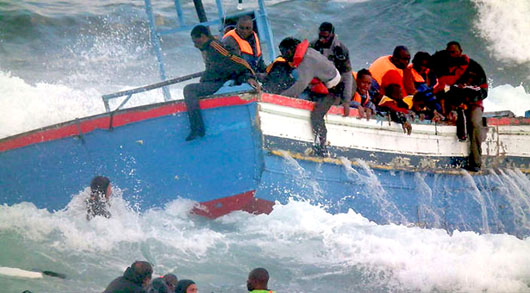
Up to 400 migrants died in boat capsize off Libya: survivors

April 15, 2015

Rome, Apr 15: Up to 400 illegal migrants trying to reach Europe died after their boat capsized off the Libyan coast on Sunday, said survivors who were saved and brought to Italy.

The Italian coastguard had previously said that they managed to rescue 144 of the people on the capsized vessel, while nine bodies were also recovered.

boat capsize

Quoting survivors, the International Organization for Migration and the charity Save the Children said between 144 and 150 survivors arrived on Tuesday morning at Reggio Calabria, located on Italy's southern tip.

"There were 400 victims in this shipwreck, which occurred 24 hours after (their vessel) left the Libyan coast," Save the Children said in a statement, citing survivors.

"There were several young males, probably minors, among the victims," the international NGO said, adding that there were also children among the survivors.

IOM spokesman in Italy Flavio Di Giacomo told AFP his organisation has also interviewed several survivors, who said there were between 500 and 550 people on board when the ship sank.

"We are continuing to investigate in order to understand how the shipwreck happened," Di Giacomo said.

According to initial findings, the boat may have capsized after passengers started moving when they saw the Italian rescue team.

On Tuesday, the coastguard said its teams had rescued nearly 8,000 people at sea since Friday.

Recent good weather in the Mediterranean has prompted a surge in the number of migrants attempting to reach Italy aboard boats.

An increasingly violent and chaotic situation in Libya, a key jumping off point for migrants, has also helped prompt the huge hike in the number of asylum seekers trying to make it to Europe.

According to Italian authorities more than 15,000 migrants have arrived in Italy so far in 2015. There were 15,000 in April alone last year and an average of 25,000 each month between June and September.

People smuggling remains a lucrative business for traffickers, with refugees and migrants rescued in the Mediterranean in February saying they paid between USD 500-1,000 for their crossing in boats that are often no more than rubber dinghies.

Comments

Add new comment

  • Coastaldigest.com reserves the right to delete or block any comments.
  • Coastaldigset.com is not responsible for its readers’ comments.
  • Comments that are abusive, incendiary or irrelevant are strictly prohibited.
  • Please use a genuine email ID and provide your name to avoid reject.
News Network
July 1,2020

As Peru begins to ease its strict coronavirus lockdown, the country's biggest LGBTQ nightclub opened its doors on Tuesday, but there will be no nighttime revellers; its dance floor will instead be filled with shelves stocked with groceries.

Instead of slinging cocktails at the bar or dancing on stage, ValeTodo Downtown's famed staff of drag queens will sell customers daily household products as the space reopens as a market while nightclubs are ordered to remain closed.

The Peruvian government will lift the lockdown in most regions of the country at the beginning of July but will keep borders closed, as well as nightclubs and bars.

The lockdown has been a struggle for the club's 120 employees like drag queen Belaluh McQueen. Her life completely changed when the government announced the quarantine. Her nights were spent at home, rather than performing as a dancer at the club in vivid-coloured costumes.

"I was very depressed because I have been doing this art for years, but you have to adapt to new challenges for the future," said McQueen, who is identified by her stage name.

Now McQueen is back to work as a grocery store employee, wearing a sequined suit, high heels and a mask. A DJ will play club music as patrons shop. "We have a new job opportunity," McQueen added.

Renamed as Downtown Market, the club, which has been a mainstay hallmark of the local LGBTQ community, ushered in its reopening with an inauguration ceremony.

"Before, I used to come here to dance and have a good time, but now we come to buy," said Alexandra Herrera, a regular attendee of the club. "The thing is to reinvent yourself."

The club's general manager, Claudia Achuy, said that the pandemic impacted the heart of Lima nightlife, but she chose to reopen as a market rather than risk cutting staff. "If we had just stayed as a nightclub we did not have a close horizon or a way of working," Achuy said.

Peru's confirmed coronavirus cases rose to 282,364 with 9,504 associated deaths on Monday, according to government data. It has the second-highest outbreak in Latin America after Brazil, according to a Reuters tally.

Comments

Add new comment

  • Coastaldigest.com reserves the right to delete or block any comments.
  • Coastaldigset.com is not responsible for its readers’ comments.
  • Comments that are abusive, incendiary or irrelevant are strictly prohibited.
  • Please use a genuine email ID and provide your name to avoid reject.
Agencies
July 28,2020

Kuala Lumpur, Jul 28: Malaysia's ex-leader Najib Razak was found guilty Tuesday in his first trial over the multi-billion-dollar 1MDB scandal, two years after the fraud contributed to the downfall of his long-ruling government.

The former prime minister could now face decades in jail after being convicted on all charges in the case related to the looting of sovereign wealth fund 1Malaysia Development Berhad.

Billions of dollars were stolen from the investment vehicle and spent on everything from high-end real estate to pricey art, while investment bank Goldman Sachs also became embroiled in the scandal.

Anger at the looting played a large part in the shock loss of Najib's long-ruling coalition in elections in 2018, and he was arrested and hit with dozens of charges following his defeat.

The verdict was a test of Malaysia's rule of law. It comes about five months after Najib's scandal-plagued party returned to power as part of a coalition, development observers had feared could affect the outcome of the case.

About 16 months after it began, the Kuala Lumpur High Court delivered the verdict in Najib's first trial, which centred on the transfer of 42 million ringgit ($9.9 million) from a former 1MDB unit, SRC International, into his accounts.

Najib had vehemently denied wrongdoing.

But Judge Mohamad Nazlan Mohamad Ghazali took apart all the arguments put forward by his defence, and found him guilty on the seven charges he faced.

"In conclusion, after considering all the evidence in this trial, I find the prosecution has successfully proven the case," the judge told the court.

The charges were one of abuse of power, three of criminal breach of trust and three of money-laundering.

The counts of abuse of power and criminal breach of trust are punishable by up to 20 years in jail each, while the money-laundering charges are punishable by up to 15 years each.

Sentencing was not handed down straight away. The 67-year-old will likely appeal and he may not be sent to jail immediately. If his conviction is upheld, he will also be barred from political office for several years.

Najib had insisted he was ignorant of the transactions.

The defence team portrayed Najib as a victim and instead sought to paint financier Low Taek Jho, a key figure in the scandal who has been charged in the US and Malaysia, as the mastermind.

Low, whose whereabouts are unknown, maintains his innocence.

Prosecutors insisted Najib was in control of the 1MDB unit, SRC International.

The return of Najib's party to power as part of a coalition in March followed the collapse of Mahathir Mohamad's reformist administration.

Since then, 1MDB-linked charges were unexpectedly dropped against the ex-leader's stepson Riza Aziz, a producer of Hollywood movie "The Wolf of Wall Street", in exchange for him agreeing to return assets to Malaysia.

Prosecutors also dropped dozens of charges against Najib ally Musa Aman, the former leader of Sabah state.

The amounts involved in Najib's first case are small compared to those in his second and most significant trial, which centres on allegations he illicitly obtained more than $500 million.

Malaysia had charged Goldman Sachs and some current and former staff, claiming large amounts were stolen when the bank arranged bond issues for 1MDB.

But the two sides agreed to a $3.9 billion settlement last week in exchange for charges being dropped.

Comments

Add new comment

  • Coastaldigest.com reserves the right to delete or block any comments.
  • Coastaldigset.com is not responsible for its readers’ comments.
  • Comments that are abusive, incendiary or irrelevant are strictly prohibited.
  • Please use a genuine email ID and provide your name to avoid reject.
News Network
April 28,2020

Washington, Apr 28: After nearly three weeks in an intensive care unit in Los Angeles, doctors treating 41-year-old Broadway actor Nick Cordero for COVID-19 were forced to amputate his right leg.

The flow of blood had been impeded by a blood clot: yet another dangerous complication of the disease that has been bubbling up in frontline reports from China, Europe and the United States.

To be sure, so-called "thrombotic events" occur for a variety of reasons among intensive care patients, but the rates among COVID-19 patients are far higher than would be otherwise expected.

"I have had 40-year-olds in my ICU who have clots in their fingers that look like they'll lose the finger, but there's no other reason to lose the finger than the virus," Shari Brosnahan, a critical care doctor at NYU Langone said.

One of these patients is suffering from a lack of blood flow to both feet and both hands, and she predicts an amputation may be necessary, or the blood vessels may get so damaged that an extremity could drop off by itself.

Blood clots aren't just dangerous for our limbs, but can make their way to the lungs, heart or brain, where they may cause lethal pulmonary embolisms, heart attacks, and strokes.

A recent paper from the Netherlands in the journal Thrombosis Research found that 31 percent of 184 patients suffered thrombotic complications, a figure that the researchers called "remarkably high" -- even if extreme consequences like amputation are rare.

Behnood Bikdeli, a doctor at New York-Presbyterian Hospital, assembled an international consortium of experts to study the issue. Their findings were published in the Journal of The American College of Cardiology.

The experts found the risks were so great that COVID-19 patients "may need to receive blood thinners, preventively, prophylactically," even before imaging tests are ordered, said Bikdeli.

What exactly is causing it? The reasons aren't fully understood, but he offered several possible explanations.

People with severe forms of COVID-19 often have underlying medical conditions like heart or lung disease -- which are themselves linked to higher rates of clotting.

Next, being in intensive care makes a person likelier to develop a clot because they are staying still for so long. That's why for example people are encouraged to stretch and move around on long haul flights.

It's also now clear the COVID-19 illness is associated with an abnormal immune reaction called "cytokine storm" -- and some research has indicated this too is linked to higher rates of clotting.

There could also be something about the virus itself that is causing coagulation, which has some precedent in other viral illnesses.

A paper in the journal The Lancet last week showed that the virus can infect the inner cell layer of organs and of blood vessels, called the endothelium. This, in theory, could interfere with the clotting process.

According to Brosnahan, while thinners like Heparin are effective in some patients, they don't work for all patients because the clots are at times too small.

"There are too many microclots," she said. "We're not sure exactly where they are."

Autopsies have in fact shown some people's lungs filled with hundreds of microclots.

The arrival of a new mystery however helps solve a slightly older one.

Cecilia Mirant-Borde, an intensive care doctor at a military veterans hospital in Manhattan, told AFP that lungs filled with microclots helped explain why ventilators work poorly for patients with low blood oxygen.

Earlier in the pandemic doctors were treating these patients according to protocols developed for acute respiratory distress syndrome, sometimes known as "wet lung."

But in some cases, "it's not because the lungs are occupied with water" -- rather, it's that the microclotting is blocking circulation and blood is leaving the lungs with less oxygen than it should.

It has just been a little under five months since the virus emerged in Wuhan, China, and researchers are learning more about its impact every day.

"While we react surprised, we shouldn't be as surprised as we were. Viruses tend to do weird things," said Brosnahan.

While the dizzying array of complications may seem daunting, "it's possible there'll be one or a couple of unifying mechanisms that describe how this damage happens," she said.

"It's possible it's all the same thing, and that there'll be the same solution."

Comments

Add new comment

  • Coastaldigest.com reserves the right to delete or block any comments.
  • Coastaldigset.com is not responsible for its readers’ comments.
  • Comments that are abusive, incendiary or irrelevant are strictly prohibited.
  • Please use a genuine email ID and provide your name to avoid reject.