


5 Hindutva leaders booked for attempt to disrupt peace in BC Road

coastaldigest.com news network
July 10, 2017

Mangaluru, Jul 10: Dakshina Kannada district police has slapped criminal cases against five local leaders of Hindutva groups for their alleged role in triggering unrest in Bantwal taluk during the funeral procession of murdered RSS activist Sharath Madivala.sharan
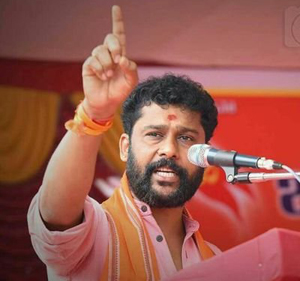
The accused include Satyajit Surathkal, State Secretary, Bharatiya Janata Party Backward Classes Morcha, and Sharan Pumpwell, State Convenor of Bajrang Dal. The other accused are Pradeep Pumpwell, Muralikrishna Hasanthadka and Harish Poonja.

Cases have been registered at jurisdictional Bantwal Town Police Station against the above five under Section 307 of the Indian Penal Code. Police are likely to arrest the five accused soon.

Sharath Madivala, a 28-year-old RSS activist was stabbed by unidentified miscreants in BC Road on July 4. He breathed his last at a hospital in Mangaluru on July 7.

On July 8 Sangh Parivar activists took the mortal remains of Sharath to his home town Sajipa Munnir in Bantwal taluk through a procession ignoring prohibitory orders. When the procession reached Bantwal, miscreants pelted stones at shops and vehicles.

It is worth mentioning here that several suspected Hindutva activists were caught on camera collecting stones on road during the procession.

Also Read: Cops raid BJP leader’s house over stone pelting during RSS activist’s funeral

Comments

MBS
 - 
Thursday, 13 Jul 2017

Bharat Maathaa
Burma Chachee
Nepal Chachoo
Bangladesh Padosiki Maa
Pakistan Dushman ki Maa
China Chath mai rehnewale ke maa
Sri lanka Samandar mai rehnewale ka Maa..
Asli Maa Footpath mai...

Shaan
 - 
Thursday, 13 Jul 2017

False news.. nobody arrested rss leaders till now.

Add new comment

  • Coastaldigest.com reserves the right to delete or block any comments.
  • Coastaldigset.com is not responsible for its readers’ comments.
  • Comments that are abusive, incendiary or irrelevant are strictly prohibited.
  • Please use a genuine email ID and provide your name to avoid reject.
News Network
May 15,2020

Bengaluru, May 15: Karnataka Chief Minister BS Yediyurappa on Friday said that the new amendment in the Agricultural Produce Marketing Committee (APMC) Act will substantially aid the farmers in getting remunerative price for their produce.

"Our motto is 'First Farmers'. The new amendment in the APMC Act will provide an opportunity for farmers to sell their produce directly to any purchase outside APMC or in other APMCs. This will help the farmers in getting remunerative price for their produce," CM Yediyurappa tweeted.

"Amendment will not dilute the powers of the work of the APMCs. All these marketing activities will be monitored by the Directorate of State APMC. This new amendment Act will benefit farmers in improving their income & suffering from losses due to market fluctuations," the Karnataka CM added.

Yediyurappa further said that the amendment will indirectly help farmers in doubling their income by 2022.

"This amendment will indirectly help farmers in doubling their income by 2022. I want to clarify that we have not removed the APMC Act, we are only amending 2 sections of the APMC Act which enable farmers to sell their produce at the markets where they intend to," he tweeted.

Comments

Add new comment

  • Coastaldigest.com reserves the right to delete or block any comments.
  • Coastaldigset.com is not responsible for its readers’ comments.
  • Comments that are abusive, incendiary or irrelevant are strictly prohibited.
  • Please use a genuine email ID and provide your name to avoid reject.
Wafa Sultana
April 4,2020

Over the last couple of days when the world was occupied with unifying efforts to fight the deadly Covid19 pandemic, sections of Indian media provided viewers a familiar scapegoat – the Indian Muslims – who are often stereotyped as a community being constantly at loggerheads with the citizenry and the State. Biased media channels were quick to resort to blaming the entire Muslim community for the spread of the disease in the country, thanks to an ill-timed Tablighi Jamaat gathering at its international headquarters in Delhi’s Nizamuddin. Unsurprisingly, the opprobrium was also marked by a sudden spike in WhatsApp forwards of videos with people wearing skullcaps licking spoons and performing Sufi breathing rituals, suggesting some sort of wild conspiracy on the part of the community to spread the virus.  Some media channels were quick to formulate, hypothesize and provide loose definitions of a newly discovered form of Jihad i.e. ‘Corona Jihad ’ thereby vilifying the Islamic faith and its followers.

While the investigation on the culpability of the organizers of the Nizamuddin event is still ongoing, there is enough information to suggest that the meeting was held before any lockdown was in force, and the problem began when there was no way of getting people out once the curfew was announced. Be that as it may, there is little doubt that organizing a meet of such a scale when there is a global pandemic smacks of gross misjudgment, and definitely the organizers should be held accountable if laws or public orders were defied. Attendees who attempt to defy quarantine measures must be dealt with strictly. However, what is alarming is that the focus and narrative have now shifted from the unfortunate event at Nizamuddin to the Tablighi Jamaat itself.

For those not familiar with the Tablighi Jamaat, the organization was founded in 1926 in Mewat by scholar Maulana Mohammad Ilyas. The Jamaat’s main objective was to get Muslim youth to learn and practice pristine Islam shorn of external influences. This is achieved through individuals dedicating time for moral and spiritual upliftment secluded from the rest of the world for a brief period of time. There is no formal membership process. More senior and experienced participants typically travel from one mosque to other delivering talks on religious topics, inviting local youth to attend and then volunteer for a spiritual retreat for a fixed number of days to a mosque in a nearby town or village to present the message to their co-religionists. Contrary to ongoing Islamophobic rhetoric, the movement does not actively proselytize. The focus is rather on getting Muslims to learn the teachings and practices of Islam.  This grassroots India-based movement has now grown to almost all countries with substantial Muslim populations. Its annual meets, or ‘ijtemas’ are among the largest Islamic congregations in the world after the annual Haj. One of the reasons for its popularity and wide network in the subcontinent and wordwide is the fact that it has eschewed the need for scholarly intervention, focusing on peer learning of fundamental beliefs and practice rather than high-falutin ideological debates. The Tablighi Jamaat also distinguishes itself from other Islamic movements through its strictly apolitical nature, with a focus on individual self-improvement rather than political mobilization. Hardships and difficulty in the world are expected to be face through ‘sabr’ (patience) and ‘dua’ (supplication),  than through quest for political power or influence. In terms of ideology, it is very much based on mainstream Sunni Islamic principles derived from the Deobandi school.

So, why is all this background important in the current context? While biased media entities have expectedly brought out their Islamophobic paraphernalia out for full display, more neutral commentators have tried to paint the Tablighi Jamaat as a fringe group and have tried to distance it from 'mainstream Muslims'. While the intent is no doubt innocent, this is a trap we must not fall into. This narrative, unfortunately, is also gaining ground due to apathy some Muslims have for the group, accusing it of being “disconnected from the realities of the world”. Unlike other Muslim organizations and movements, the Tablighi Jamat, by virtue of its political indifference, does not boast of high-profile advocates and savvy spokespersons who can defend it in mainstream or social media.  The use of adjectives such as 'outdated' and 'orthodox' by liberal columnists to describe the Jamaat feeds into the malignant attempt to change the narrative from the control of the spread of the pandemic due to the Nizamuddin gathering to 'raison d'etre' of the organization itself.

A large mainstream religious group like the Tablighi Jamaat with nearly a hundred-year history, normally considered to be peaceful, apolitical and minding its own business is now suddenly being villainized owing to unfortunate circumstances. Biased media reactions filled with disgust and hate seem to feed the Indian public conscience with a danngerous misconception - to be a nominal Muslim is okay but being a practicing one is not.  For those committed to the truth and fighting the spread of Islamophobia, the temptation to throw the entire Tablighi Jamaat under the bus must be resisted.

The writer is a lawyer and research scholar at Qatar University. Her research interests include Islamic law and politics.

Comments

zahoorahmed
 - 
Saturday, 4 Apr 2020

great article! provides a great perspective on tableeg jamat

Add new comment

  • Coastaldigest.com reserves the right to delete or block any comments.
  • Coastaldigset.com is not responsible for its readers’ comments.
  • Comments that are abusive, incendiary or irrelevant are strictly prohibited.
  • Please use a genuine email ID and provide your name to avoid reject.
News Network
January 8,2020

Bengaluru, Jan 8: The all-India shutdown by trade unions and other organisations began with little impact in the tech city as normal life continued on a working day, an official said.

"No effect of shutdown in the city though banking operations are affected as bank staff are supporting the trade unions," a state official said here.

However, thousands of workers participated in other parts of Karnataka in the nation-wide shutdown call given by trade unions, protesting central government's anti-labour laws and privatisation policies.

Protesters were seen carrying the red trade union flags at several places such as Hassan, Chamarajanagar, Tumakuru, Mysuru, Bengaluru and others.

Massive protests were seen in Peenya, and Neelmangla areas of Bengaluru.

In Madikeri, stones were pelted at a bus and some protesters were detained in Kolar.

The trade unions are against the privatisation of railways and corporatisation of 49 defence production units.

Merging 44 labour laws into four code is also one of the demands of the protesting trade unions.

The protesters are demanding raising the minimum wage in the range of ₹21,000 - 24,000 per month.

The All India Trade Union Congress (AITUC), Centre of Indian Trade Unions (CITU), Indian National Trade Union Congress and Labour Progressive Federation (LPF) have given an all-India shutdown (Bharat Bandh) call on Wednesday.

Karnataka Chief Minister B.S. Yediyurappa instructed the intelligence chief and additional director general of police Kamal Pant to maintain law and order in view of the Bharat bandh when he apprised him of the situation.

Police tightened security across the city by deploying 11 deputy commissioners of police (DCPs), 23 assistant commissioners of police (ACP), 111 inspectors, 316 sub-inspectors, 476 assistant sub-inspectors, 4,547 constables along with 82 platoons of Karnataka State Reserve Police (KSRP).

In Bengaluru city, Metro services were not affected by the nationwide strike. In view of the shutdown, security was beefed at the Metro stations.

Comments

Add new comment

  • Coastaldigest.com reserves the right to delete or block any comments.
  • Coastaldigset.com is not responsible for its readers’ comments.
  • Comments that are abusive, incendiary or irrelevant are strictly prohibited.
  • Please use a genuine email ID and provide your name to avoid reject.