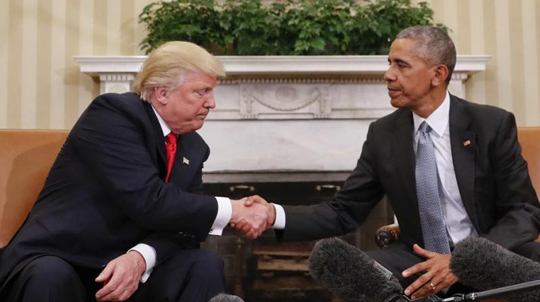
50 Top Obama Officials To Work For Donald Trump Administration

January 20, 2017

Washington, Jan 20: About 50 top officials who have been working in outgoing US President Barack Obama's administration will continue serving in those positions for Donald Trump's incoming government, future White House spokesman Sean Spicer said on Thursday.

Obamatop

Spicer said that Trump is aware of the importance of "guaranteeing continuity" in the government and, therefore, he has asked some 50 people occupying "key" positions in the current administration to continue in their posts for the time being, Efe news reported.

Among the several dozen people are Deputy Defence Secretary Robert Work and the undersecretary of political affairs at the State Department, Thomas Shannon, who will function as the acting chiefs of those agencies until the Senate can confirm the nominees proposed by Trump to head them.

Also to remain in their posts temporarily will be the interim administrator of the Drug Enforcement Administration, Chuck Rosenberg, Obama's special envoy for the fight against the Islamic State, Brett McGurk, and the director of the National Counterterrorism Centre, Nicholas Rasmussen.

Another official who will remain in his post is Adam Szubin, who is in charge of terrorism and financial intelligence policy at the Department of the Treasury.

Trump arrived on Thursday in Washington to begin the series of events leading to his inauguration which will take place on Friday at a ceremony in front of the Capitol.

Spicer said that the magnate is continuing to work on his inauguration speech, which he said will be "a very personal and sincere statement about his vision for the country" and "more of a philosophical document" than an agenda for his moves as President.

The incoming White House spokesman did not provide any details about the executive orders that Trump was intending to sign on Friday after his inauguration.

However, he did say that executive orders on the Trans-Pacific Partnership and North America Free Trade Agreement trade treaties will be signed "very quickly".

On the other hand, Spicer said that, for the moment, there are no foreign leaders scheduled to visit the White House next week, Trump's first week as President.

Comments

Add new comment

  • Coastaldigest.com reserves the right to delete or block any comments.
  • Coastaldigset.com is not responsible for its readers’ comments.
  • Comments that are abusive, incendiary or irrelevant are strictly prohibited.
  • Please use a genuine email ID and provide your name to avoid reject.
News Network
June 4,2020

Jun 4: A malaria drug President Donald Trump took to try to prevent COVID-19 proved ineffective for that in the first large, high-quality study to test it in people in close contact with someone with the disease.

Results published Wednesday by the New England Journal of Medicine show that hydroxychloroquine was no better than placebo pills at preventing illness from the coronavirus.

The drug did not seem to cause serious harm, though -- about 40% on it had side effects, mostly mild stomach problems.

 “We were disappointed. We would have liked for this to work,” said the study leader, Dr. David Boulware, an infectious disease specialist at the University of Minnesota.

“But our objective was to answer the question and to conduct a high-quality study,” because the evidence on the drug so far has been inconclusive, he said.

Hydroxychloroquine and a similar drug, chloroquine, have been the subject of much debate since Trump started promoting them in March.

Hydroxychloroquine has long been used for malaria, lupus, and rheumatoid arthritis, but no large studies have shown it or chloroquine to be safe or effective for much sicker patients with coronavirus, and some studies have suggested the drugs may do harm.

Trump took a two-week course of hydroxychloroquine, along with zinc and Vitamin D, after two staffers tested positive for COVID-19, and had no ill effects, according to results of his latest physical released by his doctor Wednesday.

Federal regulators have warned against hydroxychloroquine's use except in hospitals and formal studies because of the risk of side effects, especially heart rhythm problems.

Boulware's study involved 821 people in the United States and Canada living with someone diagnosed with COVID-19 or at high risk of getting it because of their job -- doctors, nurses, ambulance workers who had significant exposure to a sick patient while not wearing full protective gear.

They were randomly assigned to get either the nutrient folate as a placebo or hydroxychloroquine for five days, starting within four days of their exposure. Neither they nor others involved in the research knew who was getting which pills.

After 14 days in the study, 12 per cent on the drug developed COVID-19 symptoms versus 14 per cent in the placebo group, but the difference is so small it could have occurred by chance, Boulware said.

“There's basically no effect. It does not prevent infection,” he said of the drug. Even if it were to give some slim advantage, “we'd want a much larger effect” to justify its use and risk of side effects for preventing illness, he said.

Results were no different among a subgroup of participants who were taking zinc or vitamin C, which some people believe might help make hydroxychloroquine more effective or fight the coronavirus.

There are some big caveats: The study enrolled people through the Internet and social media, relying on them to report their own symptoms rather than having them tracked in a formal way by doctors.

Participants were not all tested for the coronavirus but were diagnosed as COVID-19 cases based on symptoms in many cases. And not all took their medicines as directed.

The results “are more provocative than definitive,” and the drug may yet have prevention benefits if tried sooner or in a different way, Dr. Myron Cohen of the University of North Carolina at Chapel Hill wrote in a commentary in the journal.

Others were glad to see a study that had a comparison group and good scientific methods after so many weaker reports on hydroxychloroquine.

“This fits with everything else we've seen so far which suggests that it's not beneficial," said Dr. Peter Bach, director of a health policy center at Memorial Sloan Kettering Cancer Center in New York.

This study was in younger relatively healthy people, but the results “would make me very discouraged about trying to use this in older people” who are most vulnerable to serious illness from the coronavirus, Bach said.

“If it does work, it doesn't work very well.” Dr. Dan Culver, a lung specialist at the Cleveland Clinic, said there's still a chance that giving the drug sooner than four days after someone's exposure to the virus may help prevent illness.

But the study “takes 'home run' off the table” as far as hopes for the drug, he said.

The study was mostly funded by David Baszucki, founder of Roblox, a California-based game software company, and other private donors and the Minnesota university.

Boulware also is leading a study testing hydroxychloroquine for treating COVID-19. The study is finished and results are being analyzed now.

On Tuesday, the journal Lancet posted an “expression of concern” about a study it published earlier this month of nearly 15,000 COVID-19 patients on the malaria drugs that tied their use to a higher risk of dying in the hospital or developing a heartbeat problem.

Scientists have raised serious questions about the database used for that study, and its authors have launched an independent audit.

That work had a big impact: the World Health Organization suspended use of hydroxychloroquine in a study it is leading, and French officials stopped the drug's use in hospitals. On Wednesday, the WHO said experts who reviewed safety information decided that its study could resume.


Comments

Add new comment

  • Coastaldigest.com reserves the right to delete or block any comments.
  • Coastaldigset.com is not responsible for its readers’ comments.
  • Comments that are abusive, incendiary or irrelevant are strictly prohibited.
  • Please use a genuine email ID and provide your name to avoid reject.
News Network
January 10,2020

Washington, Jan 10: It is “highly likely” that Iran shot down the civilian Ukrainian jetliner that crashed near Tehran late Tuesday, killing all 176 people on board, U.S., Canadian and British officials declared Thursday.

They said the fiery missile strike could well have been a mistake amid rocket launches and high tension throughout the region.

The crash came just a few hours after Iran launched a ballistic attack against Iraqi military bases housing U.S. troops in its violent confrontation with Washington over the U.S. drone strike that killed an Iranian Revolutionary Guard general. The airliner could have been mistaken for a threat, said four U.S. officials, speaking on condition of anonymity to discuss sensitive intelligence.

Canadian prime minister Justin Trudeau, whose country lost at least 63 citizens in the downing, said in Toronto: “We have intelligence from multiple sources including our allies and our own intelligence. The evidence indicates that the plane was shot down by an Iranian surface-to-air missile.”

Likewise, U.K. prime Minister Boris Johnson and Australian prime minister Scott Morrison offered similar statements. Morrison also said it appeared to be a mistake. “All of the intelligence as presented to us today does not suggest an intentional act,” he said.

The assessment that 176 people were killed as collateral damage in the Iranian-U.S. conflict cast a new pall over what had at first appeared to be a relatively calm aftermath following the U.S. military operation that killed Iranian Gen. Qassem Soleimani.

At the White House, U.S. president Donald Trump suggested he believed Iran was responsible for the shootdown and dismissed Iran's initial claim that it was a mechanical issue with the plane.

“Somebody could have made a mistake on the other side.” Trump said, noting the plane was flying in a “pretty rough neighborhood."

Comments

Add new comment

  • Coastaldigest.com reserves the right to delete or block any comments.
  • Coastaldigset.com is not responsible for its readers’ comments.
  • Comments that are abusive, incendiary or irrelevant are strictly prohibited.
  • Please use a genuine email ID and provide your name to avoid reject.
News Network
June 19,2020

London, Jun 19: Malala Yousafzai, the youngest Nobel Peace Prize winner who once took a bullet for campaigning for girls' education in Pakistan, was over the moon on Friday after completing her degree in Philosophy, Politics and Economics at Britain's prestigious Oxford University.

Malala, 22, who attended Oxford's Lady Margaret Hall college, took to Twitter to share two pictures that show her celebrating the milestone with her family.

"Hard to express my joy and gratitude right now as I completed my Philosophy, Politics and Economics degree at Oxford," she said in the tweet, accompanied by two pictures - one showing her sitting with her family in front of a cake that says: 'Happy Graduation Malala', and the other in which she is covered with cake smiling for the camera.

In the tweet, the famed human rights activist also revealed her plans for the immediate future - Netflix, reading and sleeping.

"I don't know what's ahead. For now, it will be Netflix, reading and sleep," she wrote.

Malala was shot in the head by the Taliban militants in December 2012 for campaigning for female education in the Swat Valley in northeastern Pakistan.

Severely wounded, she was airlifted from one military hospital in Pakistan to another and later flown to the UK for treatment.

After the attack, the Taliban released a statement saying that they would target Malala again if she survived.

At the age of 17, Malala became the youngest recipient of the Nobel Peace Prize for her education advocacy in 2014 when she shared the coveted honour with India's social activist Kailash Satyarthi.

Unable to return to Pakistan after her recovery, she moved to Britain, setting up the Malala Fund and supporting local education advocacy groups with a focus on Pakistan, Nigeria, Jordan, Syria and Kenya.

The Taliban, who are against girls' education, have destroyed many schools in Pakistan.

Comments

Add new comment

  • Coastaldigest.com reserves the right to delete or block any comments.
  • Coastaldigset.com is not responsible for its readers’ comments.
  • Comments that are abusive, incendiary or irrelevant are strictly prohibited.
  • Please use a genuine email ID and provide your name to avoid reject.