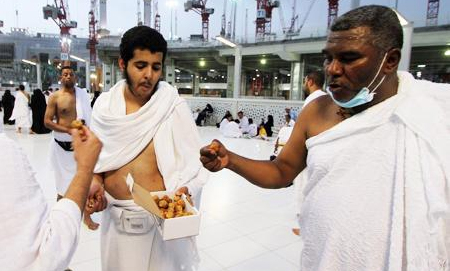
7.5m iftar packets offered at Masjid-ul-Haram

July 1, 2014

Masjid-ul-Haram ramadanJeddah, Jul 1: Philanthropists will distribute more than 7.5 million packets of iftar meals among worshippers at the Grand Mosque in Makkah throughout Ramadan.

“Everyday they supply 250,000 iftar meals, of which 80,000 meals are distributed in the northern courtyard and 70,000 in the southern courtyard,” said an official in charge of distributing the meals.

“We also distribute 90,000 to 120,000 meals in Azza and Shamiya courtyards,” the official said, adding that a large number of young Saudis participate in the massive operation.

The Charitable Warehouse in Makkah said it has set out a plan to distribute 90,000 iftar meals inside the mosque and 120,000 meals among worshippers sitting in the courtyards. “We are taking help of 120 workers,” said Abdullah Al-Nafie, director of the charity.

He added that the workers are trained for 20 hours with the support of the Dawa Center in Makkah.

Mohammed Ali, a volunteer, said he was happy to distribute iftar meals among the pilgrims and other worshippers at the Grand Mosque.

“I come to the Haram with other friends after Asr to participate in this noble program. We are doing this only to get the reward from the Almighty.”

Abdul Wahid Al-Qurashi, another volunteer said: “I have been participating in this program for the last many years. Iftar meals are distributed among worshippers sitting inside and outside the mosque. It’s a big operation and needs the support of many volunteers.”

Comments

Add new comment

  • Coastaldigest.com reserves the right to delete or block any comments.
  • Coastaldigset.com is not responsible for its readers’ comments.
  • Comments that are abusive, incendiary or irrelevant are strictly prohibited.
  • Please use a genuine email ID and provide your name to avoid reject.
News Network
March 26,2020

Riyadh, Mar 26: Leaders of the Group of 20 nations will hold a summit today via video conference to discuss measures to protect the global economy, amid coronavirus pandemic which has claimed over 18,000 lives globally.
The summit, which will be chaired by Saudi Arabia's King Salman bin Abdulaziz Al Saud, aims to "advance a coordinated global response to the COVID-19 pandemic and its human and economic implications," according to the statement published by the G20 Secretariat on Tuesday.
The lethal virus which was first detected in December last year in the Chinese city of Wuhan, has since, infected over 4,14,179 people around the world.
The coronavirus has already resulted in major disruption of global supply chains, volatility and large drops in the stock market and could cause a financial crisis as stated by IMF Managing Director Kristalina Georgieva.
India is a member nation of the G20 group.
Speaking on the summit on Wednesday, Prime Minister Narendra Modi said that the Group of 20 (G20) has an important role to play in the fight against coronavirus.
He said: "The G20 has an important global role to play in addressing the #COVID19 pandemic. I look forward to productive discussions tomorrow at the G20 Virtual Summit, being coordinated by the Saudi G20 Presidency."
The other members include Argentina, Australia, Brazil, Canada, China, Germany, France, India, Indonesia, Italy, Japan, Mexico, the Russian Federation, Saudi Arabia, South Africa, South Korea, Turkey, the UK, the US, and the European Union.
In view of the coronavirus outbreak situation, several international organisations -- including the United Nations, World Bank, the World Health Organization and the World Trade Organization will take part.
Leaders from the Food and Agriculture Organization, the Financial Stability Board, the International Labour Organization, International Monetary Fund, the Organization for Economic Cooperation and Development -- will also be the part of the conference.

Comments

Add new comment

  • Coastaldigest.com reserves the right to delete or block any comments.
  • Coastaldigset.com is not responsible for its readers’ comments.
  • Comments that are abusive, incendiary or irrelevant are strictly prohibited.
  • Please use a genuine email ID and provide your name to avoid reject.
Arab News
March 9,2020

Dubai, Mar 9: The eyes of the world will be on the oil markets when the big trading hubs in Europe and North America open following the end of the deal between Saudi Arabia and Russia that has helped to sustain crude at relatively high levels for the past three years.

There were big falls on Friday when ministers from the Organization of the Petroleum Exporting Countries (OPEC) failed to get a deal with non-OPEC members — the so-called OPEC+ — to extend output agreements. Brent oil was down nearly 10 percent at $45.27 going into the western weekend.

Saudi Aramco took immediate action to cut prices after the OPEC+ collapse, offering big discounts for crude deliveries from next month, when the current output restrictions end.

According to a notification sent to customers by Saudi Aramco, seen by Arab News, the Kingdom’s oil giant will cut between $4 and $8 per barrel, with the biggest discounts being offered to buyers in northwest Europe and the US.

Roger Diwan, an oil analyst at consultancy IHS Market, said: “We are likely to see the lowest oil prices of the past 20 years in the next quarter.”

West Texas Intermediate, the US oil benchmark, fell to $28.27 in November 2001.

The move raises the possibility of a “crude war” between the three biggest oil blocs — the US, Russia and the Arabian Gulf. Some analysts believe the American shale industry is more vulnerable to low prices than either the Russians or the Saudis.

Robin Mills, head of the Qamar consultancy, told Arab News: “I don’t think this was premeditated but Saudi Arabia has clearly swung quickly into action to put the Russians under pressure. But the Russians, with low debt and a flexible exchange rate, can cope with a few months of low prices.”

The boom in US shale has made the country the biggest oil producer in the world, but with high financing costs. Lower global prices would put a lot of shale companies out of business.

On the other hand, American motorists, and President Donald Trump, would be pleased to see lower fuel prices in an election year.

In Moscow, one prominent financier with ties to the Kingdom played down the long-term significance of the Vienna fallout.

Kirill Dmitriev, chief executive of the Russian Direct Investment Fund, told Arab News: “Saudi Arabia is our strategic partner, and cooperation between our two countries will continue in all areas. We will also continue to work within the framework of the Russia-Saudi Economic Council.”

One Russian official, who asked not to be named, added: “There is a good relationship between Alexander Novak, Russian energy minister, and his Saudi counterpart Prince Abdul Aziz bin Salman, and I am sure they will continue talking to each other less formally.”

Comments

Add new comment

  • Coastaldigest.com reserves the right to delete or block any comments.
  • Coastaldigset.com is not responsible for its readers’ comments.
  • Comments that are abusive, incendiary or irrelevant are strictly prohibited.
  • Please use a genuine email ID and provide your name to avoid reject.
News Network
May 11,2020

May 11: Saudi Arabia will triple its value-added tax rate and suspend a cost of living allowance for state workers, it said on Monday, seeking to shield finances hit by low oil prices and a slump in demand for its lifeline export worsened by the new coronavirus.

Historic oil output cuts agreed by Riyadh and other major producers have given only limited support to prices after they sank on oversupply caused by a war for petroleum market share between the kingdom and its fellow oil titan Russia.

Saudi Arabia, the world's largest oil exporter, is also being hit hard by measures to fight the new coronavirus, which are likely to curb the pace and scale of economic reforms launched by Crown Prince Mohammed bin Salman.

"The cost of living allowance will be suspended as of June 1, and the value added tax will be increased to 15% from 5% as of July 1," Finance Minister Mohammed al-Jadaan said in a statement reported by the state news agency. "These measures are painful but necessary to maintain financial and economic stability over the medium to long term...and to overcome the unprecedented coronavirus crisis with the least damage possible."

The austerity measures come after the kingdom posted a $9 billion budget deficit in the first quarter.

The minister said non-oil revenues were affected by the suspension and decline in economic activity, while spending had risen due to unplanned strains on the healthcare sector and the initiatives taken to support the economy.

"All these challenges have cut state revenues, pressured public finances to a level that is hard to deal with going forward without affecting the overall economy in the medium to long term, which requires more spending cuts and measures to support non-oil revenues stability," he added.

The government has cancelled and put on hold some operating and capital expenditures for some government agencies, and cut allocations for some reform initiatives and projects worth a total 100 billion riyals ($26.6 billion), the statement said.

Central bank foreign reserves fell in March at their fastest rate in at least 20 years and to their lowest since 2011, while oil revenues in the first three months of the year fell 24% from a year earlier to $34 billion, pulling total revenues down 22%.

"The reforms are positive from a fiscal side as greater adjustment is essential. However, the tripling of VAT is unlikely to help that much in 2020 revenue wise with the expected fall in consumption," said Monica Malik, chief economist at Abu Dhabi Commercial Bank.

She said she kept unchanged her deficit forecast of 16.3% of GDP for this year, which already factors in a greater than previously announced spending cut.

About 1.5 million Saudis are employed in the government sector, according to official figures released in December.

In 2018, Saudi Arabia's King Salman ordered a monthly payment of 1,000 riyals ($267) to every state employee to compensate them for the rising living costs after the government hiked domestic gas prices and introduced value-added tax.

DIFFICULT TIMES

A committee has been formed to study all financial benefits paid to public sector employees and contractors, and will submit recommendations within 30 days, the statement said.

In late 2015, when oil prices fell from record highs, the kingdom slashed lavish bonuses, overtime payments and other benefits once considered routine perks in the public sector.

In a country without elections and with political legitimacy resting partly on distribution of oil revenue, the ability of citizens to adapt to such reforms is crucial for stability.

"Tripling the VAT will test the limits of the balance between revenues and consumption as the economy dives into a deep recession. The move will impact consumption and could also lower the expected revenues," said John Sfakianakis, a Gulf expert at the University of Cambridge.

"These are pro-austerity and pro-revenue moves rather than pro-growth ones," he said.

Hasnain Malik, head of equity strategy at Tellimer, said the VAT rise could bring about $24-$26.5 billion in additional non-oil fiscal revenue. The rise would hit consumer spending further but was a needed step towards fiscal sustainability, he said.


Comments

Add new comment

  • Coastaldigest.com reserves the right to delete or block any comments.
  • Coastaldigset.com is not responsible for its readers’ comments.
  • Comments that are abusive, incendiary or irrelevant are strictly prohibited.
  • Please use a genuine email ID and provide your name to avoid reject.