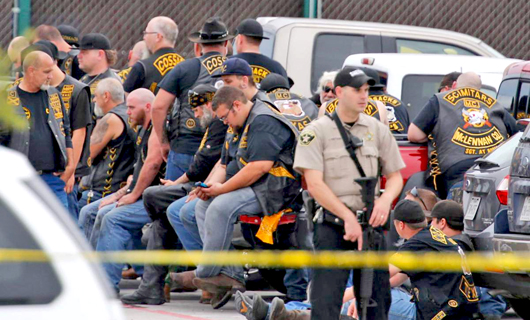
9 dead in Texas shooting involving rival biker gangs

May 18, 2015

Washington, May 18: At least nine people were killed and 18 injured in a shootout between rival biker gangs in Texas' Waco city on Sunday afternoon, police said on Monday.

biker gang1

The shootout occurred in a parking lot between the Twin Peaks and Don Carlos restaurants shortly after noon, said local television station News Channel 25.

All the dead - eight of whom died at the scene, the ninth in a local hospital - were members of the rival motorcycle gangs.

The fight broke out in the Twin Peaks after an argument, with the brawlers spilling outside into the parking lot, police said.

Police official W. Patrick Swanton said members of at least three rival gangs were in the parking lot when the shooting erupted, but he did not provide the names of the gangs or the victims.

Police were on the scene when the shooting started and officers fired on some of the bikers to put an end to the clash, said Swanton, adding that the officers' actions "saved lives" and prevented the clash from becoming even bigger.

Many officers and emergency medical teams were dispatched to the scene of the shootout, where law enforcement authorities found chains, knives, garrots, firearms and other weaponry scattered around the area.

Police said the condition of some of the injured, who were taken to local hospitals with knife and gunshot wounds, is such that more deaths may occur in the coming hours or days.

Some of the customers inside the two restaurants managed to hide in the freezers to protect themselves from the gunfire, the TV station reported.

After the shootout, the two restaurants closed and police arrested a number of people and questioned the people present.

One eyewitness, Michelle Logan, 37, told media that there were about 30 firearms in action in the parking lot and about 100 shots were fired in all.

Comments

Add new comment

  • Coastaldigest.com reserves the right to delete or block any comments.
  • Coastaldigset.com is not responsible for its readers’ comments.
  • Comments that are abusive, incendiary or irrelevant are strictly prohibited.
  • Please use a genuine email ID and provide your name to avoid reject.
News Network
March 26,2020

London, Mar 26: British Prime Minister Boris Johnson has said that the country's NHS risks becoming "overwhelmed" by the coronavirus outbreak and that the situation in Britain is just two or three weeks behind Italy.
"The numbers are very stark, and they are accelerating. We are only a matter of weeks -- two or three -- behind Italy," Johnson said, as reported by CNN.
"The Italians have a superb health care system. And yet their doctors and nurses have been completely overwhelmed by the demand. The Italian death toll is already in the thousands and climbing.
He added, "Unless we act together unless we make the heroic and collective national effort to slow the spread -- then it is all too likely that our own NHS will be similarly overwhelmed,"
"That is why this country has taken the steps that it has, in imposing restrictions never seen before either in peace or war." He said.
The problem reached a crunch point in the UK, which has dramatically increased its response to the virus outbreak this week.
Food banks that provide a lifeline for some of the estimated 14 million in poverty are running low on volunteers, many of whom have been forced to self-isolate, as well as the food itself, which is in short supply following panic-buying.
The UK has confirmed more 9,600 cases of the deadly virus with 460 deaths.
The global tally of cases has crossed 487,000 as on Thursday with 22,030 deaths globally as per the data presented by the Johns Hopkins University.

Comments

Add new comment

  • Coastaldigest.com reserves the right to delete or block any comments.
  • Coastaldigset.com is not responsible for its readers’ comments.
  • Comments that are abusive, incendiary or irrelevant are strictly prohibited.
  • Please use a genuine email ID and provide your name to avoid reject.
News Network
April 10,2020

Paris, Apr 10: French pharma major Sanofi said on Friday it has decided to donate 100 million doses of hydroxychloroquine, the anti-malaria drug which could be a potential weapon against novel coronavirus, across 50 countries.

The company has already doubled its incremental production capacity on top of the usual production for current indications across its eight hydroxychloroquine manufacturing sites worldwide and is on track to quadruple it by the summer.

"In this global health emergency, Sanofi stands ready to assist as many countries as possible, starting with countries where its medicine is registered for current approved indications as well as countries where there are no hydroxychloroquine suppliers or countries with underserved populations," it said in a statement.

Sanofi called for coordination among the entire hydroxychloroquine chain worldwide to ensure the continued supply of the medicine if proven to be a well-tolerated and effective treatment in COVID-19 patients.

"The COVID-19 pandemic is an unprecedented health and economic crisis which is shaking some of the very fundamentals of international solidarity and cooperation among countries," said Chief Executive Officer Paul Hudson. "This virus does not care about the concept of borders, so we should not either," he added.

"It is critical that international authorities, local governments, manufacturers and all other players involved in the hydroxychloroquine chain work together in a coordinated manner to ensure all patients who may benefit from this potential treatment can access it. If the trials prove positive, we hope our donation will play a critical role for patients," said Hudson.

While hydroxychloroquine is generating a lot of hope for patients around the world, said Sanofi, it should be remembered that there are no results from ongoing studies and the results may be positive or negative.

To date, there is insufficient clinical evidence to draw any conclusion over the safety and efficacy of hydroxychloroquine in the management of COVID-19 patients.

It is one of several medicines being investigated by the World Health Organisation (WHO) in its international clinical trial seeking a treatment solution for COVID-19. "Sanofi is supporting ongoing trials by providing the medicine to some participating investigator sites and other independent research centres," it said.

Comments

Add new comment

  • Coastaldigest.com reserves the right to delete or block any comments.
  • Coastaldigset.com is not responsible for its readers’ comments.
  • Comments that are abusive, incendiary or irrelevant are strictly prohibited.
  • Please use a genuine email ID and provide your name to avoid reject.
Agencies
January 20,2020

For the first time in the 15 years of the Global Risks Report, the climate change and environment risk has occupied all the top five slots.

According to the 15th edition of the World Economic Forum's (WEF) Global Risks Report, the top five risks in terms of likelihood are extreme weather, climate action failure, natural disasters, biodiversity loss and human-made environmental disasters. They all fall in the one category of climate change and related environmental disasters.

WEF President Borge Brende said the world was feeling long-mounting and interconnected risks.

The report also points to how citizens are protesting across the world as discontent rises with failed systems that are creating inequality. The citizens' discontent had hardened with systems that had failed to promote advancement, it said.

"Disapproval of how governments are addressing profound economic and social issues has sparked protests throughout the world, potentially weakening the ability of governments to take decisive action should a downturn occur. Without economic and social stability, countries could lack the financial resources, fiscal margin, political capital or social support needed to confront key global risks," it said.

Listing the grim scenario, Borge said the global economy was faced with "synchronised slowdown", the past five years had been the warmest on record and cyber attacks were expected to increase this year.

The report warns that while the myriad risks were rising, time was running out on how to prevent them.

Borge said the growing palpability of shared economic, environmental and societal risks indicated that the horizon had shortened for preventing "or even mitigating" some of the direst consequences of global risks.

"It's sobering that in the face of this development, when the challenges before us demand immediate collective action, fractures within the global community appear to only be widening," he said.

The report points to grave concern about the consequences of continued environmental degradation, including the record pace of species decline.

Pointing to an unsettled geopolitical environment, the report said today's risk landscape was one in which new centres of power and influence were forming and old alliance structures and global institutions were being tested.

"While these changes can create openings for new partnership structures in the immediate term, they are putting stress on systems of coordination and challenging norms around shared responsibility. Unless stakeholders adapt multilateral mechanisms for this turbulent period, the risks that were once on the horizon will continue to arrive," it said.

Calling it a "an unsettled world", the WEF report notes that powerful economic, demographic and technological forces were shaping a new balance of power. "The result is an unsettled geopolitical landscape in which states are increasingly viewing opportunities and challenges through unilateral lenses," it said.

"What were once givens regarding alliance structures and multilateral systems no longer hold as states question the value of long-standing frameworks, adopt more nationalist postures in pursuit of individual agendas and weigh the potential geopolitical consequences of economic decoupling. Beyond the risk of conflict, if stakeholders concentrate on immediate geo-strategic advantage and fail to re-imagine or adapt mechanisms for coordination during this unsettled period, opportunities for action on key priorities may slip away," the WEF said.

In a chapter on risks to economic stability and social cohesion, it said a challenging economic climate might persist this year and members of the multi-stakeholder community saw "economic confrontations" and "domestic political polarisation" as the top risks in 2020.

The report also warned of downward pressure on the global economy from macroeconomic fragilities and financial inequality. These pressures continued to intensify in 2019, increasing the risk of economic stagnation.

Low trade barriers, fiscal prudence and strong global investment, once seen as fundamentals for economic growth, are fraying as leaders advance nationalist policies. The margins for monetary and fiscal stimuli are also narrower than before the 2008-2009 financial crisis, creating uncertainty about how well countercyclical policies will work.

The strategic partners for the WEF report included Marsh & McLennan and Zurich Insurance Group. The academic advisers were National University of Singapore, Oxford Martin School, University of Oxford and Wharton Risk Management and Decision Processes Center, University of Pennsylvania.


Comments

Add new comment

  • Coastaldigest.com reserves the right to delete or block any comments.
  • Coastaldigset.com is not responsible for its readers’ comments.
  • Comments that are abusive, incendiary or irrelevant are strictly prohibited.
  • Please use a genuine email ID and provide your name to avoid reject.