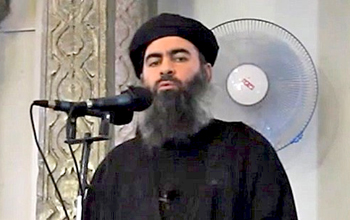
Abu Bakr al-Baghdadi injured in air strike in Iraq

November 10, 2014

Abu BakrBaghdad, Nov 10: Iraqi Interior Ministry confirmed Sunday that the Islamic State (IS) top leader Abu Bakr al-Baghdadi was injured in a air strike, which killed several senior leaders of the extremist group, state-run Iraqiya news channel reported.

Earlier in the day, a security official from Iraq's northern province of Nineveh, however, told Xinhua that he could not confirm reports saying an air strike by the US-led coalition targeted a convoy of vehicles near the city of Mosul, the capital of Nineveh province.

"We can't confirm the news of death or wounding of Abu Bakr al- Baghdadi, because all what we have is our intelligence reports which only mentioned that some 45 IS militants were killed and wounded by the air strikes of the US-led coalition near Mosul late Friday," Mohammed Ibrahim, head of security committee of Nineveh's provincial council said.

Ibrahim also said that at least two IS senior figures, Libyan and Saudi nationals, were among the dead during the coalition air strikes which destroyed several armed vehicles and positions of the IS militant group.

On Saturday, Colonel Patrick Ryder, a Central Command spokesman, said in a statement that he could not confirm whether IS top leader Abu Bakr al-Baghdadi was in the vehicle convoy consisting of 10 armed trucks.

Abu Bakr al-Baghdadi, known to his supporters as Amir al-Mu' minin, is the Caliph of the self-proclaimed Islamic State which announced the establishment of a caliphate June 29, 2014.

The militant group captured the areas in western and northwestern Iraq as well as part of northeastern Syria.

On Oct 4, 2011, the US listed al-Baghdadi as a global terrorist and announced a reward of up to $10 million for information leading to his capture or death. Only the leader of al-Qaida, Ayman al-Zawahiri, merits a larger reward of $25 million.

Comments

Add new comment

  • Coastaldigest.com reserves the right to delete or block any comments.
  • Coastaldigset.com is not responsible for its readers’ comments.
  • Comments that are abusive, incendiary or irrelevant are strictly prohibited.
  • Please use a genuine email ID and provide your name to avoid reject.
News Network
April 15,2020

Wuhan, Apr 15: In the six days after top Chinese officials secretly determined they likely were facing a pandemic from a new coronavirus, the city of Wuhan at the epicenter of the disease hosted a mass banquet for tens of thousands of people; millions began traveling through for Lunar New Year celebrations.

President Xi Jinping warned the public on the seventh day, Janaury 20. But by that time, more than 3,000 people had been infected during almost a week of public silence, according to internal documents obtained by The Associated Press and expert estimates based on retrospective infection data.

That delay from Jan 14 to Jan. 20 was neither the first mistake made by Chinese officials at all levels in confronting the outbreak, nor the longest lag, as governments around the world have dragged their feet for weeks and even months in addressing the virus.

But the delay by the first country to face the new coronavirus came at a critical time — the beginning of the outbreak. China's attempt to walk a line between alerting the public and avoiding panic set the stage for a pandemic that has infected almost 2 million people and taken more than 126,000 lives.

A This is tremendous, a said Zuo-Feng Zhang, an epidemiologist at the University of California, Los Angeles. If they took action six days earlier, there would have been much fewer patients and medical facilities would have been sufficient. We might have avoided the collapse of Wuhan's medical system.

Other experts noted that the Chinese government may have waited on warning the public to stave off hysteria, and that it did act quickly in private during that time.

But the six-day delay by China's leaders in Beijing came on top of almost two weeks during which the national Center for Disease Control did not register any cases from local officials, internal bulletins obtained by the AP confirm. Yet during that time, from Jan 5 to Jan 17, hundreds of patients were appearing in hospitals not just in Wuhan but across the country.

It's uncertain whether it was local officials who failed to report cases or national officials who failed to record them. It's also not clear exactly what officials knew at the time in Wuhan, which only opened back up last week with restrictions after its quarantine.

But what is clear, experts say, is that China's rigid controls on information, bureaucratic hurdles and a reluctance to send bad news up the chain of command muffled early warnings. The punishment of eight doctors for rumor-mongering, broadcast on national television on Jan. 2, sent a chill through the city's hospitals.

Doctors in Wuhan were afraid, said Dali Yang, a professor of Chinese politics at the University of Chicago. It was truly intimidation of an entire profession. Without these internal reports, it took the first case outside China, in Thailand on Jan 13, to galvanize leaders in Beijing into recognising the possible pandemic before them. It was only then that they launched a nationwide plan to find cases distributing CDC-sanctioned test kits, easing the criteria for confirming cases and ordering health officials to screen patients, all without telling the public.

The Chinese government has repeatedly denied suppressing information in the early days, saying it immediately reported the outbreak to the World Health Organization.

Allegations of a cover-up or lack of transparency in China are groundless, said foreign ministry spokesman Zhao Lijian at a Thursday press conference.

The documents show that the head of China's National Health Commission, Ma Xiaowei, laid out a grim assessment of the situation on Jan. 14 in a confidential teleconference with provincial health officials.

A memo states that the teleconference was held to convey instructions on the coronavirus from President Xi Jinping, Premier Li Keqiang and Vice Premier Sun Chunlan, but does not specify what those instructions were.

The epidemic situation is still severe and complex, the most severe challenge since SARS in 2003, and is likely to develop into a major public health event, the memo cites Ma as saying.

The National Health Commission is the top medical agency in the country. In a faxed statement, the Commission said it had organised the teleconference because of the case reported in Thailand and the possibility of the virus spreading during New Year travel. It added that China had published information on the outbreak in an open, transparent, responsible and timely manner," in accordance with important instructions repeatedly issued by President Xi.

The documents come from an anonymous source in the medical field who did not want to be named for fear of retribution. The AP confirmed the contents with two other sources in public health familiar with the teleconference. Some of the memo's contents also appeared in a public notice about the teleconference, stripped of key details and published in February.

Under a section titled sober understanding of the situation, the memo said that clustered cases suggest that human-to-human transmission is possible. It singled out the case in Thailand, saying that the situation had changed significantly because of the possible spread of the virus abroad.

With the coming of the Spring Festival, many people will be traveling, and the risk of transmission and spread is high, the memo continued.

Comments

Add new comment

  • Coastaldigest.com reserves the right to delete or block any comments.
  • Coastaldigset.com is not responsible for its readers’ comments.
  • Comments that are abusive, incendiary or irrelevant are strictly prohibited.
  • Please use a genuine email ID and provide your name to avoid reject.
News Network
May 12,2020

May 12: Gunmen stormed a hospital on Tuesday in an ongoing attack in the Afghan capital Kabul, as a suicide blast killed 15 people at a funeral in the country's restive east.

Special forces rescued 80 people including mothers and babies from the Kabul hospital after three gunmen launched a morning assault, killing at least four people, the interior ministry said in a statement.

Heavily armed forces were seen carrying babies wrapped in blankets away from the scene, as the clearance operation continued.

The facility, which has a large maternity ward, is located in the west of the city, home to the capital's minority Shiite Hazara community -- a frequent target of Sunni militants from the Islamic State group.

The flare-up in violence comes as Afghanistan grapples with myriad crises including a rise in militant operations across the country and a surge in coronavirus infections.

A paediatrician who fled the hospital told AFP he heard a loud explosion at the entrance of the building.

"The hospital was full of patients and doctors, there was total panic inside," he said, asking not to be named.

The maternity services at the hospital are supported by humanitarian organisation Doctors Without Borders (MSF).

"Hospitals and health workers must not be attacked. We call on all sides to stop attacking hospitals and health workers," said deputy health minister in the city, Waheed Majroh.

Around an hour later, a suicide bomber killed at least 15 people at the funeral of a local police commander in the country's eastern Nangarhar province, according to provincial spokesman Ataullah Khogyani.

The attacker detonated his explosives in the middle of the ceremony.

Zaher Adel, spokesman for the government hospital in Jalalabad, earlier said 12 bodies had arrived from the blast site and more than 50 people were being treated for injuries.

Amir Mohammad, who was wounded in the blast, said thousands of people had gathered for the funeral, an event which often draws huge crowds in Afghanistan.

The violence comes just a day after four roadside bombs exploded in a northern district of Kabul, wounding four civilians including a child.

The bombings were later claimed by the Islamic State group, according to the SITE intelligence group.

They were just the latest in a string of IS attacks on the capital.

In March, at least 25 people were killed by a gunman at a Sikh temple in Kabul, which was later claimed by the group.

IS is also responsible for an infamous attack in March 2017 on one of the country's largest hospitals, when gunmen disguised as doctors stormed the Kabul building and killed dozens.

In recent months, the jihadist group has suffered mounting setbacks after being hunted by US and Afghan forces as well as Taliban offensives targeting their fighters, but it still retains the ability to launch major assaults on urban centres.

The Taliban have largely refrained from launching large attacks on Afghan cities since February when they signed a landmark withdrawal deal with the US meant to pave the way for peace talks with the Kabul government.

Under the agreement, the Taliban promised not to target forces from the US-led coalition, but made no such pledge toward Afghan troops and have stepped up attacks in the provinces.

The Taliban have denied involvement in both of Tuesday's attacks.

Comments

Add new comment

  • Coastaldigest.com reserves the right to delete or block any comments.
  • Coastaldigset.com is not responsible for its readers’ comments.
  • Comments that are abusive, incendiary or irrelevant are strictly prohibited.
  • Please use a genuine email ID and provide your name to avoid reject.
Agencies
June 27,2020

Washington, Jun 27: Facebook has said that it will flag all "newsworthy" posts from politicians that break its rules, including those from President Donald Trump.

Separately, Facebook's stock dropped more than 8 per cent, erasing roughly USD 50 billion from its market valuation, after the European company behind brands such as Ben & Jerry's and Dove announced it would boycott Facebook ads through the end of the year over the amount of hate speech and divisive rhetoric on its platform.

Later in the day, Coca-Cola also announced it joined the boycott for at least 30 days.

CEO Mark Zuckerberg had previously refused to take action against Trump posts suggesting that mail-in ballots will lead to voter fraud, saying that people deserved to hear unfiltered statements from political leaders.

Twitter, by contrast, slapped a "get the facts" label on them.

Until Friday, Trump's posts with identical wording to those labelled on Twitter remained untouched on Facebook, sparking criticism from Trump's opponents as well as current and former Facebook employees.

Now, Facebook is all but certain to face off with the president the next time he posts something the company deems to be violating its rules.

"The policies we're implementing today are designed to address the reality of the challenges our country is facing and how they're showing up across our community," Zuckerberg wrote on his Facebook page announcing the changes.

Zuckerberg said the social network is taking additional steps to counter election-related misinformation.

In particular, the social network will begin adding new labels to all posts about voting that will direct users to authoritative information from state and local election officials.

Facebook is also banning false claims intended to discourage voting, such as stories about federal agents checking legal status at polling places.

The company also said it is increasing its enforcement capacity to remove false claims about local polling conditions in the 72 hours before the US election.

Ethan Zuckerman, director of the Massachusetts Institute of Technology's Center for Civic Media, said the changes are a "reminder of how powerful Facebook may be in terms of spreading disinformation during the upcoming election".

He said the voting labels will depend on how good Facebook's artificial intelligence is at identifying posts to label.

"If every post that mentions voting links, people will start ignoring those links. If they're targeted to posts that say things like 'Police will be checking warrants and unpaid traffic tickets at polls' a classic voter suppression disinfo tactic and clearly mark posts as disinfo, they might be useful," he said.

But Zuckerman noted that Facebook "has a history of trying hard not to alienate right-leaning users, and given how tightly President Trump has aligned himself with voter-suppressing misinfo, it seems likely that Facebook will err on the side of non-intrusive and ignorable labels, which would minimize impact of the campaign."

Earlier in the day, shares of Facebook and Twitter dropped sharply after consumer-product maker Unilever announced a new ad boycott on Facebook, Twitter and Instagram through at least the end of the year.

The European company said it took the move to protest the amount of hate speech online.

Unilever said the polarised atmosphere in the United States ahead of November's presidential election placed responsibility on brands to act.

In addition to the decline in Facebook shares, Twitter ended the day more than 7 per cent lower.

Unilever, which is based in the Netherlands and Britain, joins a raft of other advertisers pulling back from online platforms.

Facebook in particular has been the target of an escalating movement to withhold advertising dollars to pressure it to do more to prevent racist and violent content from being shared on its platform.

"We have decided that starting now through at least the end of the year, we will not run brand advertising in social media newsfeed platforms Facebook, Instagram and Twitter in the U.S.," Unilever said.

"Continuing to advertise on these platforms at this time would not add value to people and society."

Facebook did not immediately respond to a request for comment. On Thursday, Verizon joined others in the Facebook boycott.

Unilever "has enough influence to persuade other brand advertisers to follow its lead," said eMarketer analyst Nicole Perrin.

She noted that Unilever pulled back spending "for longer, on more platforms (including Twitter) and for more expansive reasons" in particular, by citing problems with "divisiveness" as well as hate speech.

Sarah Personette, vice president of global client solutions at Twitter, said the company's "mission is to serve the public conversation and ensure Twitter is a place where people can make human connections, seek and receive authentic and credible information, and express themselves freely and safely."

She added that Twitter is "respectful of our partners' decisions and will continue to work and communicate closely with them during this time."


Comments

Add new comment

  • Coastaldigest.com reserves the right to delete or block any comments.
  • Coastaldigset.com is not responsible for its readers’ comments.
  • Comments that are abusive, incendiary or irrelevant are strictly prohibited.
  • Please use a genuine email ID and provide your name to avoid reject.