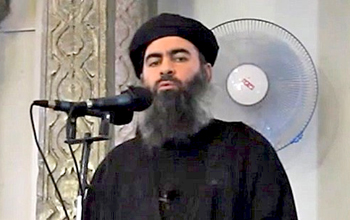
Abu Bakr al-Baghdadi injured in air strike in Iraq

November 10, 2014

Abu BakrBaghdad, Nov 10: Iraqi Interior Ministry confirmed Sunday that the Islamic State (IS) top leader Abu Bakr al-Baghdadi was injured in a air strike, which killed several senior leaders of the extremist group, state-run Iraqiya news channel reported.

Earlier in the day, a security official from Iraq's northern province of Nineveh, however, told Xinhua that he could not confirm reports saying an air strike by the US-led coalition targeted a convoy of vehicles near the city of Mosul, the capital of Nineveh province.

"We can't confirm the news of death or wounding of Abu Bakr al- Baghdadi, because all what we have is our intelligence reports which only mentioned that some 45 IS militants were killed and wounded by the air strikes of the US-led coalition near Mosul late Friday," Mohammed Ibrahim, head of security committee of Nineveh's provincial council said.

Ibrahim also said that at least two IS senior figures, Libyan and Saudi nationals, were among the dead during the coalition air strikes which destroyed several armed vehicles and positions of the IS militant group.

On Saturday, Colonel Patrick Ryder, a Central Command spokesman, said in a statement that he could not confirm whether IS top leader Abu Bakr al-Baghdadi was in the vehicle convoy consisting of 10 armed trucks.

Abu Bakr al-Baghdadi, known to his supporters as Amir al-Mu' minin, is the Caliph of the self-proclaimed Islamic State which announced the establishment of a caliphate June 29, 2014.

The militant group captured the areas in western and northwestern Iraq as well as part of northeastern Syria.

On Oct 4, 2011, the US listed al-Baghdadi as a global terrorist and announced a reward of up to $10 million for information leading to his capture or death. Only the leader of al-Qaida, Ayman al-Zawahiri, merits a larger reward of $25 million.

Comments

Add new comment

  • Coastaldigest.com reserves the right to delete or block any comments.
  • Coastaldigset.com is not responsible for its readers’ comments.
  • Comments that are abusive, incendiary or irrelevant are strictly prohibited.
  • Please use a genuine email ID and provide your name to avoid reject.
News Network
May 7,2020

United Nations, May 7: An average of 80,000 COVID-19 cases were reported each day in April to the World Health Organization, the top UN health agency has said, noting that South Asian nations like India and Bangladesh are seeing a spike in the infections while the numbers are declining in regions such as Western Europe.

WHO Director-General Tedros Adhanom Ghebreyesus said on Wednesday that countries must also be able to manage any risk of the disease being imported into their territories, and communities should be fully educated to adjust to what will be a "new norm".

He said as the countries press forward in the common fight against COVID-19, they should also lay the groundwork for resilient health systems globally.

"More than 3.5 million cases of COVID-19 and almost 250,000 deaths have now been reported to the WHO. Since the beginning of April, an average of around 80,000 new cases have been reported to the WHO every day," Ghebreyesus said in Geneva yesterday.

Asserting that the virus cases were not just numbers, he said: "every single case is a mother, a father, a son, a daughter, a brother, sister or friend".

He said while the numbers are declining in Western Europe, more cases are being reported every day from Eastern Europe, Africa, South-East Asia, the Eastern Mediterranean and the Americas. Even within regions and within countries, there are divergent trends, the agency added.

While some countries are reporting an increase in COVID-19 cases over time, many have seen caseloads rise because they have ramped up testing, the WHO official said.

"We've also seen in Europe and Western Europe a fundamental decrease in the number of cases, but we have seen an associated increase in the number of cases reported in places like the Russian Federation. Southeast, the Western Pacific areas are relatively on the downward trend like Korea and others, but then we do see in South Asia, in places like Bangladesh, in India, some trends towards increase.

"So it's very difficult to say that any particular region is improving or (not improving). There are individual countries within each region that are having difficulties getting on top of this disease and I am particularly concerned about those countries that have (an) ongoing humanitarian crisis," WHO's Executive Director Michael Ryan said.

The death toll due to COVID-19 in India rose to 1,783 while the number of cases climbed to 52,952 on Thursday, registering an increase of 89 deaths and 3,561 cases in the last 24 hours, the Union Health Ministry said.

The number of active COVID-19 cases stood at 35,902 while 15,266 people have recovered, it said.

Noting that while seeing an increase in the number of cases is not good in terms of transmission, WHO's Emerging Diseases and Zoonoses Unit head Maria Van Kerkhove said: "but I don't want to equate that with something (being) wrong".

"I want to equate that with countries are working very hard to increase their ability to find the virus, to find people with the virus, to have testing in place to identify who has COVID-19, and putting into place what they need to do to care for those patients," Kerkhove said.

With more countries considering easing restrictions implemented to curb the spread of the coronavirus, the WHO has again reminded the authorities of the need to maintain vigilance.

"The risk of returning to lockdown remains very real if countries do not manage the transition extremely carefully, and in a phased approach," Ghebreyesus said.

He urged countries to consider the UN agency's six criteria for lifting stay-at-home measures.

That advice includes ensuring surveillance is strong, cases are declining and transmission is controlled. Health systems also must be able to detect, isolate, test and treat cases, and to trace all contacts.

Additionally, the risk of outbreak in settings such as health facilities and nursing homes needs to be minimised, while schools, workplaces and other public locations should have preventive measures in place.

"The COVID-19 pandemic will eventually recede, but there can be no going back to business as usual. We cannot continue to rush to fund panic but let preparedness go by the wayside," he said.

He said the crisis has highlighted the importance of strong national health systems as the foundation of global health security: not only against pandemics but also against the multitude of health threats that people across the world face every day.

"If we learn anything from COVID-19, it must be that investing in health now will save lives later," Ghebreyesus said.

While the world currently spends around USD 7.5 trillion on health annually, the WHO believes the best investments are in promoting health and preventing disease.

"Prevention is not only better than cure, it's cheaper, and the smartest thing to do," he said.

The deadly coronavirus, which originated from the Chinese city of Wuhan in December last year, has infected over 3.7 million people and killed 263,831 people globally, according to a tally by Johns Hopkins University.


Comments

Add new comment

  • Coastaldigest.com reserves the right to delete or block any comments.
  • Coastaldigset.com is not responsible for its readers’ comments.
  • Comments that are abusive, incendiary or irrelevant are strictly prohibited.
  • Please use a genuine email ID and provide your name to avoid reject.
Agencies
April 14,2020

The US Commission on International Religious Freedom (USCIRF) has reprimanded the Imran Khan government for denying food aid to Hindus and Christians in Pakistan amid the coronavirus pandemic and warned that it will trigger an additional crisis due to religious discrimination.

The USCIRF is an independent federal government entity set up by the US Congress to monitor and report on religious freedom in the world.

Pakistan continues to be in the tier one of the USCIRF list of the countries whose record on religious freedom remains abysmal.

In a statement issue on Monday, the USCIRF said it was troubled by the reports of food aid being denied to Hindus and Christians in Pakistan amid pandemic.

Citing one of the examples of religious discrimination, the USCIRF said that in Karachi, the Saylani Welfare International Trust, a non-government organization set up to help the homeless and seasonal workers, has been refusing food aid to Hindus and Christians and providing it only Muslims.

Describing such actions "reprehensible", the USCIRF commissioner Anurima Bhargava said: "As COVID-19 continues to spread, vulnerable communities within Pakistan are fighting hunger and to keep their families safe and healthy. Food aid must not be denied because of one's faith."
One of the USCIRF commissioners, Johnnie Moore warned that if the Khan government continued with such policies, Pakistan would add an additional crisis.

"In a recent address by Prime Minister Khan to the international community, he highlighted that the challenge facing governments in the developing world is to save people from dying of hunger while also trying to halt the spread of COVID-19. This is a monumental task laying before many countries.

"Prime Minister Khan's government has the opportunity to lead the way but they must not leave religious minorities behind. Otherwise, they may add on top of it all one more crisis, created by religious discrimination and inter-communal strife."

The organization which makes foreign policy recommendations to the US President, the Secretary of State, and Congress, urged the Pakistani government to ensure that food aid from distributing organizations is shared equally with Hindus, Christians, and other religions minorities.

Last year, in its annual report, the USCIRF had noted that Hindus and Christians in Pakistan "face continued threats to their security and are subjected to various forms of harassment and social exclusion".

Comments

Add new comment

  • Coastaldigest.com reserves the right to delete or block any comments.
  • Coastaldigset.com is not responsible for its readers’ comments.
  • Comments that are abusive, incendiary or irrelevant are strictly prohibited.
  • Please use a genuine email ID and provide your name to avoid reject.
News Network
February 6,2020

Washington, Feb 6: The US has expressed concern over the current situation of religious freedom in India and raised the issue with Indian officials, a senior State Department official has said.

The remarks came in the wake of widespread protests held across India against the Citizenship Amendment Act (CAA).

The senior State Department official, on condition of anonymity, said that he has met with officials in India about what is taking place in the nation and expressed concern.

"We are concerned about what's taking place in India. I have met with the Indian foreign minister. I've met with the Indian ambassador (to express my concern)," the official, who was recently in India, told reporters on Wednesday.

The US has also "expressed desire first to try to help and work through some of these issues", the official said as Secretary of State Mike Pompeo launched a 27-nation International Religious Freedom Alliance.

"To me, the initial step we try to do in most places is say what can we do to be of help you work through an issue to where there's not religious persecution. That's the first step, is just saying can we work with you on this," the official said.

India maintains that the Indian Constitution guarantees fundamental rights to all its citizens, including its minority communities.

It is widely acknowledged that India is a vibrant democracy where the Constitution provides protection of religious freedom, and where democratic governance and rule of law further promote and protect fundamental rights, a senior official of the Ministry of External Affairs has said.

According to the CAA, members of Hindu, Sikh, Buddhist, Jain, Parsi and Christian communities who have come from Pakistan, Bangladesh and Afghanistan till December 31, 2014 following religious persecution there will get Indian citizenship.

The Indian government has been emphasising that the new law will not deny any citizenship rights, but has been brought to protect the oppressed minorities of neighbouring countries and give them citizenship.

Defending the CAA, Prime Minister Narendra Modi last month said that the law is not about taking away citizenship, it is about giving citizenship.

"We must all know that any person of any religion from any country of the world who believes in India and its Constitution can apply for Indian citizenship through due process. There's no problem in that," he said.

Comments

Add new comment

  • Coastaldigest.com reserves the right to delete or block any comments.
  • Coastaldigset.com is not responsible for its readers’ comments.
  • Comments that are abusive, incendiary or irrelevant are strictly prohibited.
  • Please use a genuine email ID and provide your name to avoid reject.